

If you love to travel, enjoy getting to know new communities and are considering a career in nursing, travel nursing can be a natural fit. A travel nurse is a registered nurse (RN) who takes short-term assignments in areas with high staffing needs.1
If you are an RN looking to advance your education as you prepare for travel nursing, explore the online graduate nursing programs at the University of St. Augustine for Health Sciences (USAHS).
What Does a Travel Nurse Do?
Before you explore the requirements and professional standards for travel nurses, it helps to start with the basics: What does a travel nurse actually do?
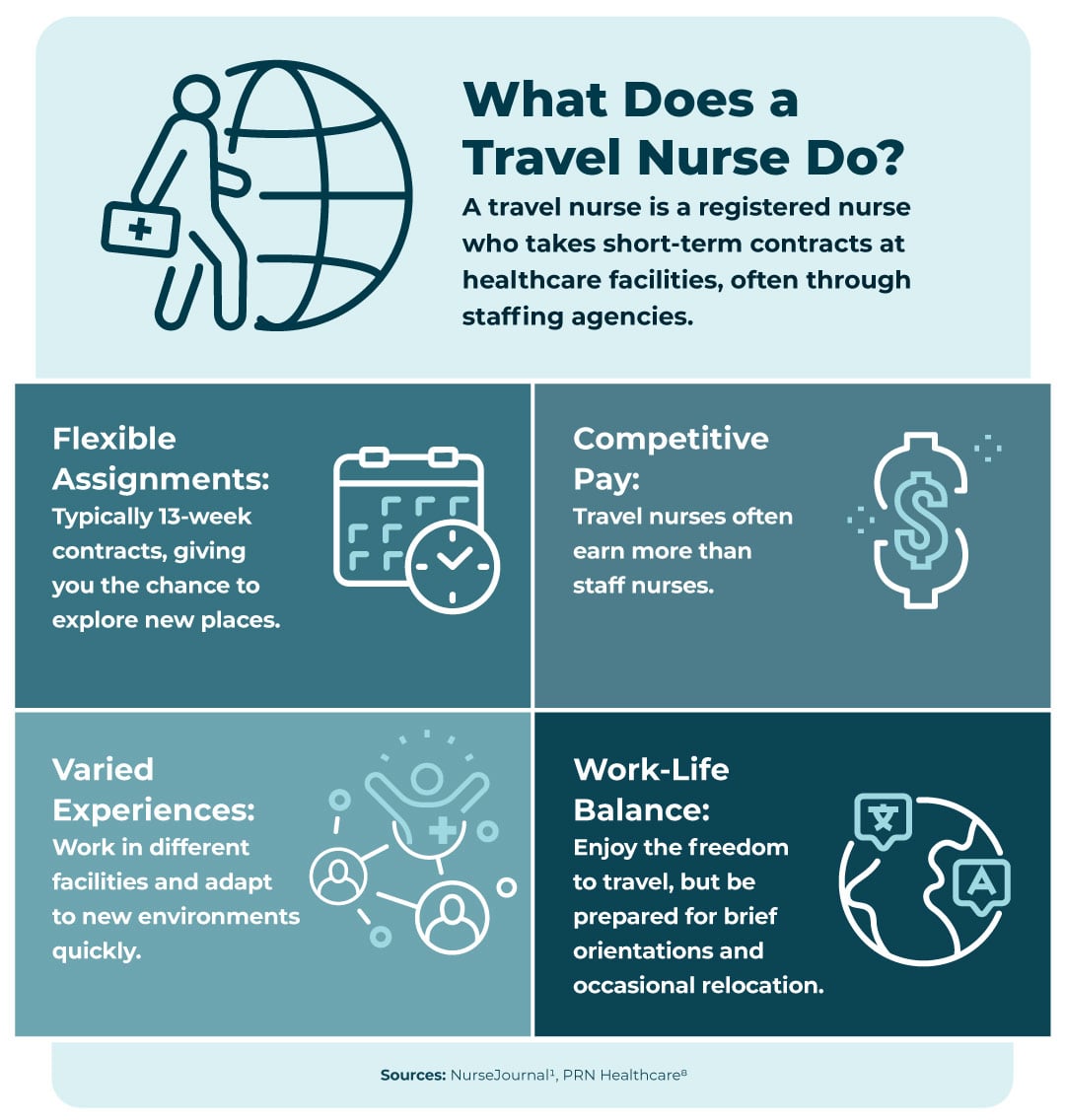
Are you wondering: What is a travel nurse? A travel nurse is a registered nurse who accepts short-term contracts at hospitals and other facilities outside their home base, often arranged through a staffing agency.1
Assignments are typically around 13 weeks, which gives a healthcare facility time to recruit, hire and train permanent staff. Most travel nurses work with third-party agencies to find placements. These agencies match nurses with facilities based on the nurse’s experience and the facility’s current needs.1
Travel nursing has clear advantages. You may be able to explore new places and travel nurses often earn more than staff nurses.1 There are also tradeoffs. Orientation can be brief; you may move on just as you start to feel settled. Assignment quality can vary widely and being away from home for extended periods is common.1
Baseline Requirements for Travel Nursing
Now that we’ve covered some of the basics, let’s review some of the baseline requirements for travel nursing to give you a better idea of what’s needed.
RN Degree and NCLEX-RN Exam
Travel nurses must be registered nurses (RNs), which typically means completing either an Associate Degree in Nursing (ADN) or a Bachelor of Science in Nursing (BSN) program.2 An ADN is typically a two-year program that focuses on essential clinical skills, while a BSN is a four-year degree that provides a broader nursing education.
After finishing an ADN or BSN program, nursing graduates must also pass the National Council Licensure Examination (NCLEX)3 before applying for travel nurse positions. Passing the NCLEX is what allows you to earn a nursing license and practice as an RN.
Experience
In addition to meeting education and licensure requirements, most travel nurse agencies and facilities look for 12 to 24 months of recent bedside experience in your specialty. That typically means planning to work two years as an RN before you start applying for travel nursing assignments.2
You may also be asked to submit a few letters of reference, so it’s worth building strong professional relationships during your time as a staff RN.4 Any additional experience requirements for a specific placement are usually outlined by the agency when they share assignment details.
Licensure
To work as a travel nurse, you’ll need an active RN license or, in some cases, an Advanced Practice Registered Nurse (APRN) credential. An active RN is a nurse with a current, valid license.1 An APRN is an RN who has completed a master’s or doctoral degree and advanced clinical training.
Travel nurses also need an unencumbered license in at least one U.S. state.2 Your license must be unrestricted with no disciplinary actions or practice limitations. For agencies, an unencumbered license is a quick way to confirm you are in good standing and ready to step into an assignment.
You may have more flexibility if your home state participates in the Nurse Licensure Compact (NLC). The NLC is an agreement that allows RNs and Licensed Practical/Vocational Nurses (LPN/VNs) to practice in participating member states without applying for additional licenses.5
Optional Further Education
Continuing your studies can strengthen your profile and help you stand out as a competitive travel nurse applicant. The USAHS School of Nursing offers a Master of Science in Nursing (MSN), Doctor of Nursing Practice (DNP) and Post-Graduate Nursing Certificates (PG-C), delivered online with hands-on learning. For FNP and PMHNP role specialties, programs also include clinical practicum placements.
USAHS’ online Master of Science in Nursing program typically takes 2 to 3 years to complete for BSN-prepared nurses*, with accelerated options that can open doors to advanced roles. Program length varies depending on your entry pathway and chosen role specialty.** As part of this program, you will have immersive experiences with the latest educational technology and simulations. This program will prepare you for specialties like Family Nurse Practitioner (FNP), Psychiatric Mental Health Nurse Practitioner (PMHNP) and Nurse Executive (NE).***
USAHS also offers an online and hands-on Doctor of Nursing Practice (DNP) program designed for working nurses. It focuses on systems leadership, policy and evidence-based practice. This program can take between 2.3 and 4 years to complete****, depending on the student’s entry path and role specialty.
Working Across States
So, how does travel nursing work? Part of the excitement of being a travel nurse is that you have the opportunity to work across state lines in several different settings. While this brings new experiences and adventures, it can also bring licensing complications.
As a travel nurse, you must be licensed in every state where you practice, either via a multi-state compact license or by obtaining individual state licenses. If you declare a compact state as your primary state of residence, you will be eligible for a multi-state license.6 This will widen your opportunities and make moving from one compact state to another easier logistically.
If you first get your license in a non-compact state and then apply for licensure in a compact state, you will not be asked to give up your non-compact state license.6
Nurse Licensure Compact
As of October 2025, there are 43 U.S. jurisdictions participating in the NLC. This has expanded mobility for travel nurses and simplified compliance. However, not all states are members, so it’s still your responsibility to verify if the state you are applying to is part of the compact.7
If you are applying to jobs in non-compact states or a state with pending NLC legislation (or if your home state isn’t compact), you’ll need a single-state license.
Professional Standards for Travel Nurses
Regardless of setting, travel nurses are expected to uphold the American Nurses Association (ANA) Code of Ethics, Scope and Standards of Practice and all standards of their specialty, just like staff nurses. This code is an ethical guide for nurses that helps them make complex patient care and practice decisions. After one to two years working as a staff RN, you will already be well acquainted with the ANA Code of Ethics by the time you apply to be a travel nurse.
Nursing at USAHS
At USAHS, we designed our School of Nursing for working nurses who want to move forward without putting life on pause. Our graduate programs are delivered in a flexible online format and paired with real-world practice experiences so you can apply what you are learning in settings close to home.
If you are aiming to work in travel nursing, advanced practice or another specialized role, one of these paths may be a strong fit:
- MSN (Master of Science in Nursing): Our MSN is designed to help you advance into higher-level nursing roles with online coursework and required practicum experiences, depending on your chosen role specialty.
- BSN-to-DNP: If you want to progress from a BSN to the terminal practice doctorate, our online BSN-to-DNP builds advanced competencies in areas like healthcare policy, evidence-based practice and systems leadership, preparing you to lead and influence care at a higher level.
- MSN-to-DNP: For nurses who already hold an MSN, our MSN-to-DNP option focuses on advanced leadership and systems-level skills such as policy, evidence-based practice and health information systems, so you can broaden your impact.
Request more information about our programs and pursue your dream career in nursing with USAHS.
*Time to completion may vary by student, depending on individual progress, credits transferred and other factors.
**Sometimes our available role specialties change. Please call for availability.
***Please note, the MSN Nurse Educator and MSN Nurse Executive role specialties typically take 2 years and 8 months to complete, based off the most recent 3-year graduate data (2021-2022, 2022-2023 and 2023-2024); however, time to completion may vary by student depending on individual progress, traditional versus accelerated pathway, credits transferred and other factors.
**** Please note, the DNP-FNP program typically takes 3 years and 4 months to complete, based off the most recent 2-year graduate data (2022-2023 and 2023-2024); however, individual experiences will vary based on factors including, but not limited to, individual progress, traditional vs. accelerated pathway, credits transferred and other factors.
FAQs
What is a travel nurse?
A travel nurse is an RN who takes temporary travel nurse contracts at different healthcare facilities to fill staffing gaps, address nursing shortages and help facilities manage sudden increases in patient numbers or allow their full-time staff to take vacations.
How much does a travel nurse make?
Travel nurses with travel nurse contracts usually have higher salaries than staff nurses and the opportunity to live in different parts of the country, but they tend to have shorter orientation periods and need to adapt quickly to new work environments.8
What does a travel nurse do?
Travel nurses fill temporary positions in healthcare facilities such as hospitals and clinics. They perform all of the duties of an RN, but they are usually only at a hospital or clinic for a few months.
How do travel nurses find housing?
Travel nurses typically find housing through their staffing agency, which may offer housing options or provide stipends to secure accommodations that meet their needs during assignments.
References:
- Davidson, A., “How To Become a Travel Nurse,” . NurseJournal, October 8, 2025, https://nursejournal.org/careers/travel-nurse/.
- “How to Become a Travel Nurse,” American Nurses Association (ANA) Nursing Resources Hub, May 18, 2023, https://www.nursingworld.org/content-hub/resources/nursing-resources/how-to-become-travel-nurse.
- “NCLEX Registration Process,” National Council of State Boards of Nursing (NCSBN), January 16, 2026, https://www.nclex.com/.
- “Travel nursing compliance and licensure,” Aya Healthcare, 2026, https://www.ayahealthcare.com/travel-nursing/how-to-become-a-travel-nurse/.
- “Nurses & the NLC,” Nurse Licensure Compact (NLC), 2026, https://nursecompact.com/how-it-works/nurses-and-the-nlc.page.
- “Frequently asked questions: Unlocking access to nursing care across the nation,” The Interstate Commission of Nurse Licensure Compact Administrators (ICNLCA), https://www.ncsbn.org/public-files/faq.pdf.
- Gaines, K., “Compact Nursing States List 2026,” Nurse.org, October 29, 2025, https://nurse.org/articles/enhanced-compact-multi-state-license-enlc.
- “Travel Nurse Salary: How Much Do Travel Nurses Make?,” PRN Healthcare, 2026, https://www.prnhealthservices.com/travel-nursing-contracts/travel-nurse-salary.