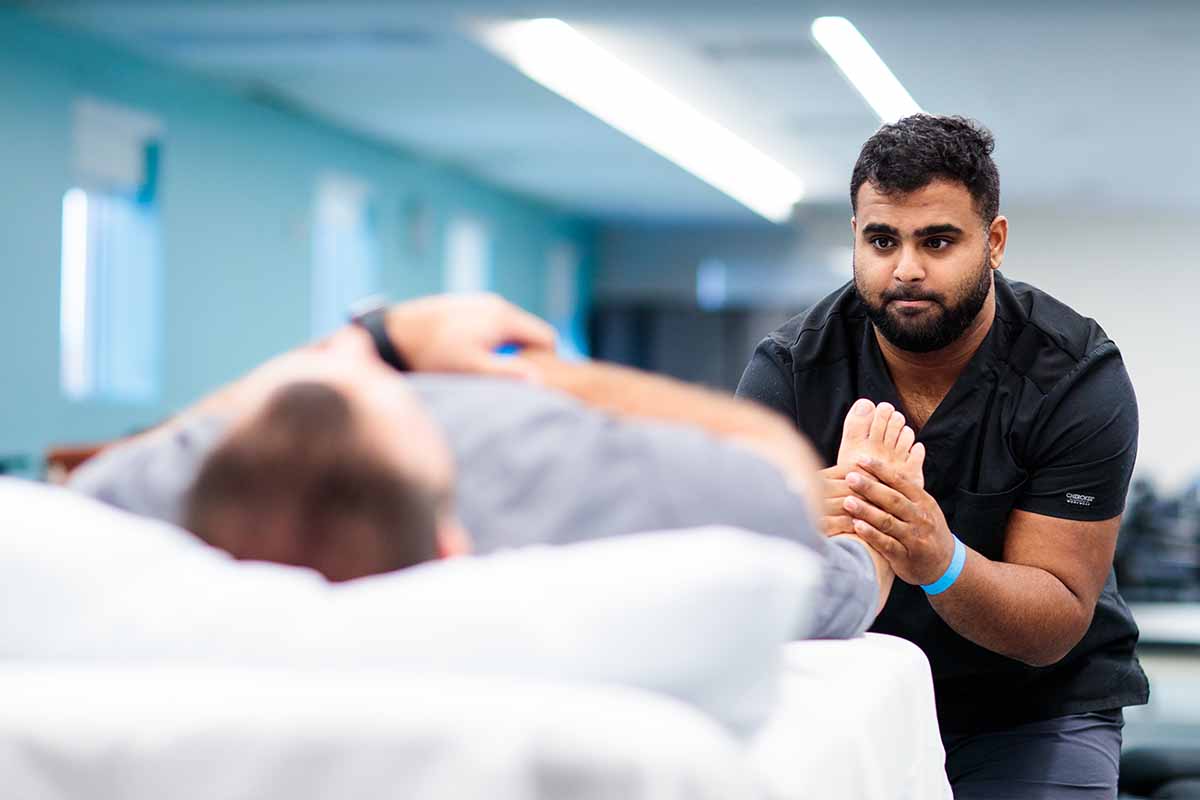


Just as not everyone is destined for a career in medicine, not every physical therapist (PT) wants to work in the same location every day for their entire career.
Look into how to become a travel physical therapist (PT) if working in the same office seems boring, or if you don’t know what type of practice you want to pursue.
At the University of St. Augustine for Health Sciences (USAHS), we recognize that the field of health sciences is constantly evolving. We prepare our graduates for different practice options, including virtual and travel physical therapy positions. Learn how to become a travel PT to help patients and see the world as soon as you graduate.
What Is a Travel Physical Therapist?
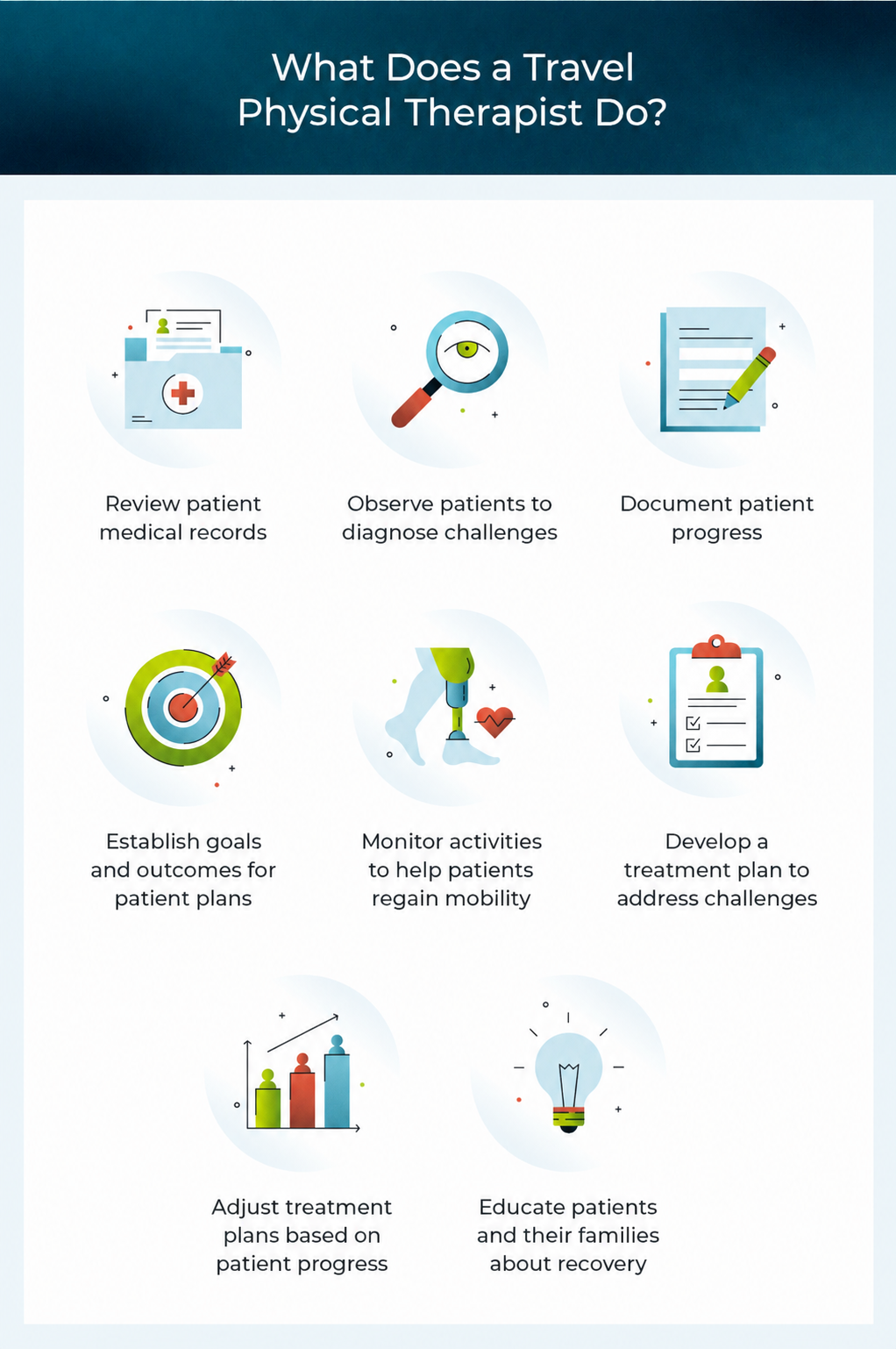
A travel physical therapist does everything a traditional physical therapist does but on a short-term contract. They travel to different locations to fill gaps where physical therapists work.
Sometimes, the openings include positions the facility has been unable to fill with a full-time employee. Other times, the traveling physical therapist is filling in for a staff member on maternity or short-term disability leave.
The demand for physical therapists is expected to grow 11 percent between 2024 and 2034. Many of these openings are expected to result from current physical therapists leaving or retiring.1 According to the U.S. Bureau of Labor Statistics (BLS), the median annual wage for physical therapists, as of May 2024, is $101,020.1†
Four Steps to Start Your Travel Physical Therapist Career
There are many reasons people opt for a travel physical therapy job. They may want to see the world or work somewhere that pays them more. Others might not know what type of setting they want to work in and pursue a travel PT role to experience different opportunities before accepting a long-term position.
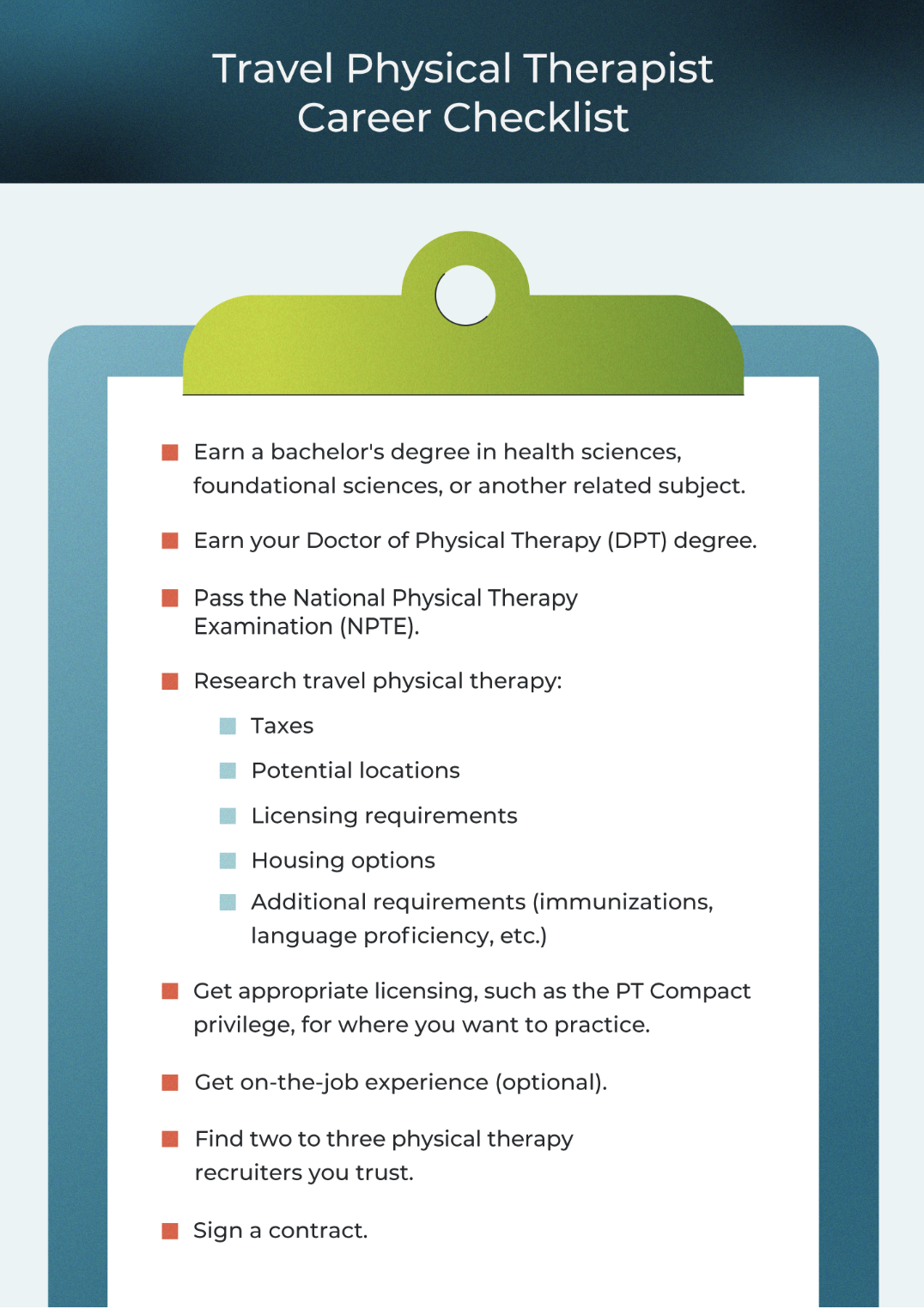
The journey to becoming a traveling physical therapist overlaps with becoming a physical therapist and includes a few additional steps. Here’s how to become a traveling physical therapist:
1. Earn a Physical Therapy Degree
First, you’ll need to earn a degree in physical therapy.
Start with a bachelor’s degree in one of the five best undergraduate degrees for physical therapy. You can earn a degree in any related field with classes that meet travel physical therapy educational requirements and prerequisites.
Then, you’ll earn a Doctor of Physical Therapy (DPT) degree. The DPT program includes coursework in pathology, biomechanics and more. You’ll gain hands-on experience with simulations and on-site clinical rotations.
2. Educate Yourself About Travel PT
When you realize you want to be a travel physical therapist, research how the industry works. Talk to other traveling physical therapists or explore online resources.
For example, there are some things you’ll need to know, such as:
- What will your taxes be like?
- What licensing requirements exist where you want to work?
- What locations are most interesting to you?
Some people prefer to stay close to home or live in places they know. For example, maybe you vacation on a Florida beach every summer and want to work there. Others prefer to use travel physical therapy jobs to cross destinations like Hawaii or Australia off their bucket list.
3. Pass the NPTE and Get Licensed Where You Want to Travel
Once you know where you want to practice, you’ll need to take the National Physical Therapy Examination (NPTE) and get licensed for any state where you choose to practice.2
The Physical Therapy Compact (PT Compact) is an interstate agreement that allows eligible physical therapists and physical therapist assistants (PTAs) to practice in participating states without obtaining a separate full license for each one. More than 30 member states currently participate in the Compact, making it easier for clinicians to provide care across state lines.3
Instead of applying for a new license in every state, qualified PTs and PTAs can purchase a Compact Privilege for each participating state where they plan to practice. This streamlined process generally reduces paperwork, processing time and administrative burden compared with applying for individual state licenses.3
However, you must still pay the required state-based fees for each Compact Privilege and, in some cases, complete the state’s jurisprudence exam or satisfy other state-specific requirements before practicing.
4. Work with a Travel Physical Therapy Recruiter
While it is possible to find jobs yourself, it may take time and effort, limiting your ability to enjoy your destination. Consider working with recruiters at travel healthcare agencies. Their job is to find jobs you’d be a good fit for and pass them along to you—and because that’s all they do, they often have access to more resources than you.
Look for a dependable recruiter who puts your needs before their commission. Find one who communicates how you want—some traveling physical therapists want to review every possibility with daily updates, others only want to hear from a recruiter when they have the perfect job opportunity.
Recommended: Get Clinical Experience Before Becoming a Traveling PT
Most travel physical therapy positions expect candidates to have at least one year of recent clinical experience before taking an assignment. While exact requirements vary by employer and specialty, this level of experience is often recommended—and frequently required—because travel PTs are expected to work independently with minimal onboarding.
Unlike permanent staff positions, travel assignments typically last only a few weeks or months. Facilities rely on travel clinicians to step in quickly, manage patient caseloads with confidence and adapt to new workflows without extensive training or mentorship.
Building one year of hands-on experience in a traditional physical therapy role helps you strengthen your clinical decision-making, improve your confidence and become comfortable treating a wide range of patients. It also makes you a more competitive candidate for travel positions and can open the door to a broader selection of assignments and higher-paying opportunities.
Preparing for a career in travel physical therapy involves more than meeting licensure requirements. Research from Mansoor Alameri, PT, MPT, PhD, found that simulation-based learning supports the development of clinical decision-making (CDM) skills, helping future physical therapists build the adaptability and confidence needed to succeed in a variety of clinical environments.
If you think you would benefit from mentorship, consider working as a traditional physical therapist for a year or two before you reach out to a travel physical therapy recruiter.
How Much Do Travel Physical Therapists Make?
For many aspiring physical therapists, salary is an important consideration. While earnings vary by employer, location and experience, travel physical therapists are often compensated differently than permanent staff PTs because travel assignments often include additional pay components beyond base wages.4 Here’s a general overview of the structure for travel physical therapist salary.
| Factor | What to Know |
| Baseline PT salary | BLS reports a median annual salary of $101,020 for all physical therapists.1† |
| Travel PT compensation | Compensation typically combines a taxable hourly wage with non-taxable travel stipends for eligible assignments.4,5 |
| How stipends work | Eligible travel PTs may receive non-taxable housing, meals and incidental expense stipends while working temporary assignments away from their tax home. Because these stipends are generally separate from taxable wages, take-home pay can be higher than in a comparable permanent position.4,5 Individual tax situations vary, and travel PTs must meet IRS requirements to receive tax-free stipends.5 |
| Typical travel PT hourly pay | Around $41.13 per hour, though actual earnings and take-home pay vary based on stipend eligibility and other factors like contract length, demand and specialty.6*† |
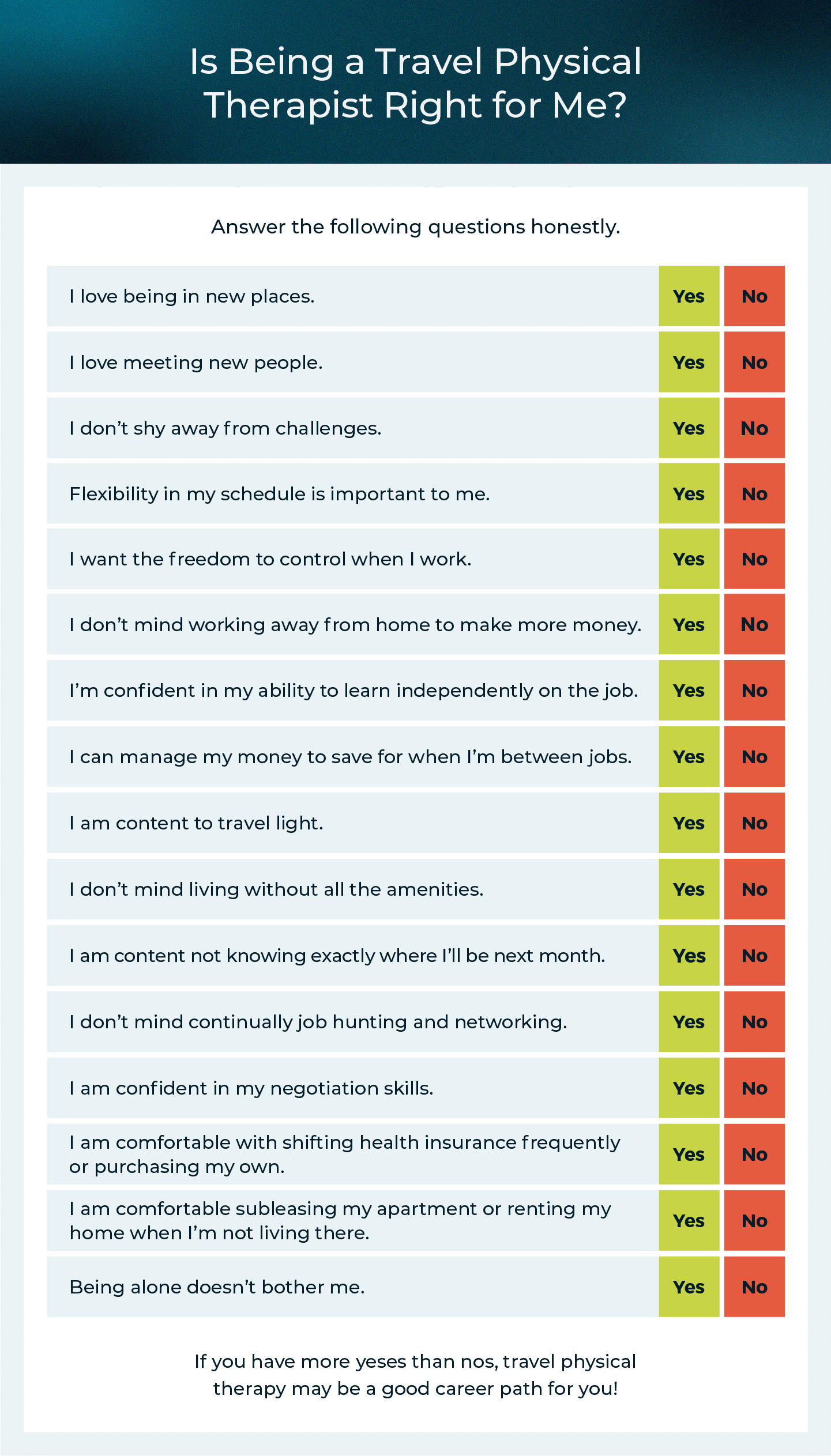
No matter your reason for becoming a physical therapist, you may want to consider whether traveling is the right choice.
Pros
Becoming a travel PT has several benefits that make it an appealing career.
- Adventure: As a travel physical therapist, you’ll see many new places and experience unique challenges. Use your free time in a new city to explore, live like the locals and try new foods and activities. The challenges involved in traveling and working in new places will make you a stronger, more adaptable person and physical therapist.
- Flexible schedule and good work-life balance: As a travel PT, you control when you work, so you can take time off between contracts to travel or take care of personal responsibilities like caring for a sick family member.
- High demand: The projected percent change in PT employment from 2024 to 2034 is 11%, much faster than the average for all occupations.1 This statistic shows the demand for PTs is high–being a travel PT allows you the flexibility to work where demand is highest.
- Clinical and soft skills: By traveling, you’ll experience a variety of hospital systems and practice models, pushing your clinical skills more than if you stayed in one location. You’ll also increase soft skills that will make you a better therapist, such as:
- Resilience
- Problem-solving
- Adaptability
- Communication
- Compromise
Cons
A career in travel physical therapy isn’t for everyone since it has a few potential downsides.
- No paid time off: Because employers hire you for short periods, you won’t accrue any paid time off.7 However, if you save appropriately, you can take time off without worrying about money.
- Lack of short-term housing: Affordable short-term rentals can be challenging to find.8 Some recruiters can help you find options wherever you’re headed, or you can talk with other traveling physical therapists. Eliminate housing issues by getting an RV or camper and parking at campgrounds near your temporary office.
- Canceled contracts: Just because you signed a contract doesn’t mean you’re guaranteed a job. For example, you may be filling in temporarily for an open long-term position, and they may find someone available to start sooner than expected. To minimize the loss of pay, negotiate for a two-week or one-month notice clause in your contract.9
- Health insurance gaps: Because you are bouncing from contract to contract, your insurance can get complicated. Protect yourself from gaps in coverage by asking for specific health insurance start dates before you sign a contract or get coverage through your travel healthcare agency.10
- Higher costs: Working as a travel PT entails expenses that others don’t have to worry about.7 These costs can add up to the point that they offset any financial gains you make by choosing high-paying contracts.
- You’ll need to set up a tax home for tax purposes.11 House hacking can potentially make some extra income from a home you aren’t living in.12
- Moving expenses add up. Most travel physical therapists travel light to keep these costs as low as possible, and it might be a good idea to keep moves close together.
- You’ll put a lot of miles on your car (and gas in the tank) as you move from place to place. You can limit your driving time by traveling to areas with well-developed public transportation systems or renting a car from one position to the next.
- Loneliness: Traveling between new locations can make it hard to develop and maintain relationships.13 While constantly changing locations is exciting, it can get lonely. Some travel physical therapists partner with another traveling healthcare worker or get a pet to keep them company.
Travel PT vs. Staff PT
| Travel Physical Therapist | Staff Physical Therapist | |
| Pay | Hourly wage + eligible travel stipends | Salary or hourly wage; standard benefits package |
| Schedule | Short-term contracts; choose when and where to work | Fixed schedule; consistent workplace |
| Benefits and PTO | Varies by agency; PTO may be limited between contracts | Employer-sponsored health insurance, retirement plans and paid time off |
| Job Stability | Temporary assignments; contracts may be canceled or end regularly | Ongoing employment with predictable income |
| Licensure | May need multiple state licenses depending on assignments | Typically licensed in one state of practice |
| Travel and Housing | Frequent relocation; housing often arranged independently, may be supported with stipends | No relocation required |
Frequently Asked Questions (FAQ)
How long does it take to become a travel physical therapist?
Most travel physical therapists complete a bachelor’s degree followed by a Doctor of Physical Therapy (DPT) degree, which typically takes about seven years of full-time education. Some employers may prefer candidates to have at least one year of clinical experience before accepting travel assignments.
Do you need a license in every state to be a travel PT?
Yes. Travel physical therapists must hold a valid physical therapy license in every state where they practice. Some states participate in the Physical Therapy Licensure Compact (PT Compact), which can make it easier for eligible PTs to practice across participating states.3
How much do travel physical therapists make?
Travel physical therapists often earn more than staff PTs because compensation may include both taxable wages and eligible housing, meals and incidental expense stipends.5 Total earnings may vary based on location, specialty, experience, assignment length and market demand.
How much experience do you need before becoming a travel physical therapist?
Many travel healthcare agencies and employers prefer that physical therapists have at least one year of clinical experience before taking travel assignments.14 Previous experience helps clinicians adapt more quickly to new facilities, patient populations and documentation systems.
Do travel physical therapists need a DPT?
Yes. In the United States, becoming a licensed physical therapist requires earning a DPT degree from an accredited program, passing the National Physical Therapy Examination (NPTE) and meeting state licensure requirements.
What’s the difference between a travel PT and a staff PT?
A travel physical therapist works temporary assignments in different locations, while a staff physical therapist works in a permanent position with one employer. Travel PTs often have greater flexibility and may receive travel stipends, while staff PTs typically have more consistent schedules and benefits.
Become a Travel Physical Therapist with USAHS
Now that you know how to become a travel PT, start your journey with USAHS. We’ll ensure you get the PT education you need to succeed, whether you want to see the world while you work or stay close to home.
Apply today to take advantage of our flexible programs and start your journey to your DPT degree. Financial aid support is available.
*The information provided on this website is based on self-reported data and is intended for general informational purposes only. Payscale is a limited data source that relies on voluntary submissions from individuals and employers.
†This data represents national figures, is not based on school-specific data and represents national median annual wages, not starting pay for recent grads. Conditions in your area may vary. USAHS does not guarantee salary levels.
Please be aware that the accuracy, completeness, and reliability of the data may vary due to its voluntary nature and limited scope. While efforts are made to maintain the data’s accuracy, we cannot guarantee its absolute correctness or currency.
The largest PT school in the United States,** the University of St. Augustine for Health Sciences (USAHS) offers a hands-on Doctor of Physical Therapy (DPT) degree. Join a collaborative cohort of peers who learn under the mentorship of expert faculty-practitioners. Practice with mock and real patients in our state-of-the-art simulation centers and learn anatomy with our high-tech tools. Prepare for clinical practice with a wide range of patients, as well as for advanced roles in research, practice leadership and policymaking. Residential (in-person coursework and immersive weekday lab experiences held on campus complemented by online learning), Hybrid Immersion (online coursework, live weekday sessions held virtually and two immersive in-person lab experiences per term held over 3-7 days during trimesters 1-4) and Flex (online coursework supplemented with synchronous sessions held virtually and on-campus labs delivered 7-9 weekends each trimester) formats are available.
**Based on total DPT degrees conferred during 2020-2023, as reported by the Integrated Postsecondary Education Data System (IPEDS). Data is captured by IPEDS through interrelated surveys conducted annually by the U.S. Department of Education’s National Center for Education Statistics (NCES). https://nces.ed.gov/ipeds/ and from USAHS’ internal graduation data.
Sources:
- “Occupational Outlook Handbook: Physical Therapists,” U.S. Bureau of Labor Statistics (BLS), August 28, 2025, https://www.bls.gov/ooh/healthcare/physical-therapists.htm.
- “National Exam (NPTE),” The Federation of State Boards of Physical Therapy (FSBPT), 2023, https://www.fsbpt.org/Secondary-Pages/Exam-Candidates/National-Exam-NPTE.
- “PT Compact,” PT Compact, 2026, https://ptcompact.org/.
- “Travel Physical Therapist Salary Guide,” Vivian, July 21, 2026, https://www.vivian.com/therapy/physical-therapist/travel/salary/.
- “The Complete Travel Therapy Tax Guide,” Traveltherapytax.com, 2026, https://traveltherapytax.com/.
- “Average Traveling Physical Therapist Salary,” Payscale, 2026. https://www.payscale.com/research/US/Job=Traveling_Physical_Therapist/Salary.
- Casazza, J., “Is it Worth it Financially to be a Travel Physical Therapist?”, Travel Therapy Mentor, August 21, 2022, https://traveltherapymentor.com/2022/08/21/is-it-worth-it-financially-to-be-a-travel-physical-therapist/.
- Blake, K. and Iole, N., “How to Find Short-Term Apartment Rentals,” Apartment List, May 11, 2026, https://www.apartmentlist.com/renter-life/short-term-rentals-guide.
- Pilger, L., “Travel Therapy Contract Cancellations,” Travel Therapy Mentor, April 27, 2023, https://traveltherapymentor.com/2023/04/27/travel-therapy-contract-cancellations/.
- Kuhn, J., “How to Get Health Insurance as a Travel Therapist,” The Traveling Traveler, August 2023, https://www.thetravelingtraveler.com/travel-therapist-health-insurance/.
- Kagan, J., “Tax Home: What it is, How it Works, Examples and FAQ,” Investopedia, February 28, 2022, https://www.investopedia.com/terms/t/taxhome.asp.
- Allred, C., “What is house hacking and is it something you should be doing?”, Rocket Mortgage, May 8, 2026, https://www.rocketmortgage.com/learn/house-hacking.
- “The Hidden Downsides of Travel Physical Therapy,” The Travel DPT, September 3, 2025, https://thetraveldpt.com/the-hidden-downsides-of-travel-physical-therapy.
- “Let’s Get You Hired! Use AMN Passport for a Streamlined Booking Process,” AMN Healthcare, 2026, https://www.amnhealthcare.com/careers/allied/travel-therapy/.