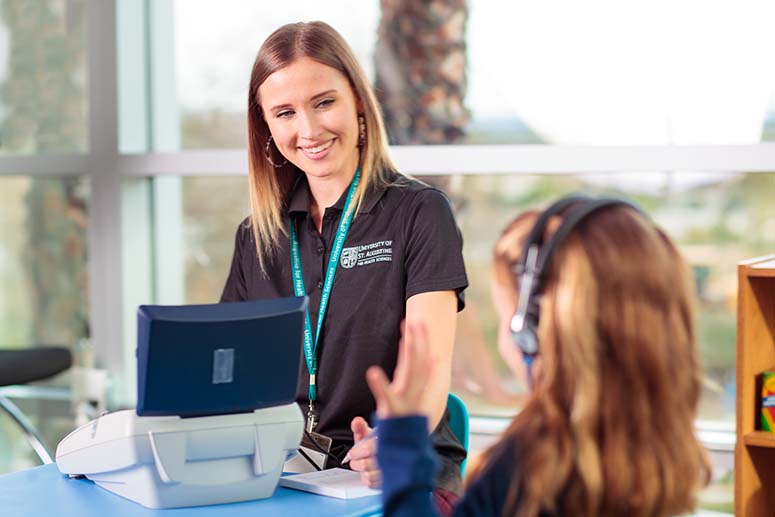
Working as a speech-language pathology assistant (SLPA) is a good way to check out the field of speech-language pathology before you commit to earning your graduate degree. We spoke with two USAHS alumna who were working as speech-language pathology assistants (SLPAs) when they entered our Master of Science in Speech-Language Pathology (MS-SLP) program. We found out why they decided to transition from SLPAs to becoming speech-language pathologists (SLPs), how their professional roles have changed and what exciting things they are doing now in their careers.
Broadening Her Theoretical Perspective
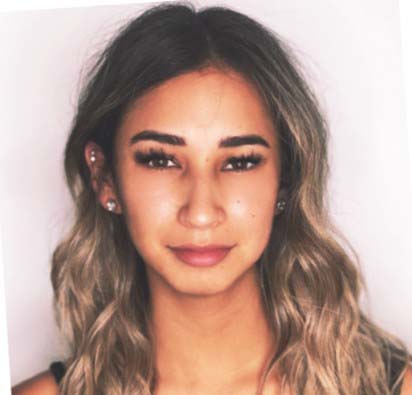
Karina Lee, CCC-SLP ’20
During a year of teaching English and studying Spanish in Spain, Karina Lee, CCC-SLP, USAHS ’20, confirmed her passion for speech and language. Upon returning home to South Florida, she earned a graduate certificate in communication sciences and disorders (CSD) and became a licensed SLPA.
At the nonprofit Crystal Academy in Coral Gables, FL, Lee provided speech and language therapy for children diagnosed with autism spectrum disorder (ASD) and other developmental disorders. Although she enjoyed her role as an SLPA, she wasn’t qualified to diagnose patients. “I knew what I had to do in my job—but I didn’t know why I was doing it,” Lee says. “I like to know how things work.”
She wanted to gain the broad theoretical background and the credentials of an SLP.
Lee applied to USAHS’ MS-SLP program because it was “online, faster than most SLP programs and very interactive,” she says. “It allowed me to stay in Miami and keep my job.” The program features four in-person residency weeks, which she attended in Austin (though the final residency was held virtually due to the pandemic). “I loved that I had such a great excuse to check out Austin.”
During the residencies, she enjoyed meeting her cohort in person—and she’s still close friends with three classmates. “The professors were great,” she adds. “Dr. Savage made me feel super comfortable before, during, and after the program.” Her clinical practica gave her experience working in a variety of settings, including private practice, schools and teletherapy.
After graduating, Lee moved north to Boca Raton, FL, to work in a private practice in which about 70% of her clients are on the autism spectrum. She specializes in feeding therapy—working with children with oral-motor and oral-processing deficits, limited diets, sensory aversions and feeding challenges. She also focuses on augmentative and alternative communication (AAC), which encompasses methods beyond standard verbal communication, including signing, picture communication systems and high-tech speech-generating devices. She says,
“AAC is a way for people to communicate—which is a basic human right.”
One of Lee’s patients, Leora, is a 17-year-old with autism spectrum disorder (ASD) who is non-verbal and who uses an AAC speech-generating device to communicate. Lee created a case study about Leora for Simucase, a virtual learning platform in which members observe, assess, diagnose and provide interventions for real patients. “Leora can make requests and label a variety of objects, but she has a much harder time using verbs,” Lee says. “In our case study, students get to see me collaborate with Leora’s occupational therapist (OT). I coach the OT on how to teach her verbs by modeling the verbs on her AAC device. The students follow along and target her goal for using action verbs in a structured activity with flashcards. I’m hoping our Simucase can teach students to be more comfortable and confident working on AAC with teenagers—and learn to collaborate with OTs.”
Outside of her day job, Lee is developing a private practice to provide boutique-style speech, language and feeding therapy services individualized to each child’s specific needs, whether in home, at school or via teletherapy.
She is also writing a children’s book to help neurotypical children and parents better understand autistic children, using language that celebrates neurodiversity. She explains, “I’ve learned that the autism community prefers identify-first language, such as ‘autistic person.’ If it’s seen more like something they ‘carry’ (like ‘a person with autism’), it seems like it’s something that can be taken away—and it’s not.”
Working with a Jamaican University
Lee is engaging in her profession in other rewarding ways—such as volunteering as an SLP liaison at a university in Kingston, Jamaica. The university’s Child Assessment and Research in Education (CARE) Centre provides special education services to school kids with learning differences, including ASD. Lee answered the center’s call for volunteers to advise Shanique Westcarr, MSCP, the center’s manager and clinical psychologist, in Zoom meetings.
“As the psychologist, Ms. Westcarr sees many children with communication difficulties,” Lee says. “But once she identifies these children, many of their parents and teachers are then at a standstill on how to actually help them. There are only a few SLPs on the island, and even getting a formal diagnosis is difficult.” Lee consulted with Westcarr about red flags for autism, differential diagnoses and developmental speech and language milestones. She also sent resources for teachers and parents to use to improve a child’s speech and language.
“There are so many different things I can do with this degree,” she says. “I’ll never get bored.”
Learning with Technology
Bethany Willoughby, CCC-SLP, USAHS ’20, grew up working in healthcare. Her mother owned Amana Rose, a nursing home franchise in Texas. Throughout her teenage years, Willoughby volunteered as an assistant to occupational therapists. She developed an interest in dysphagia (swallowing disorders), which she explored in college through a double major in SLP & audiology and child learning development. After graduating, she worked for a year as a licensed SLPA.
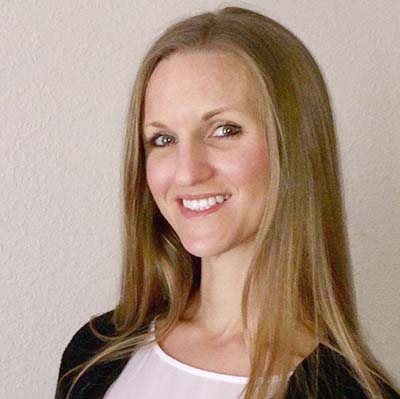
Bethany Willoughby, CCC-SLP ’20
However, it was always her plan to earn her graduate degree and become an SLP, because in Texas, SLPAs are not licensed to treat swallowing. “I also wanted to be the one who did the assessments and made the goals,” Willoughby says.
“As an assistant, I could only implement the goals. Now that I’m an SLP, I can create goals that I feel fit the patient best—and implement them.”
She applied to USAHS’ MS-SLP program and got in, though she needed to take one leveling course first. She says that learning with technology was one of her favorite aspects of the program. In the Austin Center for Innovative Clinical Practice (CICP), her class practiced using an endoscope and nasopharyngoscopes, instruments used to examine the throat and vocal folds to diagnose voice and swallowing disorders. Willoughby volunteered to be a “guinea pig” for the class, letting a practitioner insert the nasopharyngoscope into her nose. The camera projected a mirror image of what it saw; Willoughby could watch food and liquid going down her own throat. “It was a little painful—but cool,” she says. “And it was enlightening to know what my patient would experience.” She believes it’s important for students to volunteer for real-world learning opportunities.
“If you volunteer, you don’t forget that moment. It’s burned into your brain.”
Then, when a mobile van visited campus to expose speech students to modified barium swallow study (MBSS) technology, Willoughby helped to perform swallow studies on patients from the local community. She says this experience was a “game-changer” for her career. “Having practiced with all this technology,” she says, “I was so much more prepared for my job than my coworkers who went to other schools. I knew just what to do on my first day. I’m teaching my coworkers about what I learned. My clinical fellowship mentor said, ‘You are a seasoned SLP right out of school.’”
Faculty research reinforces the value of community engagement in SLP education. Research co-authored by Lekeitha R. Morris, PhD, CCC-SLP, associate program director and professor, MS-SLP program at USAHS, found that a social justice education program helped students better recognize how healthcare professionals can make a meaningful impact in their communities and inspired a greater commitment to taking action through service and advocacy.
The Value of Motivation
She also enjoyed learning about the brain in the wet lab. “I touched the brain of a person with dementia,” she says. “It was tiny from atrophy. Now when I see a brain on imaging, I remember feeling it; I smell the formaldehyde.” Other highlights included an extended class visit to an Austin, TX, aphasia clinic, training on working with people with dementia, and a course on counseling patients.
“I saw that if I used all the tools the teacher gave me, I would succeed,” Willoughby says. “I didn’t stop at the textbook. I would take the skills I’d learned about research—and do more research. If you’re motivated, the program is a nice fit. If you try to coast through, it won’t work for you. But all the tools are there.” She says that associate dean Meghan Savage, PhD, CCC-SLP, was an influential mentor to her. “You can’t ask for more in terms of motivation. She always had my back. We’re still in touch.”
Given that she and her husband were raising a young daughter, Willoughby appreciated that the lectures and coursework for the MS-SLP program were online. “I was available for my daughter when she needed me,” she says.
“I would wake up at 5 to do my homework for two hours before my daughter woke up. And I would work for two hours after she went to bed. You won’t find a campus that lets you come in at 5 a.m.”
Willoughby had thought her future career would center around kids, but during a practicum within a skilled nursing facility, she realized she wanted to focus on seniors. “I had grown up in the nursing home environment,” she says. “It was familiar; I was good at building relationships. I would paint their fingernails, brush their hair. Older people are more relatable. We can have an adult conversation.”
Now, Willoughby is working in Dallas at a rehabilitation services provider with facilities across the country. The building where she works is three-quarters of a mile long, she says, with skilled nursing, memory care, assisted living and inpatient rehab. “You learn fast in a building like that. I work with a massive variety of people with a huge gap in abilities.” Having graduated during the pandemic, she began her job wearing full PPE, helping COVID patients regain their ability to swallow after being on a ventilator. “That was my entry into the real world,” she says.
Willoughby says the advantage of being an SLPA is that they don’t need to do nearly as much paperwork as SLPs. “I enjoyed getting to write a note about the patient’s session, and that was all the paperwork I had to do.” However, as an SLP, she can assess and treat dysphagia, as well as speech, language and cognitive disorders. Without her MS-SLP degree, she would not be allowed to work in geriatric healthcare because it involves so much dysphagia. She also wouldn’t be able to start her own aphasia clinic, which she hopes to do someday. She says, “I enjoy working in geriatrics because I can see how much help is genuinely needed in those populations, so I feel like I’m making a difference.”
SLPA vs SLP: What’s the Difference?1
While SLPAs and SLPs both support individuals with communication and swallowing disorders, their roles, responsibilities and education requirements differ.
SLPAs work under the supervision of a licensed SLP, helping implement treatment plans, documenting client progress and supporting therapy sessions. In contrast, SLPs are licensed clinicians who evaluate, diagnose, develop treatment plans and make clinical decisions independently.
The educational requirements also differ. SLPAs typically earn an associate or bachelor’s degree, along with any state-specific licensure requirements.
For SLPAs, advancing to an SLP career may offer opportunities for greater responsibility, expanded career options and higher earning potential.
Does USAHS Offer an SLPA to SLP Bridge Program?
If you are working as an SLPA, you may be wondering whether there’s a bridge program that allows you to transition directly into becoming an SLP. While the University of St. Augustine for Health Sciences (USAHS) does not offer an accelerated SLPA-to-SLP bridge program, we do provide a clear pathway to earning your MS-SLP.
If your bachelor’s degree isn’t in communication sciences and disorders, speech-language pathology or a related field, or you’re missing prerequisite coursework, you can complete the academic requirements needed to apply to our MS-SLP program through our affordable leveling courses.
USAHS offers six leveling courses that serve as a bridge to our hybrid online MS-SLP program. After completing the required courses, you’ll be eligible to apply for admission to the master’s program. If you need to complete four or more leveling courses, our Preparatory Pathway offers an even more streamlined route. This option reserves your spot in the MS-SLP program once you’ve successfully met all eligibility requirements, helping you move confidently toward your goal of becoming a licensed SLP.
The University of St. Augustine for Health Sciences (USAHS) offers a Master of Science in Speech-Language Pathology (MS-SLP) program. Designed for working students, the MS-SLP is an online program with four required on-campus residencies. The program offers three start dates per year, in January, May and September. Join a collaborative cohort of peers who learn under the mentorship of expert faculty-practitioners. Prepare to make a difference in the lives of clients across the lifespan with a meaningful career in speech therapy.
For students with a bachelor’s degree in a field other than communications sciences and disorders (CSD) or SLP and for students with a CSD or SLP degree whose undergraduate program did not include the required leveling coursework, we offer SLP leveling courses for completing the necessary prerequisites to enter the graduate program.
The Master of Science (M.S.) education program in Speech-Language Pathology {residential Austin, TX; satellite Dallas, TX; satellite San Marcos, CA; satellite St. Augustine, FL; all distance education} at the University of St. Augustine for Health Sciences is accredited by the Council on Academic Accreditation in Audiology and Speech-Language Pathology of the American Speech-Language-Hearing Association, 2200 Research Boulevard, #310, Rockville, MD 20850, 800-498-2071 or 301-296-5700.
Sources
- “What is an SLP? What is an SLPA? Here’s the Difference,” APA Speech Therapy, https://www.latalkspot.com/blog/slp-vs-slpa-heres-the-difference.