
Inside a bright lab at the University of St. Augustine for Health Sciences (USAHS) in Miami, laughter mixes with the sound of power tools and the occasional buzz of electric car engines. For Rosie DeFeo, PT, DPT, EdD, PCS, ATP, assistant professor of PT programs at USAHS Miami and pediatric specialist, it’s the perfect symphony, powered by purpose, possibility and a lot of heart.
Promoting mobility in Miami
“It’s the fun part of the project,” Dr. DeFeo says. “Students like to see the impact. It’s something they do that’s hands-on, and they get to see it in action.”
She’s talking about the local South Florida arm of the national Go Baby Go program that adapts toys and ride-on cars for children with mobility challenges. The vehicles are customized with features like push-button controls, at no cost to families, giving them new ways to access play and engage with the world around them.
Under Dr. DeFeo’s leadership, the program found a home at USAHS Miami nearly five years ago. Working alongside graduate occupational therapy (OT) and physical therapy (PT) students at USAHS Miami, she’s helped the initiative grow from a campus project into a meaningful community service opportunity and an immersive learning lab for future therapists.
Dr. DeFeo says they developed the local Go Baby Go initiative as a partnership with the USAHS Miami student-led organization, Pediatric Special Interest Group (Pediatric SIG), OT and PT students interested in pediatrics. “It’s their chance to get experience early on and give back,” she explains.
Custom cars, kid-powered independence
Go Baby Go is about more than making toys move. It centers on making movement possible for children who experience significant barriers to independence. Many of the kids who receive the modified ride-on cars can’t operate standard foot pedals or hold themselves upright in a vehicle.
“We make simple electrical and structural modifications to place the child safely in the seat. We support them however they need, whether it’s their head or trunk, and give them access to make the vehicle go,” Dr. DeFeo shares.
Sometimes it’s as simple as a large button placed within arm’s reach. For others, it’s a joystick operated with gross motor movements, or even a switch operated with the back of the head. Each car is individualized to the driver, and the process always starts with a question: What will help this child move, explore and play?

Hands-on learning, lasting impact
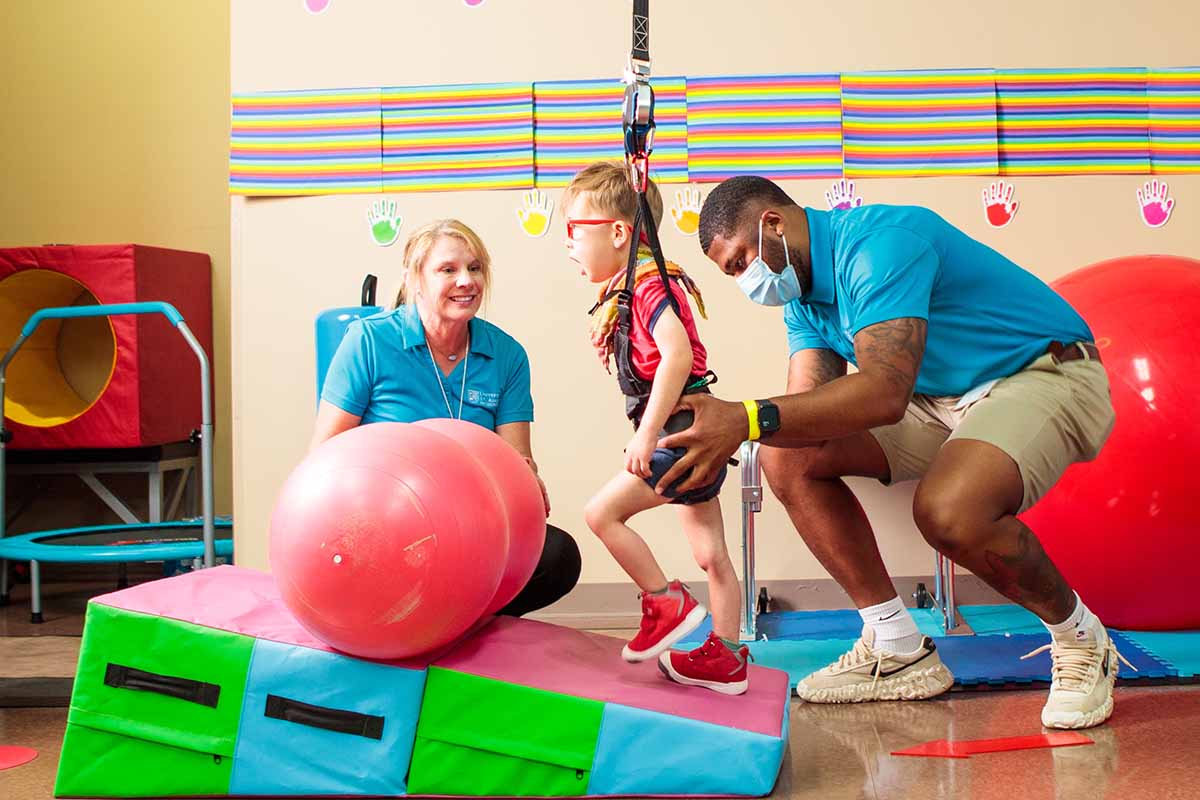
The same philosophy drives USAHS Miami’s pediatric Pro Bono Clinic, where students, guided by Dr. DeFeo and other faculty-practitioners, work directly with kids with conditions like cerebral palsy, autism and complex genetic or cardiac histories.
In the summer, students participated in intensive gait training clinics using body-weight support harnesses, where they saw immediate benefits of therapeutic play. These real-world experiences help them bridge the gap between classroom training and clinical practice.
“In our Pro Bono Clinics, PT and OT students co-treat the pediatric patients,” Dr. DeFeo says. “It’s a great interprofessional learning moment where students discover how their skills go hand in hand.”
Take Mariano, for example, an almost two-year-old who experienced a brain hemorrhage in utero and was referred to the Pro Bono Clinic by another parent. He arrived struggling to tolerate movement and sound, unable to lift his head or engage with toys.
“We were able to tailor the use of some of the adapted toys to get him to alert to sound, start responding to things around him,” she describes.
His mother, Andrea Lopez, is full of gratitude. She says Go Baby Go has gifted them several toys, including a ride-on vehicle made especially for him, to hold his back because he doesn’t have good head control. “The car is more than a toy; it’s life-changing. It’s priceless to teach other people that my son is capable of playing,” Lopez says.
Building creativity, empathy and collaboration
Students often get involved with the Go Baby Go initiative after seeing the toys in action in the Pro Bono Clinic. They learn how to build 3D-printed switches, modify toys and create accessible remote-controlled robots for older kids. For children who aren’t candidates for full-ride-on cars, the team sends them hope with an adapted toy.
“We want to get the toys out to the kids who need them and keep it little or no cost for the people who want access to them,” Dr. DeFeo says.
While students are focusing on the children, another faculty member meets with parents, helping them process stress and find connection. “It’s their time to step away, even for just a little bit,” Dr. DeFeo explains. “We’re very fortunate that these families brave the Miami traffic to get to us and trust us with students who are learning to be therapists.”
The project creates a space where hope, play and meaningful progress come together for families and students. It continues to grow, fueled by donations and student enthusiasm. Local high schoolers joined in this year, with one group planning a Color Run fundraiser.