






School of Nursing

Post-Graduate Nursing Certificate Program

Our Post-Graduate Nursing Certificate program is designed for nurses who have completed an MSN or DNP degree. The specialty curricula will prepare you to take on more responsibility or change your career trajectory and achieve your next career goal in clinical advanced practice, nursing administration or nursing leadership. Our Post-Graduate Nursing Certificate program is online and hands-on, and, for the FNP and PMHNP role specialties, conclude with a wide range of clinical practicum placements. In just two to six trimesters* you’ll be on the way to a rewarding new role following the completion of our hands-on + online nursing certificate program!


See Requirements & Program Details

*Time to completion may vary by student, depending on individual progress, traditional vs. accelerated pathway, credits transferred and other factors.

Have questions? We’re here to help.

Ready to start your application?

Facts and Figures

certification pass rate

97%

First-Time FNP Certification Pass Rate Based on 2023 USAHS MSN-FNP, DNP-FNP and PGC (FNP) graduates who took the ANCC or AANP certification exam. The 2023 AANPCB national first-time certification exam pass rate was 73%. First-time licensure pass rates are reported two years post-graduation; rates for 2024 graduates expected in early 2027.

clinical placement stethoscope icon

100%

Clinical Placements Fall 2021 - Fall 2025. Future clinical education placement experiences will vary based on individual student specialty and academic needs, as well as site availability for assignments from term to term.

faculty-icon

100%

Doctoral-Prepared Faculty

lighthouse-icon

40+

Years in Graduate Health Sciences Education

Add another role specialty.

Are you looking to grow your nursing career in clinical advanced practice, nursing administration or nursing leadership? We offer four of our five role specialties as certificates through our Post-Graduate Nursing Certificate program:

Our specialty curricula broaden your foundational knowledge, preparing you to take on more responsibility or change your career trajectory. Our Post-Graduate Nursing Certificate program is designed for nursing students who’ve completed at least a Master of Science in Nursing (MSN).

Post-Graduate Nursing Certificate Curriculum

Students in the Post-Graduate Nursing Certificate program complete 12 credit hours when they choose either the Nurse Educator or Nurse Executive certificate. The Family Nurse Practitioner (FNP) certificate is 31 credit hours, while the Psychiatric Mental Health Nurse certificate is 37 hours.

Family Nurse Practitioner Post-Graduate Certificate

CoursesHours
Curriculum
Trimester 1
NUR 7560 - Advanced Pharmacology
Advanced practice nurses must be knowledgeable about pharmacotherapeutics and principles of safe prescribing. This is an online course that focuses on advanced concepts of pharmacology, including pharmacokinetics, pharmacodynamics, and pharmacogenomics. Emphasis is placed on common drug classes prescribed by advanced practice nurses for acute and chronic conditions in patients across the lifespan. Factors influencing effective therapy and legal considerations are also included.
3
NUR 7610 - Advanced Physiology and Pathophysiology
This course for advanced practice nursing students explores the study of physiology and pathophysiology. Emphasis includes understanding and identifying diseases by examining alterations in common physiological conditions across the lifespan. This course equips advanced practice nurses with the requisite knowledge and skills necessary for accurate disease diagnosis and management through an in-depth exploration of pathophysiologic processes, cellular changes, and systemic manifestations. 
3
Trimester 2
NUR 7570 - Primary Healthcare of the Family I
This course provides in-depth exploration of healthcare issues specific to women and pediatric populations within the primary care setting. Students develop the comprehensive knowledge and skills essential for the formulation of differential diagnoses and management of acute and chronic conditions as well as for health promotion and disease prevention in women and children across the lifespan. The Family Nurse Practitioner (FNP) student applies role specialty competency-based learning through attendance at the required FNP Skills Intensive to progress to practicum. 
Required on-campus Intensive Experience
3
NUR 7580 - Advanced Health Assessment and Differential Diagnosis
This course prepares advanced practice nurses to apply methods of advanced assessment in formulating differential diagnoses of acute and chronic conditions across the lifespan. Emphasis is on advanced physical assessment skills, risk assessment, diagnostic reasoning, and documentation.
3
Trimester 3
NUR 7571 - FNP Role Practicum I
This course is the first in a series of three Family Nurse Practitioner (FNP) practicum courses. Students must demonstrate beginning proficiency in integrating theoretical and evidence-based, best practice knowledge of assessment, differential diagnosis, diagnosis, management, and evaluation of patients with acute and chronic health problems for the population of the family across the lifespan while demonstrating fiduciary stewardship in the delivery of quality care. FNP students demonstrate progressive synthesis and application of FNP role competencies, building on and translating concepts and skills derived from prerequisite courses. Students complete clinical hours in diverse primary care settings under the supervision of faculty and qualified preceptors.
4
NUR 7575 - Primary Healthcare of the Family II
This course is designed for the Family Nurse Practitioner (FNP) student, focusing on the assessment, diagnosis, management, and prevention of acute primary care conditions across the lifespan. Emphasizing clinical decision-making and evidence-based practice, students develop the comprehensive knowledge and skills essential for the formulation of differential diagnoses and management of acute primary care conditions. The course highlights care strategies, treatment protocols, and patient education to ensure safe, efficient, and cost-effective care.
3
Trimester 4
NUR 7572 - FNP Role Practicum II
This course builds on the advanced practice nursing concepts, skills, and role development of the family nurse practitioner (FNP) derived in NUR 7571 - FNP Role Practicum I. The student must demonstrate competency in integrating theoretical and evidence-based, best practice knowledge of assessment, differential diagnosis, diagnosis, management, and evaluation of patients with acute and chronic health problems for the population of the family across the lifespan while demonstrating fiduciary stewardship in the delivery of quality care. The FNP student must demonstrate progressive synthesis and application of FNP role competencies. Students complete clinical hours in diverse primary care settings under the supervision of faculty and qualified preceptors.
4
NUR 7585 - Primary Healthcare of the Family III
This course provides an in-depth exploration of chronic primary care conditions across the lifespan, with emphasis on the care of older adults and mental health management. Family Nurse Practitioner (FNP) students develop the comprehensive knowledge and skills essential for the formulation of differential diagnoses, management, and prevention of chronic primary care conditions. Students learn to deliver evidence-based, safe, and cost-effective care in primary care settings, addressing the unique challenges of chronic care management and geriatric care and integrating mental health assessments and interventions.
3
Trimester 5
NUR 7573 - FNP Role Practicum III
This cumulative course is the final in the series of three FNP practicum courses. Students demonstrate mastery of FNP role competencies by engaging in a comprehensive review and evaluation process. The FNP student must exhibit advancing synthesis and application of skills showcasing cumulative proficiency in managing increasingly complex acute and chronic health problems across the lifespan. Students complete clinical hours in diverse primary care settings under the supervision of faculty and qualified preceptors.
5
Certificate Credit Hours 31

Psychiatric Mental Health Nurse Practitioner Post-Graduate Certificate

PMHNP Role Specialty

CoursesHours
Curriculum
Trimester 1
NUR 7560 - Advanced Pharmacology
Advanced practice nurses must be knowledgeable about pharmacotherapeutics and principles of safe prescribing. This is an online course that focuses on advanced concepts of pharmacology, including pharmacokinetics, pharmacodynamics, and pharmacogenomics. Emphasis is placed on common drug classes prescribed by advanced practice nurses for acute and chronic conditions in patients across the lifespan. Factors influencing effective therapy and legal considerations are also included.
3
NUR 7610 - Advanced Physiology and Pathophysiology
This course for advanced practice nursing students explores the study of physiology and pathophysiology. Emphasis includes understanding and identifying diseases by examining alterations in common physiological conditions across the lifespan. This course equips advanced practice nurses with the requisite knowledge and skills necessary for accurate disease diagnosis and management through an in-depth exploration of pathophysiologic processes, cellular changes, and systemic manifestations. 
3
Trimester 2
NUR 7310 - Foundations of Neuroscience
This course is the foundation for practicing health professionals who explore and gain knowledge about neurobiology and psychopathophysiology as this relates to the etiology (cause), epidemiology (prevalence), developmental theories, and abnormal behavior. Students learn about evidence based empirical interventions while understanding ethical, cultural, and developmental applications. Students learn about the Diagnostic and Statistical Manual of Mental Disorders criterion and the neurobiological progression across the lifespan. 
3
NUR 7580 - Advanced Health Assessment and Differential Diagnosis
This course prepares advanced practice nurses to apply methods of advanced assessment in formulating differential diagnoses of acute and chronic conditions across the lifespan. Emphasis is on advanced physical assessment skills, risk assessment, diagnostic reasoning, and documentation.
3
Trimester 3
NUR 7315 - Advanced Psychopharmacology
This course focuses on evidence-based advanced practice psychopharmacology, building on previous advanced pharmacology coursework. Psychiatric mental health nurse practitioner students learn the scientific principles of pharmacokinetics, pharmacodynamics, pharmacogenetics, and psychotherapeutic medications. Emphasis is placed on psychopharmacologic treatment for acute and chronic psychiatric conditions across the lifespan. Students learn ethical safe prescribing practices and interprofessional collaboration with focus on optimal patient outcomes.
3
NUR 7330 - Psychotherapy for Psychiatric Mental Health Nurse Practitioner Practice
This course focuses on psychotherapeutic theories, psychotherapy modalities, and therapeutic skills for the Psychiatric Mental Health Nurse Practitioner student. Students acquire knowledge about a client-centered, culturally responsive approach; patient goals; therapeutic environment management; psychotherapeutic communication; psychoeducation goals; and crisis management. This course prepares students to apply multiple therapeutic approaches in psychotherapy, including cognitive and dialectical behavioral therapy, motivational interviewing, group supportive therapy, interpersonal therapy, recovery and SMART model framework, trauma therapy, and complementary alternative interventions in addition to applying interprofessional collaboration and developing a framework for clinical practice for individuals and populations across the lifespan. This course includes 50 hours of psychotherapy simulation.
3
Trimester 4
NUR 7350 - PMHNP: Acute and Chronic Management of Child/Adolescent with Psychiatric Mental Health Conditions
This course focuses on the role of the psychiatric mental health advanced practice nurse. Emphasis is on critical thinking, diagnostic reasoning, clinical judgment, theoretical underpinnings while applying scientific evidence-based theories, therapeutic concepts of communication, and screening tools. This course feeds into the associated practicum course for application of assessment skills; Diagnostic and Statistical Manual of Mental Disorders diagnostic reasoning; acute and chronic management, including psychopharmacology and psychotherapy; interprofessional collaboration; ethical standards and cultural diversity inclusion; health promotion; disease prevention; and differential diagnosis in planning care for children, adolescents, and families.
Required virtual intensive
3
NUR 7541 - PMHNP Role Practicum I Child & Adolescent Populations
This course focuses on the clinical role of the psychiatric mental health advanced practice nurse and builds on previous coursework. Students precept for a minimum of 180 PMHNP direct clinical practice hours through the application of didactic coursework from Acute and Chronic Management of Child/Adolescent with Psychiatric Mental Health Conditions. This clinical practicum allows students to build skills in psychiatric assessment, diagnoses, differential diagnosis, psychopharmacologic and psychotherapy interventions, and interprofessional collaboration. Emphasis is on upholding ethical standards and cultural diversity inclusion, health promotion, disease prevention, and differential diagnosis in planning care for children, adolescents, and families.
4
Trimester 5
NUR 7375 - PMHNP: Acute and Chronic Management of the Adult and Older Adult with Psychiatric Mental Health Conditions
This course focuses on the role of the psychiatric mental health advanced practice nurse. Emphasis is on critical thinking, diagnostic reasoning, clinical judgment, theoretical underpinnings while applying scientific evidence-based theories, therapeutic concepts of communication, and screening tools. This course provides foundational content, which is applied in PMHNP Role Practica II: Adult and Older Adult Populations. Foundational knowledge in advanced assessment skills; Diagnostic and Statistical Manual of Mental Disorders diagnostic reasoning; acute and chronic management, including psychopharmacology and psychotherapy; interprofessional collaboration, ethical standards, and cultural diversity inclusion; and health promotion, disease prevention, differential diagnosis in planning care for adult and older adult populations.
3
NUR 7542 - PMHNP Role Practicum II Adult and Older Adult Populations
This course focuses on the clinical role of the psychiatric mental health advanced practice nurse and builds on previous coursework. Students precept for a minimum of 180 PMHNP direct clinical practice hours through application of didactic coursework from PMHMP: Acute and Chronic Management of the Adult and Older Adult with Psychiatric Mental Health Conditions. This clinical practicum allows students to build skills in psychiatric assessment, diagnoses, differential diagnosis, psychopharmacologic and psychotherapy interventions, and interprofessional collaboration. Emphasis is on upholding ethical standards and cultural diversity inclusion, health promotion, disease prevention, and differential diagnosis in planning care for adults and older adults.
4
Trimester 6
NUR 7543 - PMHNP Role Practicum III Diverse/Special Populations
This course focuses on the role of the psychiatric mental health advanced practice nurse with an emphasis on diverse and special populations. This course builds on previous coursework as students demonstrate critical thinking, diagnostic reasoning, clinical judgment, theoretical underpinnings while applying scientific evidence-based theories, therapeutic concepts of communication, and screening tools. This course is a clinical practice-based practicum lead by expert clinical PMHNP faculty as students expand assessment skills; Diagnostic and Statistical Manual of Mental Disorders diagnostic reasoning; acute and chronic management, including psychopharmacology and psychotherapy; interprofessional collaboration; ethical standards and cultural diversity inclusion; health promotion; disease prevention; and differential diagnosis in planning care for diverse, special populations and specialty populations of the student's choice. Course requires 225 contact hours. 
5
Certificate Credit Hours 37

Nurse Educator Post-Graduate Certificate

*The Nurse Educator post-graduate certificate program is not accepting new students. 
CoursesHours
Curriculum
Trimester 1
EDF 7175 - Foundational Theories in Education
This online course examines the theories of teaching and learning related to research and health science education. Selected learning theories are analyzed from the perspective of teaching and learning. Students are introduced to the various historical learning theories and research-based educational theories from the perspective of a modern-day learner. Strategies and ideas for the use of educational theories in learning are explored with emphasis on application in today's learning environments.
3
NUR 7100 - Pathophysiology, Health Assessment, and Pharmacology (Non-NP)
This course expands on foundational nursing education to enhance nursing expertise in pathophysiology, health assessment, and non-prescriptive pharmacology throughout the lifespan. Emphasizing the specialized knowledge and skills essential for the non-NP advanced practice nurse, this curriculum integrates pathophysiological concepts, physical assessment techniques, and pharmacology principles. Students explore application of these principles to become proficient in the provision of safe and quality care for patient populations across the lifespan and cross-culture presenting with routine medical conditions.
3
Trimester 2
EDF 7161 - Program and Curricular Design for Health Science Education
The focus of this course is a systematic approach to program planning design. This course examines program planning models such as Interactive Model of Program Design. Learners investigate and learn about constructing program outcomes, learning objectives, transfer of learning, program structure, program evaluation, budgeting, and marketing.
3
EDF 7050 - Teaching Methods in Higher Education
This online course engages learners to examine the basic concepts associated with teaching and learning within higher educational environments and methods to be an effective academic educator. This course focuses on educational theoretical underpinnings for teaching in an academic setting and experiential learning of the processes of instructional design, course development, and effective teaching and facilitation of learning in a higher education environment. Emphasis is placed on the application of knowledge to demonstrate mastery of content taking into consideration the needs of adult learners. This course discusses the fundamentals of teaching and is highly recommended for the new instructor, or instructors wishing to review theories and concepts related to teaching, learning, and assessment.
3
Certificate Credit Hours 12

Nurse Executive Post-Graduate Certificate

CoursesHours
Curriculum
Trimester 1
HSA 7250 - Human Resources Management and Organizational Development in Healthcare
Using a systematic approach, students address the role of human resources in healthcare organizations. Students gain an understanding of key roles in planning for workforce needs and aligning with the strategic goals of the organization. Students examine organizational behavior and dynamics, as well as leadership principles to help navigate change. Students analyze theory and practice of managing individuals and groups through motivation, communication, teamwork, collaboration, leadership, organizational change, negotiation, and conflict management and resolution. 
3
NUR 7100 - Pathophysiology, Health Assessment, and Pharmacology (Non-NP)
This course expands on foundational nursing education to enhance nursing expertise in pathophysiology, health assessment, and non-prescriptive pharmacology throughout the lifespan. Emphasizing the specialized knowledge and skills essential for the non-NP advanced practice nurse, this curriculum integrates pathophysiological concepts, physical assessment techniques, and pharmacology principles. Students explore application of these principles to become proficient in the provision of safe and quality care for patient populations across the lifespan and cross-culture presenting with routine medical conditions.
3
Trimester 2
IPE 7133 - Foundations in Healthcare Administration with Strategic Planning
Students build on leadership concepts introduced in IPE 7121 to develop a foundational understanding of healthcare administration while analyzing the changing landscape of the healthcare environment. Application of these concepts occurs through formulating, implementing, and evaluating a strategic plan while working with an interprofessional team. Students examine the role of strategic planning in achieving organizational performance measures as well as the notion of planning as a cyclical process within the healthcare organization in the role of a healthcare administrator.  
3
HSA 7236 - Accounting, Finance and Economics for the Healthcare Leader
This course provides basic accounting, finance, and economics for the healthcare leader. Students will be able to educate patient care team members on financial implications of patient care decisions, use financial statements for decision making, use basic accounting, finance, and economics concepts needed for efficient management of the healthcare organization, develop policies and procedures for coding and reimbursement, and negotiate contracts for effectiveness and compliance.
3
Certificate Credit Hours 12
† Course requires practicum hours. 
Close

PG Certificate Program Accreditation and State Approvals/Post-Graduation Licensure

Post-Graduate Nursing Certificate—Nurse Executive Specialty

State Approvals

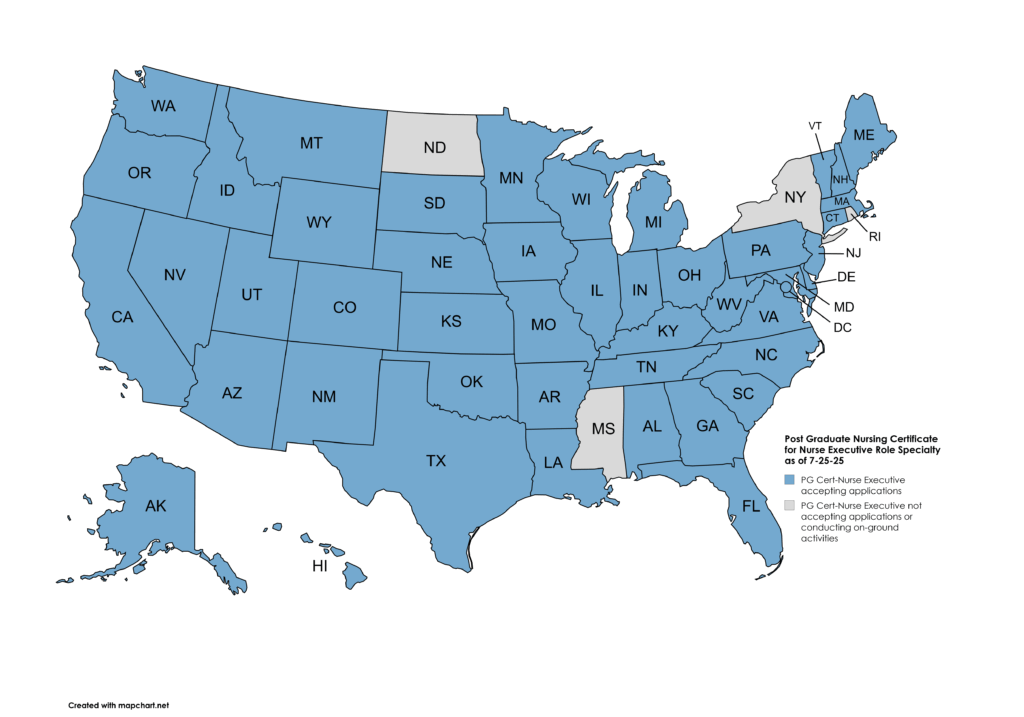
We are currently accepting applications for enrollment in the Post-Graduate Nursing Certificate with a Nurse Executive specialty from the following states: Alabama, Alaska, Arizona, Arkansas, California, Colorado, Connecticut, Delaware, District of Columbia, Florida, Georgia, Hawaii, Idaho, Illinois, Indiana, Iowa, Kansas, Kentucky, Louisiana, Maine, Maryland, Massachusetts, Michigan, Minnesota, Missouri, Montana, Nebraska, Nevada, New Hampshire, New Jersey, New Mexico, North Carolina, Ohio, Oklahoma, Oregon, Pennsylvania, South Carolina, South Dakota,  Tennessee, Texas, Utah, Virginia, Vermont, West Virginia, Washington, Wisconsin, and Wyoming.

USAHS is currently not accepting applications from states where the institution does not have state authorization. However, prospective students are encouraged to check back in the near future as the program may be offered in additional states. Current and admitted students are also advised to monitor this page for any updates prior to relocating to another state, as this can have an impact on continued enrollment in the program.

Post-Graduation Licensure

The Post-Graduate Nursing Certificate program with a Nurse Executive Role Specialty is not designed or intended to lead to professional licensure in any state.


Post-Graduate Nursing Certificate—Nurse Educator Specialty

State Approvals

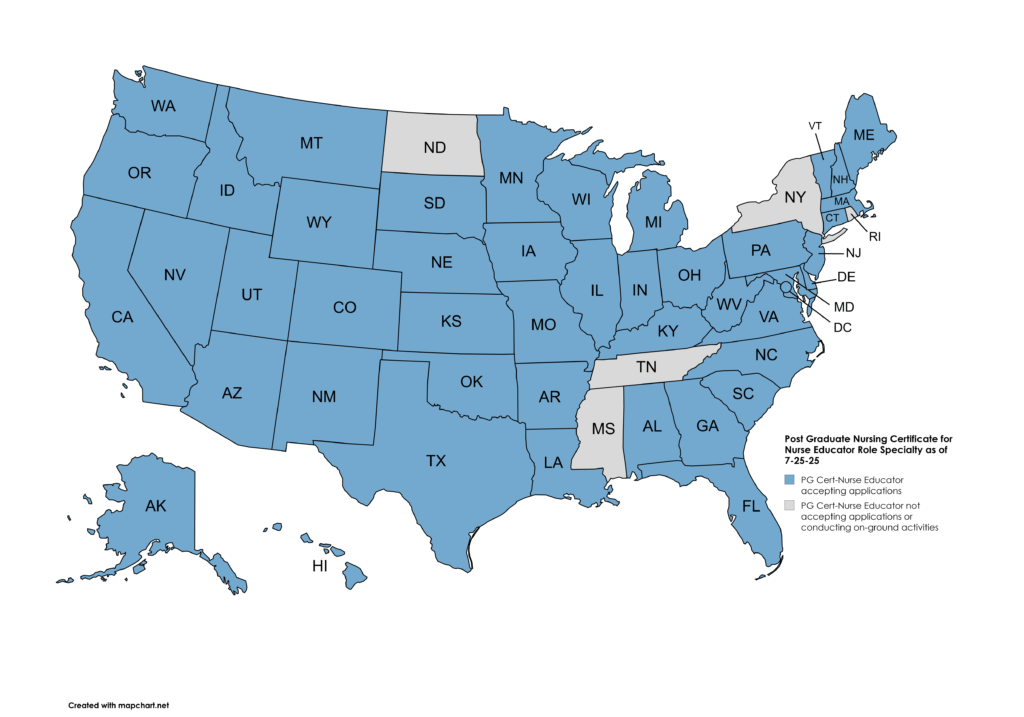
We are currently accepting applications for enrollment in the Post-Graduate Nursing Certificate with a Nurse Educator specialty from the following states: Alabama, Alaska, Arizona, Arkansas, California, Colorado, Connecticut, Delaware, District of Columbia, Florida, Georgia, Hawaii, Idaho, Illinois, Indiana, Iowa, Kansas, Kentucky, Louisiana, Maine, Maryland, Massachusetts, Michigan, Minnesota, Missouri, Montana, Nebraska, Nevada, New Hampshire, New Jersey, New Mexico, North Carolina, Ohio, Oklahoma, Oregon, Pennsylvania, South Carolina, South Dakota, Texas, Utah, Virginia, Vermont, West Virginia, Washington, Wisconsin, and Wyoming.

USAHS is currently not accepting applications from states where the institution does not have state authorization. However, prospective students are encouraged to check back in the near future as the program may be offered in additional states. Current and admitted students are also advised to monitor this page for any updates prior to relocating to another state, as this can have an impact on continued enrollment in the program.

Post-Graduation Licensure

The Post-Graduate Nursing Certificate program with a Nurse Educator Role Specialty is not designed or intended to lead to professional licensure in any state.


CCNE does not accredit non-APRN post-graduate nursing certificate programs. As such, the USAHS Post-Graduate Nursing Certificate program specializations in Nurse Educator and Nurse Executive are not accredited by CCNE.

Post-Graduate Nursing Certificate—Family Nurse Practitioner Specialty

State Approvals

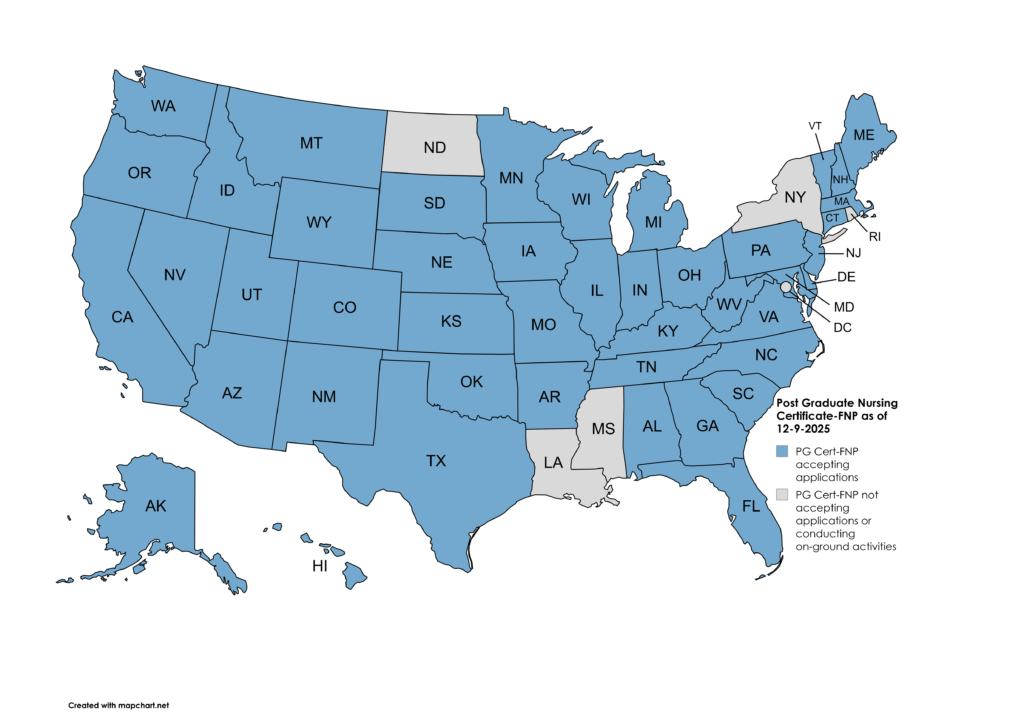
USAHS is currently accepting applications for enrollment in the Post-Graduate Nursing Certificate program with a Family Nurse Practitioner specialty for residents in the following states: Alabama, Alaska, Arizona, Arkansas, California, Colorado, Connecticut, Delaware, Florida, Georgia, Hawaii, Idaho, Illinois, Indiana, Iowa, Kansas, Kentucky, Maine, Maryland, Massachusetts, Michigan, Minnesota, Missouri, Montana, Nebraska, Nevada, New Jersey, New Hampshire, New Mexico, North Carolina, Ohio, Oklahoma, Oregon, Pennsylvania, South Carolina, South Dakota, Tennessee, Texas, Utah, West Virginia, Washington, Wisconsin, Vermont, Virginia, and Wyoming.

USAHS is currently not accepting applications from states where the program does not meet state licensure requirements and/or where the institution does not have state authorization. However, prospective students are encouraged to check back in the near future as the program may be offered in additional states. Current and admitted students are also advised to monitor this page for any updates prior to relocating to another state, as this can have an impact on continued enrollment in the program and the ability to be placed for on-the-ground activities or practicum experiences.

Post-Graduation Licensure

The map below identifies the states from which the University is now accepting applications for the Post-Graduate Nursing Certificate with an FNP specialty. For states denoted in blue, USAHS has determined the program satisfies the educational requirements for professional licensure in those states. USAHS has not made a determination regarding whether the Post-Graduate Nursing Certificate with a Family Nurse Practitioner specialty satisfies the educational requirements for professional licensure in the states denoted in gray.

USAHS has not made a determination that its curriculum meets the educational requirements for licensure or certification in the following locations:  American Samoa, the Commonwealth of Puerto Rico, Guam, the Virgin Islands, the Commonwealth of the Northern Mariana Islands, the Republic of the Marshall Islands, the Federated States of Micronesia, and the Republic of Palau.  USAHS is currently not accepting applications from states where the program does not meet state licensure requirements and/or where the institution does not have state authorization.

PGC FNP map


It remains the student’s responsibility to understand, evaluate, and comply with all requirements relating to practicum experiences, licensing or certification, authorization or endorsement for the state in which she or he resides. For more information, students should contact the appropriate state licensure board to understand state licensure requirements as regulations vary from state to state.

Post-Graduate Nursing Certificate—Psychiatric Mental Health Nurse Practitioner Specialty

State Approvals

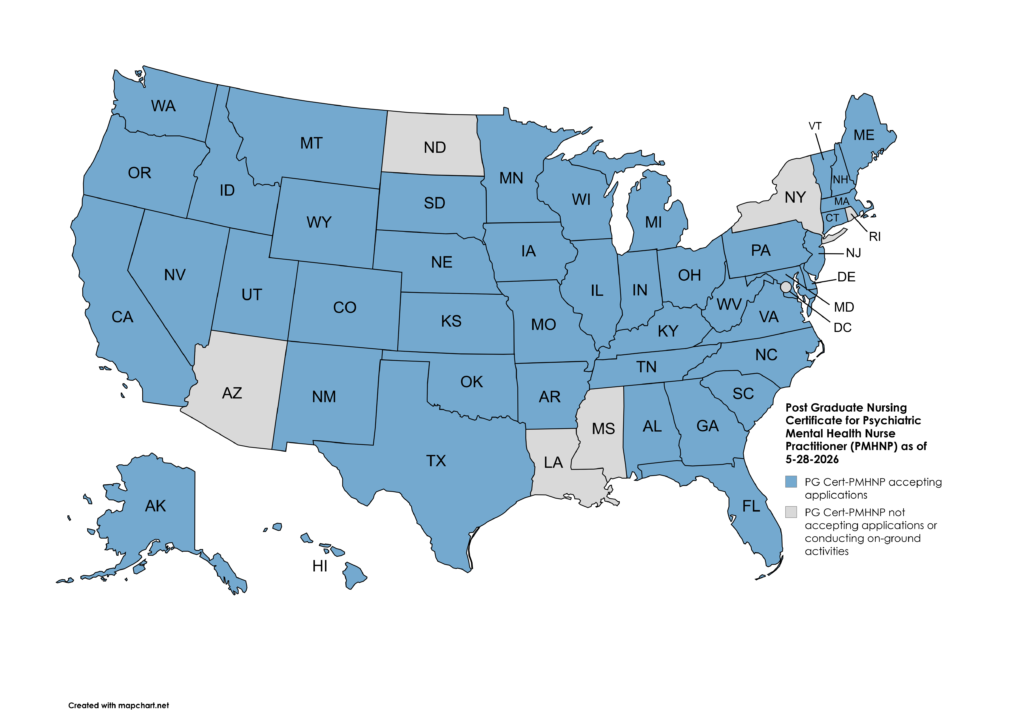
USAHS is currently accepting applications for enrollment in the Post-Graduate Nursing Certificate program with a Psychiatric Mental Health Nurse Practitioner specialty for residents in the following states: Alabama, Alaska, Arkansas, California, Colorado, Connecticut, Delaware, Florida, Georgia, Hawaii, Idaho, Illinois, Indiana, Iowa, Kansas, Kentucky, Maine, Maryland, Massachusetts, Michigan, Minnesota, Missouri, Montana, Nebraska, Nevada, New Hampshire, New Jersey, New Mexico, North Carolina, Ohio, Oklahoma, Oregon, Pennsylvania, South Carolina, South Dakota, Tennessee, Texas, Utah, Vermont, Virginia, Washington, West Virginia, Wisconsin and Wyoming.

USAHS is currently not accepting applications from states where the program does not meet state licensure requirements and/or where the institution does not have state authorization. However, prospective students are encouraged to check back in the near future, as the program may be offered in additional states. Current and admitted students are also advised to monitor this page for any updates prior to relocating to another state, as this can have an impact on continued enrollment in the program and the ability to be placed for on-the-ground activities or practicum experiences.

Post-Graduation Licensure

The map below identifies the states from which the University is now accepting applications for the Post-Graduate Nursing Certificate – Psychiatric Mental Health Nurse Practitioner specialty. For states denoted in blue, USAHS has determined the program satisfies the educational requirements for professional licensure in those states. USAHS has not made a determination regarding whether the Post-Graduate Nursing Certificate – Psychiatric Mental Health Nurse Practitioner specialty satisfies the educational requirements for professional licensure in the states denoted in gray.

USAHS also has not made a determination that its curriculum meets the educational requirements for licensure or certification in the following locations:  American Samoa, the Commonwealth of Puerto Rico, Guam, the Virgin Islands, the Commonwealth of the Northern Mariana Islands, the Republic of the Marshall Islands, the Federated States of Micronesia, and the Republic of Palau.


It remains the student’s responsibility to understand, evaluate, and comply with all requirements relating to practicum experiences, licensing or certification, authorization or endorsement for the state in which she or he resides. For more information, students should contact the appropriate state licensure board to understand state licensure requirements, as regulations vary from state to state.

Higher Education State Approvals

The University of St. Augustine for Health Sciences holds licensure/authorization to operate a physical campus in three states — California, Florida and Texas. Please refer to the Licensure page for more detailed information. The University has additional state approvals and exemptions to provide distance education. Please visit the State Licensure page for more detailed information.

CCNE Accreditation

Higher Education State Approvals

The Post-Graduate NP Certificate program at the University of St. Augustine for Health Sciences is accredited by the Commission on Collegiate Nursing Education, 655 K Street NW, Suite 750, Washington, DC 20001, 202-887-6791.

Note on Certification Exam

Nurse practitioner graduates must hold a master’s, postgraduate, or doctoral degree from a nurse practitioner program accredited by the CCNE or the Accreditation Commission for Education in Nursing (ACEN) to be eligible to take the necessary role specialty national examination to be certified as a nurse practitioner, which most states require in order to be licensed to practice as an NP. Graduates should take the exam that aligns with their role specialty: FNP-BC or FNP, or PMHNP-BC or PMH-BC. The Post-Graduate Nursing Certificate program with specializations in Family Nurse Practitioner and Psychiatric Mental Health Nurse Practitioner at the University of St. Augustine for Health Sciences is accredited by the Commission on Collegiate Nursing Education, 655 K Street NW, Suite 750, Washington, DC 20001, 202-887-6791.

Note on Licensure, Authorization, Endorsement, or Other State Credential Necessary to Practice as a Nurse Practitioner

Most states require that graduates pass a nurse practitioner national certification exam in order to apply for licensure or other credentials to practice as a nurse practitioner in a state. Graduates must hold a master’s, postgraduate, or doctoral degree from a nurse practitioner program accredited by the CCNE or the Accreditation Commission for Education in Nursing (ACEN) in order to be eligible for an NP national certification exam; national certification as an NP is required for licensure to practice as an NP in most states. Graduates should take the exam that aligns with their role specialty: FNP-BC or FNP, or PMHNP-BC or PMH-BC. The Post-Graduate Nursing Certificate program with specializations in Family Nurse Practitioner and Psychiatric Mental Health Nurse Practitioner at the University of St. Augustine for Health Sciences is accredited by the Commission on Collegiate Nursing Education, 655 K Street NW, Suite 750, Washington, DC 20001, 202-887-6791. While the Post-Graduate Nursing Certificates in nurse practitioner programs are designed to lead to licensure, authorization, endorsement, or other state credential necessary to practice as a nurse practitioner, it is the prospective student’s responsibility to understand, evaluate, and comply with all requirements relating to nursing practice in the state in which he or she intends to practice and/or resides as requirements vary widely.

Prospective students are advised that relocation to another state may impact their ability to complete on-the-ground activities, practicum experiences and/or obtain professional licensure, certification, or other credentials in another state.  Prospective students are advised to carefully review, evaluate and understand the requirements of the applicable licensure board in the state in which they intend to relocate. USAHS makes no representations or guarantee that completion of coursework or programs will permit an individual to obtain state licensure, authorization, endorsement, or other state credential, including prescriptive authority, where requirements may vary between different states. Additionally, current and admitted students are also advised to monitor this page for any updates prior to relocating to another state, as this can have an impact on continued enrollment in the program and the ability to be placed for on-the-ground activities and practicum experiences.  For more information about the requirements to practice, students should contact the appropriate Board of Nursing or state agency.

Notice to State of Washington Students: The University of St. Augustine for Health Sciences is approved by the Washington State Board of Nursing to conduct practice experiences for residents of Washington state for the MSN/Nurse Educator, MSN/Nurse Executive, MSN/FNP, MSN/AGNP, MSN/PMHNP, RN-MSN/FNP, RN-MSN/AGNP, RN-MSN/PMHNP, MSN-entry DNP, DNP/Nurse Executive, DNP/FNP, Post-Graduate Nursing Certificate (PMHNP), and Post-Graduate Nursing Certificate (FNP) program tracks. Learn more.

Close

Post-Graduate Nursing Certificate Program Data

The Following Programs Participate in Title IV Federal Student Loans (paper copies of disclosures are available upon request):

Post-Graduate Nursing Certificate – FNP
Post-Graduate Nursing Certificate – PMHNP (Non-APRN Entry)

Close

Post-Graduate Nursing Certificates at a Glance

Family Nurse Practitioner Role Specialty

  • Expand your clinical practice beyond hospital settings to focus on family healthcare across the lifespan
  • Online coursework + one required on-campus clinical intensive
  • 31 credit hours + practicum contact hours:
    Fall 2025 and prior: 585 hours
    Spring 2026 and beyond: 754 hours
  • 5 trimesters* (1.7 years)
  • Sept., Jan. & May start dates

PMHNP Role Specialty

  • Learn the full range of specialized services that constitute mental health and psychiatric care and treatment
  • Online coursework + one required virtual clinical intensive
  • 37 credit hours + practicum contact hours:
    Fall 2025 and prior: 585 hours
    Spring 2026 and beyond: 754 hours
  • 6 trimesters* (2 years)
  • Sept., Jan. & May start dates

Nurse Educator** and Nurse Executive Role Specialties

  • Online coursework + optional virtual immersions
  • 12 credit hours
  • 2 trimesters* (0.7 year)
  • Sept., Jan. & May start dates

Nurse Educator Details

Alum Appreciation Grant

Tuition Savings

Alum Appreciation Grant

USAHS supports your journey with Special Tuition Grant savings towards completing one of our nursing certificate programs online.
Over the life of the program. This offer is not a guarantee that all candidates eligible for the offer will be granted acceptance or admission into USAHS. All prospective students will be subject to the same standard admission and registration process when applying to USAHS. The Grant is applicable to tuition only and does not apply toward books, materials, and other supplies or fees. This offer is only valid for eligible new students who enroll and start classes in the above programs at USAHS through Summer 2026. Please refer to the Financial Aid webpage for additional information.

All Alum Nursing  $5,000

Criteria
Available to all eligible students
No application is needed

How Our Post-Graduate Nursing Certificates Stand Apart

We’re online + hands-on.

Post-Graduate Nursing Certificate program is delivered online, with both synchronous and asynchronous elements. Alongside their coursework, students completing nurse practitioner certificates program, such as their FNP or PMHNP, must complete one required clinical intensive in our state-of-the-art Centers for Innovative Clinical Practice. This provides an opportunity to practice hands-on skills and meet faculty and peers while pursuing a graduate certificate in nursing.

Curricula That Bolster Your Qualification

Our Post-Graduate Nursing Certificate program follows the same in-depth course curricula as the role specialties in our MSN and BSN-entry DNP programs. By the end of our online nursing certificate programs, you’ll be prepared to take the respective certification exams. Note that to sit for some exams, you may need a specific number of hours of experience.

Clinical Practicum Placements

FNP and PMHNP certificate students must complete practicum contact hours. To complete these nurse practitioner certificate programs, you must work onsite with a preceptor who meets accreditation and state licensure requirements. Practicum placements are determined by USAHS based on the student’s academic needs and to provide the best educational experience. NP nursing students should plan on some travel or even to relocate for practica. There are no practica for the Nurse Educator or Nurse Executive certificates.

Getting Started

Ready to take the next step toward earning a graduate certificate in nursing? It’s easy to get started right away!

Get MoreInformation

Get More
Information

Our webinars and virtual campus tours provide a wealth of information to help ensure you make the right choice among our nursing certificates online.

Schedule a One-on-One Consultation

Schedule a One-on-One Consultation

Our enrollment advisors are always ready to provide personalized guidance around our hands-on + online nursing certificate program that is based on your needs.

Start YourApplication

Start Your
Application

There’s no time like the present to pursue one of our post-graduate certificates in nursing online with USAHS!

News

Related Articles

Latest Nursing News

Let's Connect

We're here to support you on your educational journey.

Please complete our contact form. An enrollment advisor will reach out to provide information and answer your questions.