Healthcare encompasses many roles with increasing median pay, particularly in advanced practice and licensed clinical careers.1 Several healthcare jobs offer six-figure median wages, including those of physicians, surgeons, physician assistants and nurse practitioners.2,3,4 There are many high paying healthcare jobs available, from roles focused on diagnosing and prescribing to hands-on rehabilitation.
Graduate health sciences programs at the University of St. Augustine for Health Sciences (USAHS) can guide students toward physical therapy, occupational therapy, speech-language pathology and nursing through flexible formats that align with your lifestyle and schedule. USAHS helps prepare students for paths like physical therapy (PT), occupational therapy (OT), speech-language pathology (SLP), advanced nursing and leadership. Here’s a walkthrough of some good-paying healthcare jobs, and how USAHS can help you pursue healthcare.
High-Paying Healthcare Careers At a Glance
Are you exploring high-paying jobs in healthcare? Healthcare salaries vary by region, experience, work setting and specialty. Many clinicians earn well above the median wage in high-demand markets or advanced roles, but salaries can also vary based on individual schedules, overtime, shift differentials and contract type.1
Here are some examples of high-paying jobs in healthcare:
Physicians and Surgeons
Physician and surgeon roles are some of the highest-paying jobs in healthcare. The U.S. Bureau of Labor Statistics (BLS) reports that physicians and surgeons have an annual median wage of about $239,200.2
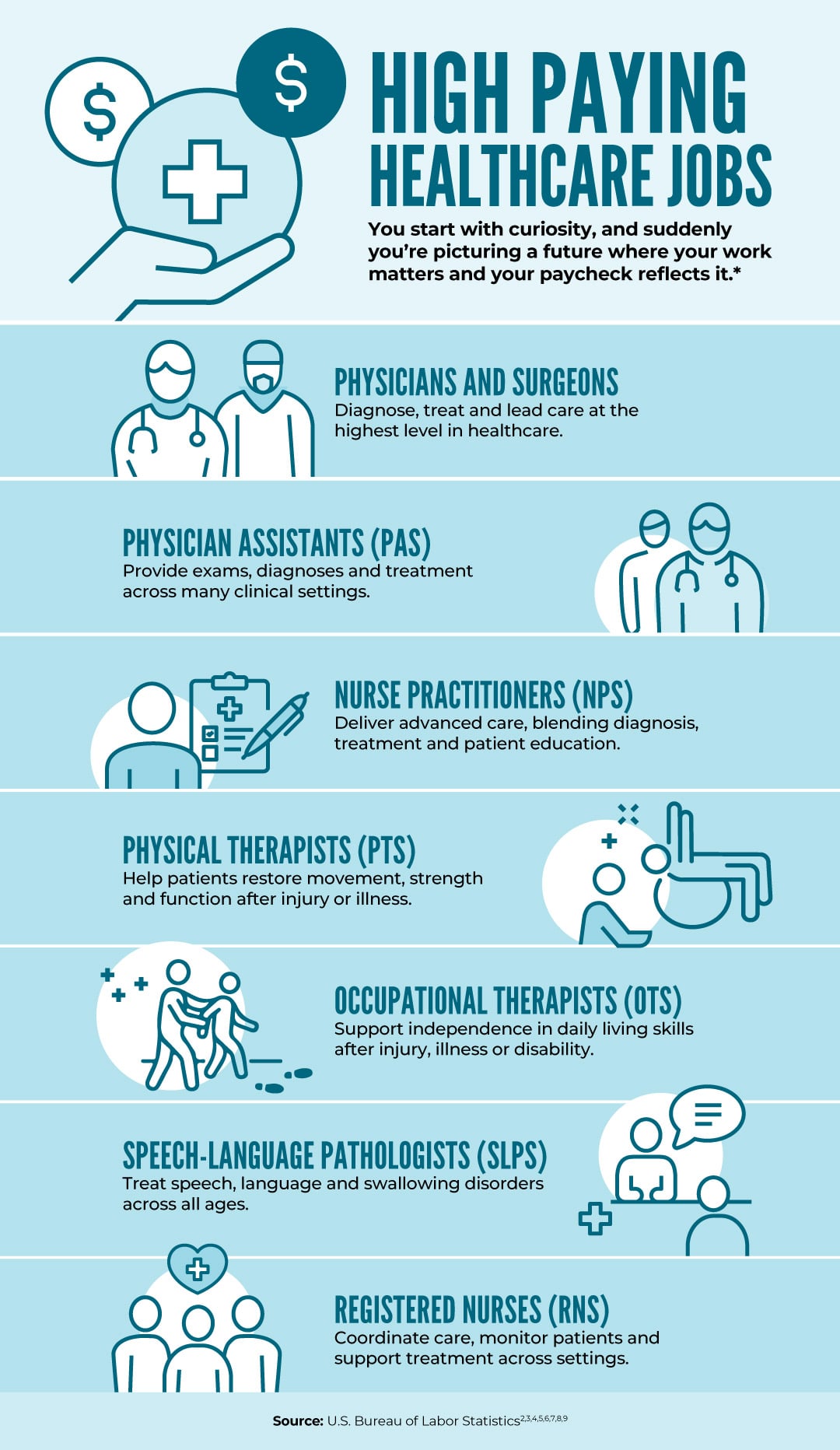
Physicians and surgeons diagnose and treat illnesses and injuries, order and interpret tests and lead medical decision-making. They also perform procedures and surgeries and coordinate care teams across settings like hospitals, clinics and emergency departments.
In terms of job outlook, the BLS projects employment for physicians and surgeons to grow about 3% from 2024 to 2034, with an average of 23,600 job openings each year.2 This number represents total U.S. demand across all specialties and settings, as well as openings resulting from retirements and career shifts.
Physician Assistants (PAs)
The BLS reports a median annual wage of $133,260 for PAs as of May 2024.3
PAs, also called physician associates in some settings, offer many of the same services as physicians while working under physician supervision. They can perform exams, diagnose illnesses, order tests, assist in procedures and prescribe medications. You might find PAs working in primary care, specialty clinics, surgery, emergency medicine and more.3
In terms of job outlook, the BLS projects PA employment to grow 20% from 2024 to 2034, with an average of 12,000 job openings each year.3 This reflects national demand and ongoing role replacement needs.3
Nurse Practitioners (NPs)
For nurse practitioners (NPs), the BLS reports a mean annual wage of about $128,490 as of May 2023.*4 In terms of job outlook, the BLS projects employment for advanced practice registered nurses (including nurse practitioners, nurse anesthetists and nurse midwives) to grow by approximately 35% from 2024 to 2034, much faster than the average for all occupations. 5 While datasets differ in how they group advanced nursing roles, BLS projections consistently place NP-related roles among the fastest growing in healthcare.5
NPs often handle a mix of assessment, diagnosis, treatment and patient education, and they collaborate with physicians, pharmacists, PTs and other clinicians. NPs may work in adult and geriatric health, pediatric health, or psychiatric and mental health.5
Nursing at USAHS
If you already work as a nurse, graduate education is often the next step toward advanced practice, leadership or education-related paths. At USAHS, we offer online nursing pathways designed for working professionals, with flexible coursework and local practicum experiences for clinical specialties.
Here are the graduate nursing programs available at USAHS:
- Master of Science in Nursing (MSN): The USAHS MSN program helps registered nurses advance their careers through specialized role tracks that build leadership, clinical and evidence-based practice skills. Students complete a blend of coursework and hands-on experiences designed to prepare them for expanded responsibilities in today’s evolving healthcare environment.
- Doctor of Nursing Practice (DNP): The USAHS DNP program is a degree focused on advanced clinical practice, systems leadership and translating research into real-world healthcare improvements. It equips nurses to lead organizational change, improve patient outcomes and address complex healthcare challenges at the highest level of nursing practice.
- Post-Graduate Nursing Certificates (PG-C): USAHS Post-Graduate Nursing Certificates allow nurses who already hold an MSN or DNP to gain additional role specialization without completing another degree program. These focused programs help nurses expand their scope of practice and prepare for certification in a new specialty area.
We also offer pathways towards NP role specialties, like Family Nurse Practitioner (FNP) and Psychiatric Mental Health Nurse Practitioner (PMHNP), designed to combine flexible online learning with hands-on practicum experiences.
Physical Therapists (PTs)
For physical therapists, the BLS reports a median annual wage of $101,020 as of May 2024.*6 In terms of job outlook, the BLS projects PT employment to grow 11% from 2024 to 2034.6 The BLS also notes that national projections reflect factors like aging populations and ongoing demand for rehabilitation and movement-based care.6
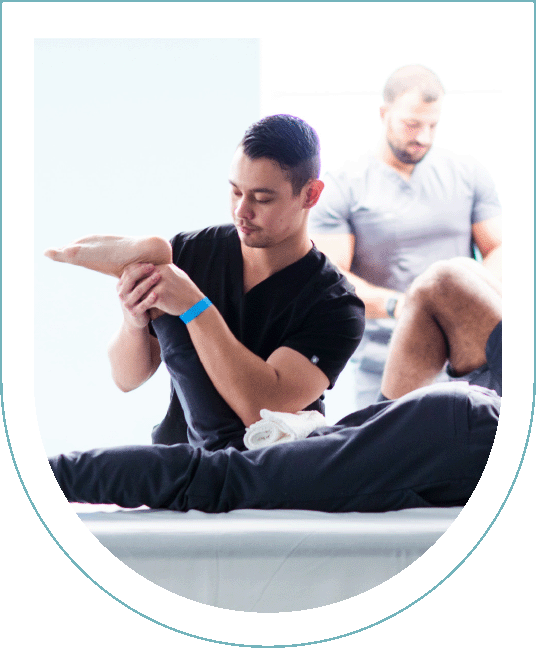
PTs help patients improve their mobility, manage pain and recover from injuries and chronic conditions through exercise, hands-on care and education.6
PTs study movement, identify impairments, build an individualized plan and guide people through the rehabilitation process. They also teach patients how to prevent re-injury, build sustainable habits and keep improving after PT is complete.6
Physical Therapy at USAHS
We offer multiple Doctor of Physical Therapy (DPT) pathways that emphasize hands-on learning and clinical experiences in diverse settings.
- Residential DPT: On-campus weekday classes and labs plus some online coursework (7 trimesters, about 2.3 years)**
- Hybrid Immersion DPT: Online coursework, live virtual weekday sessions, plus two on-campus lab immersions per term (7 trimesters, about 2.3 years)**
- Flex DPT: Online coursework plus live virtual evening and weekend sessions plus on-campus labs on select weekends (9 trimesters, about 3 years)**
Occupational Therapists (OTs)
For OTs, the BLS reports a median annual wage of $98,340 as of May 2024.*7 OTs evaluate and treat people who have injuries, illnesses or disabilities and help them develop, recover, improve and maintain skills needed for daily living and working.7
OTs generally work in hospitals, outpatient clinics, schools, home health and specialized programs across physical rehabilitation, pediatrics, mental health and more.7
Occupational Therapy at USAHS
USAHS offers entry-level OT degrees and post-professional options, which can support a range of professionals at various career stages, from new clinicians to experienced OTs who want to expand their skills.
Our Master of Occupational Therapy (MOT) program prepares students to help individuals across the lifespan develop, recover and improve the skills needed for daily living and meaningful participation in life. Through a blend of classroom learning, hands-on labs and fieldwork experiences, students develop the clinical reasoning and practical skills for entry-level practice.
We also offer a Doctor of Occupational Therapy (OTD) as an entry-to-practice option. The OTD degree builds on the same clinical training foundation as an entry-level master’s degree, while placing more emphasis on leadership, advocacy and health policy. The OTD program culminates with a mentored capstone project.
For practicing OTs, we have a Post-Professional Doctor of Occupational Therapy (PPOTD) degree that is 100% online and designed for working clinicians, with focus areas like leadership, research, advocacy and higher education.
Plus, our OTA-to-MOT bridge pathway is for qualified occupational therapy assistants (OTAs). OTA-to-MOT can be helpful for experienced assistants who want to expand into the OT scope of practice without a bachelor’s degree.
Speech-Language Pathologists (SLPs)
For SLPs, the BLS reports a median annual wage of $95,410 as of May 2024.*8 SLPs assess and treat people who have communication disorders, and they also work with clients who have issues swallowing (dysphagia).8 SLP covers all ages, from early language development to adult neurorehabilitation and medical swallowing care.
Speech-Language Pathology at USAHS
USAHS offers a Master of Science in Speech-Language Pathology (MS-SLP), which is a hybrid, mostly online program designed to prepare students for clinical practice as SLPs.
We also offer SLP Leveling Courses to help students meet prerequisites and become eligible to pursue the MS-SLP. That path can be helpful if your undergraduate degree didn’t include all the required coursework.
Registered Nurses
RNs often serve as the connective tissue of the care plan, especially in busy hospitals. The BLS reports a median annual wage of $93,600 for RNs as of May 2024.9
RNs provide and coordinate patient care, educate patients and the public about health conditions and deliver clinical support across hospitals, clinics, schools, home health and many other settings.9
Nursing at USAHS
USAHS offers graduate nursing programs to help RNs move into advanced practice, leadership or education roles.
- Master of Science in Nursing (MSN) with two entry pathways for Registered Nurse (RN) entry and Bachelor of Science in Nursing (BSN) entry
- Doctor of Nursing Practice (DNP) with BSN or MSN-entry options
- Post-Graduate Nursing Certificates (PG-C) for nurses who have already completed an MSN or DNP and want to add a role specialty or expand their credentials
USAHS offers Family Nurse Practitioner (FNP) and Psychiatric Mental Health Nurse Practitioner (PMHNP) role specialties through its MSN program for RN and BSN entry pathways, as well as a Nurse Executive role specialty through its MSN program for BSN-prepared nurses. Programs combine online coursework with practicum experiences as required by the selected specialty.
Pursuing a Career in Healthcare
Healthcare roles continue to top lists of high-paying jobs in America because many offer strong median wages and steady national demand across settings.* Choosing the best career for you is about more than just numbers. Fit matters, and so does the day-to-day workload.
Here are some helpful prompts that may help narrow down your options:
- If you want to lead diagnosis and treatment, you might consider a physician or surgeon pathway.2
- If you like medicine and autonomy but prefer a shorter training period than medical school, PA or NP roles may be a good fit.3,4,5
- If you want a clinical path centered around movement and function with hands-on coaching, PT or OT might be a strong match.6,7
- If communication, cognition and swallowing care interest you, SLP opens doors across various school and healthcare settings.8
- If you want a broad clinical foundation with the possibility for diverse specialties, RN careers offer a wide range with clear growth pathways.9
USAHS is a great choice if you’re ready to pursue a future in OT, PT, SLP or nursing, especially if you want flexible program formats designed for different schedules and learning preferences.
FAQs
How can I work in healthcare?
First, decide what kind of work you want to do. Next, figure out the required education level. Some healthcare roles require doctoral-level education, like physicians and surgeons.2
Finally, think about the setting. Many healthcare professionals work in multiple settings throughout their careers. If you’re unsure, shadowing and informational interviews can be useful.
Do I need to attend medical school to get a high-paying healthcare job?
No. Medical school leads to becoming a physician or surgeon, whose salaries often sit at the top of healthcare wage tables.2 However, it’s not the only path to landing high-paying healthcare jobs. The BLS reports six-figure median wages for several non-physician roles, including PAs and PTs.
How can USAHS help me find a good-paying healthcare job?
USAHS can help if you want to pursue OT, PT, SLP or graduate nursing. There are programs designed around clinical preparation and skill-building, with multiple learning formats.
You can choose a program structure that fits your schedule while still building clinical skills through labs, residencies or practicums. If you’re balancing work, family or other life factors, having multiple format options can help make pursuing education feel more realistic.
*This data represents national figures, is not based on school-specific data and represents national median annual wages, not starting pay for recent grads. Conditions in your area may vary. USAHS does not guarantee salary levels.
**Time to completion can vary by student, depending on individual progress, credits transferred and other factors.
References:
- “Occupational Outlook Handbook: Healthcare Occupations,” U.S. Bureau of Labor Statistics (BLS), August 28, 2025, https://www.bls.gov/ooh/healthcare/.
- “Occupational Outlook Handbook: Physicians and Surgeons,” U.S. Bureau of Labor Statistics, August 28, 2025, https://www.bls.gov/ooh/healthcare/physicians-and-surgeons.htm.
- “Occupational Outlook Handbook: Physician Assistants,”U.S. Bureau of Labor Statistics (BLS) August 28, 2025, https://www.bls.gov/ooh/healthcare/physician-assistants.htm.
- “Occupational Employment and Wages, May 2023: Nurse Practitioners,” U.S. Bureau of Labor Statistics (BLS), April 3, 2024, https://www.bls.gov/oes/2023/may/oes291171.htm.
- “Occupational Outlook Handbook: Nurse anesthetists, nurse midwives and nurse practitioners,” U.S. Bureau of Labor Statistics (BLS), August 28, 2025), https://www.bls.gov/ooh/healthcare/nurse-anesthetists-nurse-midwives-and-nurse-practitioners.htm.
- “Occupational Outlook Handbook: Physical therapists,” U.S. Bureau of Labor Statistics (BLS), August 28, 2025, https://www.bls.gov/ooh/healthcare/physical-therapists.htm.
- “Occupational Outlook Handbook: Occupational Therapists,” U.S. Bureau of Labor Statistics (BLS), August 28, 2025, https://www.bls.gov/ooh/healthcare/occupational-therapists.htm.
- “Occupational Outlook Handbook: Speech-Language Pathologists.,” U.S. Bureau of Labor Statistics (BLS), August 28, 2025, https://www.bls.gov/ooh/healthcare/speech-language-pathologists.htm.
- “Occupational Outlook Handbook: Registered Nurses,” U.S. Bureau of Labor Statistics (BLS), August 28, 2025, https://www.bls.gov/ooh/healthcare/registered-nurses.htm.