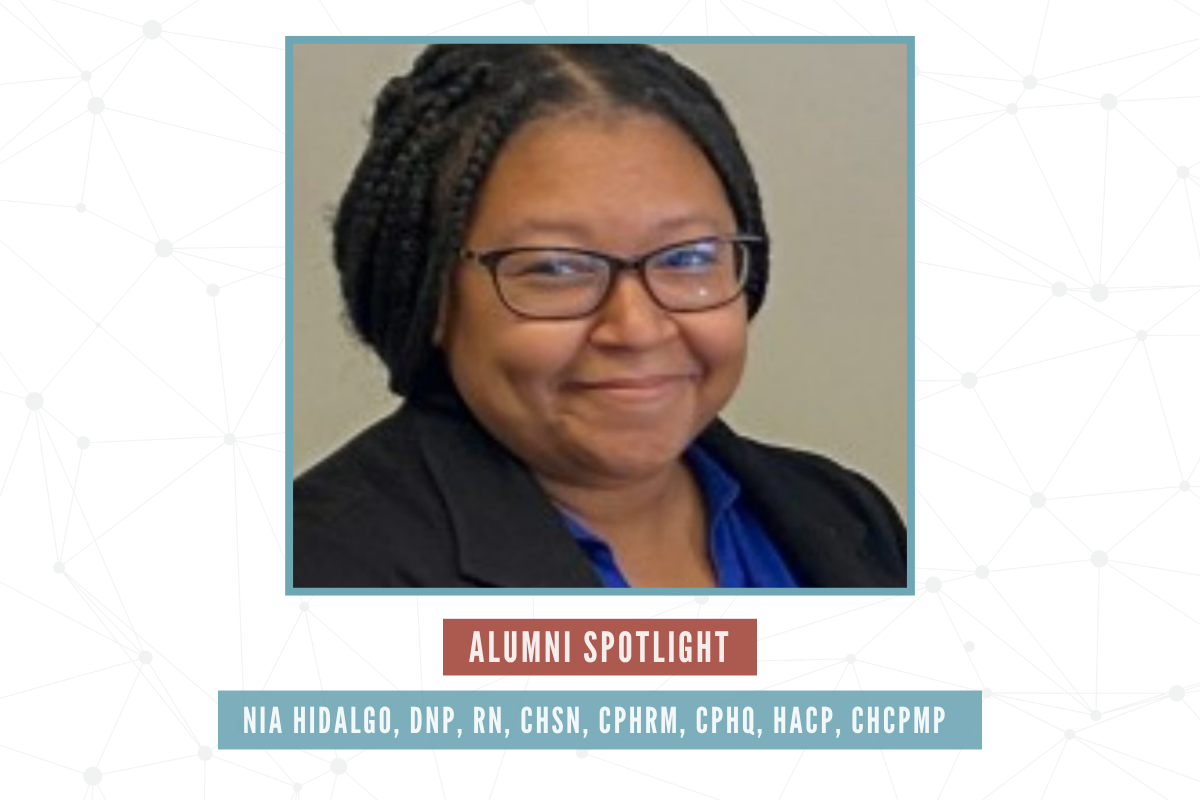
When Nia Hidalgo, DNP, RN, CHSN, CPHRM, CPHQ, HACP, CHCPMP, discusses her nursing journey, she does it the same way she approaches her work—open, practical and centered on helping others move forward.
A 2020 Doctor of Nursing Practice (DNP) alum of the University of St. Augustine for Health Sciences (USAHS) and new member of the Alumni Association Advisory Board, Dr. Hidalgo brings more than a decade of experience as a registered nurse (RN) in quality, regulatory and patient safety roles.
Her message to nurses considering graduate school: Go for an advanced degree. “I’ve always wanted to go for a higher nursing degree,” Dr. Hidalgo explains. “I wasn’t sure what type of degree or what school, but when I looked at USAHS, it really embodied what I was looking for.”
The power of advanced nursing education
Dr. Hidalgo earned her DNP during a memorable time. She graduated in the middle of the COVID-19 pandemic. Like many students, she was balancing work, family and uncertainty, but she describes the experience as rewarding. “My professors worked really hard to get through the challenges of learning during a pandemic, and I felt supported as a student,” she says.
That faculty guidance left a lasting impression and continues to shape how she shows up for students today. Now working as a Patient Safety Program Manager, Dr. Hidalgo says her advanced nursing degree directly impacted her career growth. “Achieving a DNP has helped me career-wise and made me more marketable. My resume really jumps out.”
She argues that graduate nursing degrees, like a DNP or a Master of Science in Nursing (MSN), are increasingly important for roles like nurse educators, nurse directors or nurse researchers. “Earning a DNP will help anyone who wants to push their career forward,” Dr. Hidalgo says.
Faculty mentors also stood out during her time as a student, particularly during the height of the pandemic. They hosted something called COVID Power Hour. “It was a Zoom meeting where students and professors could talk about how they were feeling and dealing with everything,” Dr. Hidalgo recalls.
As a nurse accustomed to supporting patients through stress, she found those sessions meaningful. She says they helped her learn to remain calm and listen, strategies she uses today when supporting her own coworkers and students.
How research drives nursing excellence
One of the most valuable aspects of her DNP program, Dr. Hidalgo says, was learning how to translate research into real-world practice.
“Part of my role is staying aware of clinical practice guidelines and best practices for disease processes,” Dr. Hidalgo explains. “In the DNP program, you learn how to research and then put your findings into practice, especially when developing policies and procedures.”
That skill set now supports her work across multiple system-level initiatives, from ensuring compliance with clinical practice guidelines, regulatory standards and core measurement requirements to improving patient outcomes.
Shaping future nurses
Dr. Hidalgo’s commitment to mentoring nursing students is a big reason why she joined USAHS’ Alumni Association Advisory Board. She currently precepts MSN and DNP students and recently worked with a DNP student from USAHS. “The experience of working with a student from the school I attended really drove me to join the board,” Dr. Hidalgo says. “I want to make myself available to students who want to learn and become more involved with the school that supported me.”
At the hospital where she works, she helps students access rare resources, including an expansive medical library, and connects them with a medical librarian to strengthen their research skills. “I want other DNP students to have those same opportunities,” she advocates.
Fostering professionalism in nursing
Despite her extensive experience and impressive credentials, including certifications in healthcare safety, risk management and quality, Dr. Hidalgo keeps things grounded. “I don’t force anyone to call me doctor,” she says with a smile. “I usually tell people, ‘Just call me Nia.’”
Still, she recognizes the credibility that comes with advanced nursing education. “When people see all the letters after my name, I explain that I wanted to be well educated for my role. All of my credentials tie back to what I do every day,” she elaborates.
Embracing lifelong learning
For nurses who wonder if it’s too late to return to school, Dr. Hidalgo reassures them that it’s never too late. “I worked, I had kids, and it was still doable,” she says. She credits strong time management skills for making it work. She describes how she lived by her planner and scheduled time to read, work on modules and stay organized.
She also encourages students to leverage academic resources like tutoring services. “Having another set of eyes on your work is so valuable,” she says.
Looking back, Dr. Hidalgo sees her DNP as more than a degree, but as a foundation for leadership and service. “The school you attend has a hand in shaping the person you become. Ultimately, you feel like you want to give back,” she explains.
For prospective graduate nursing students, her advice is simple and honest: advanced education opens doors, builds confidence and gives nurses the tools to make meaningful change. And for Dr. Hidalgo, it all comes back to influencing the future of nursing, one student at a time.