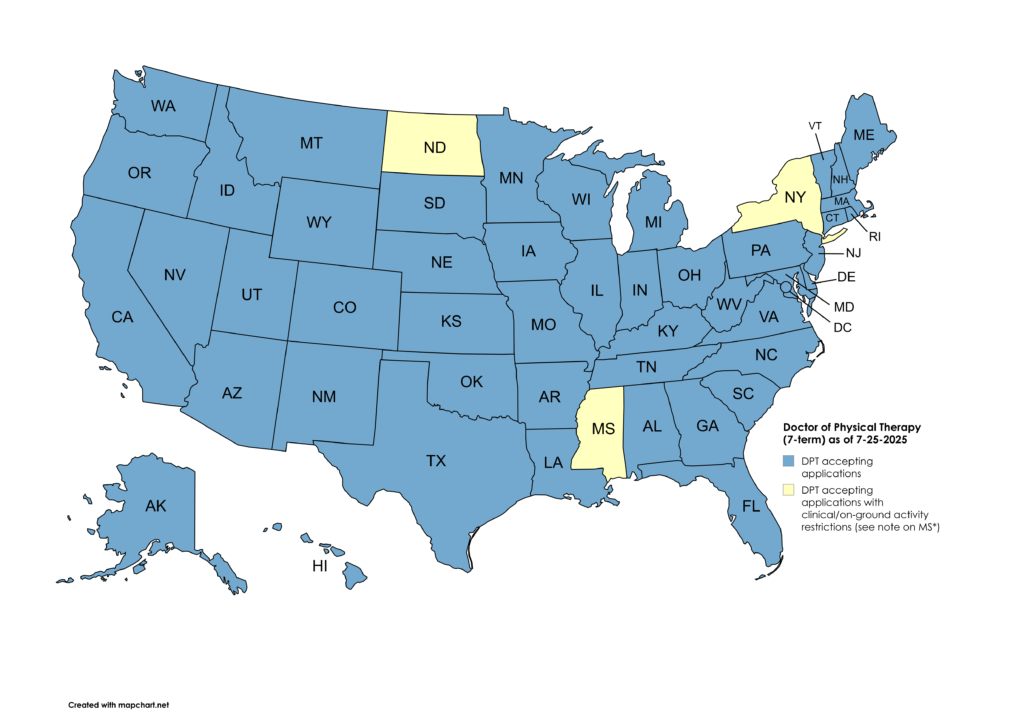
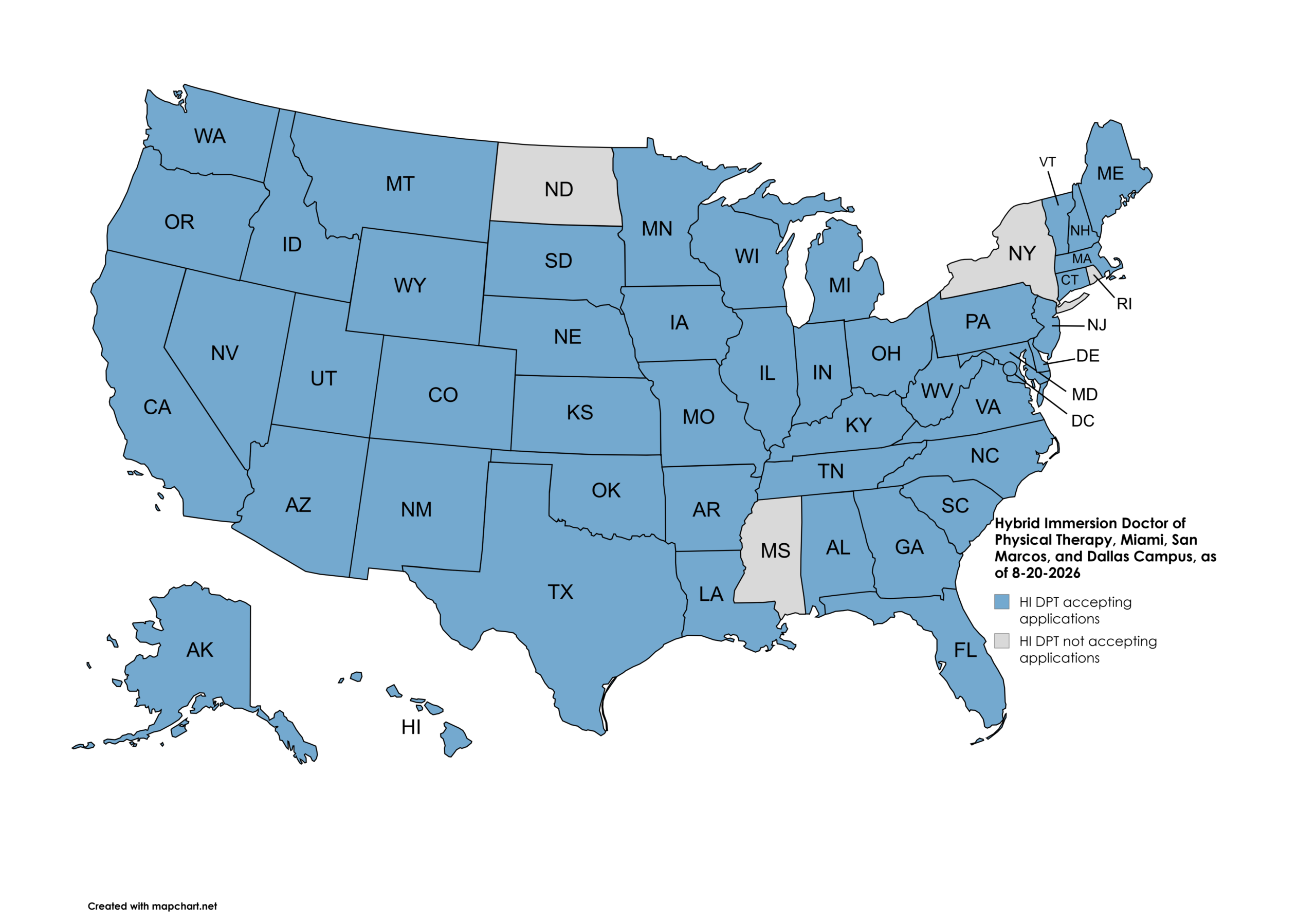
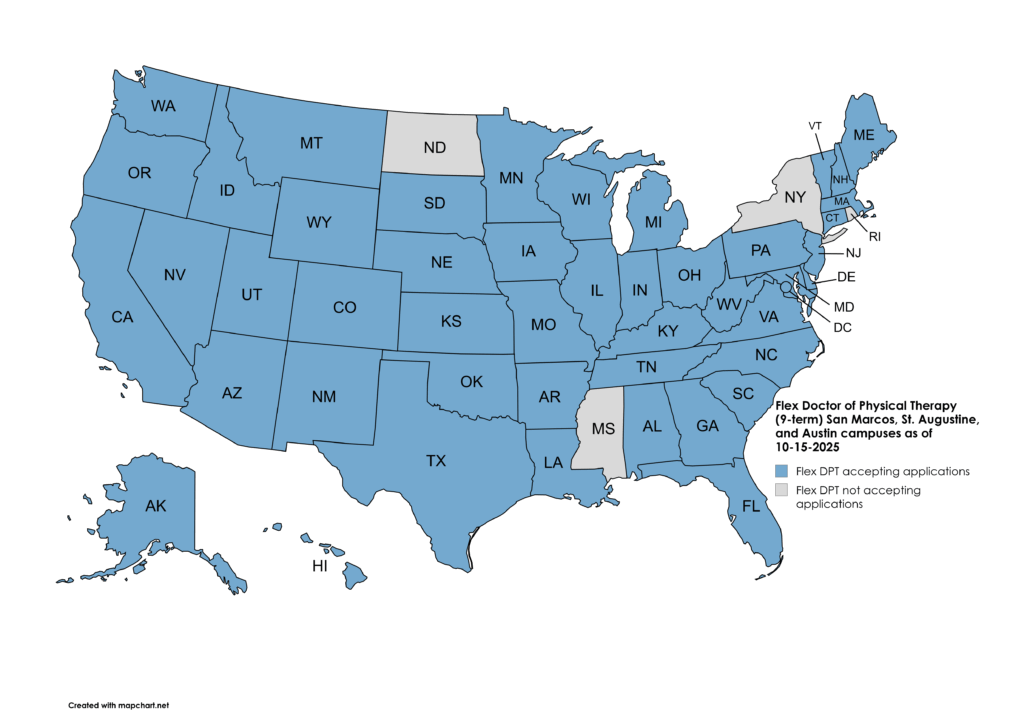
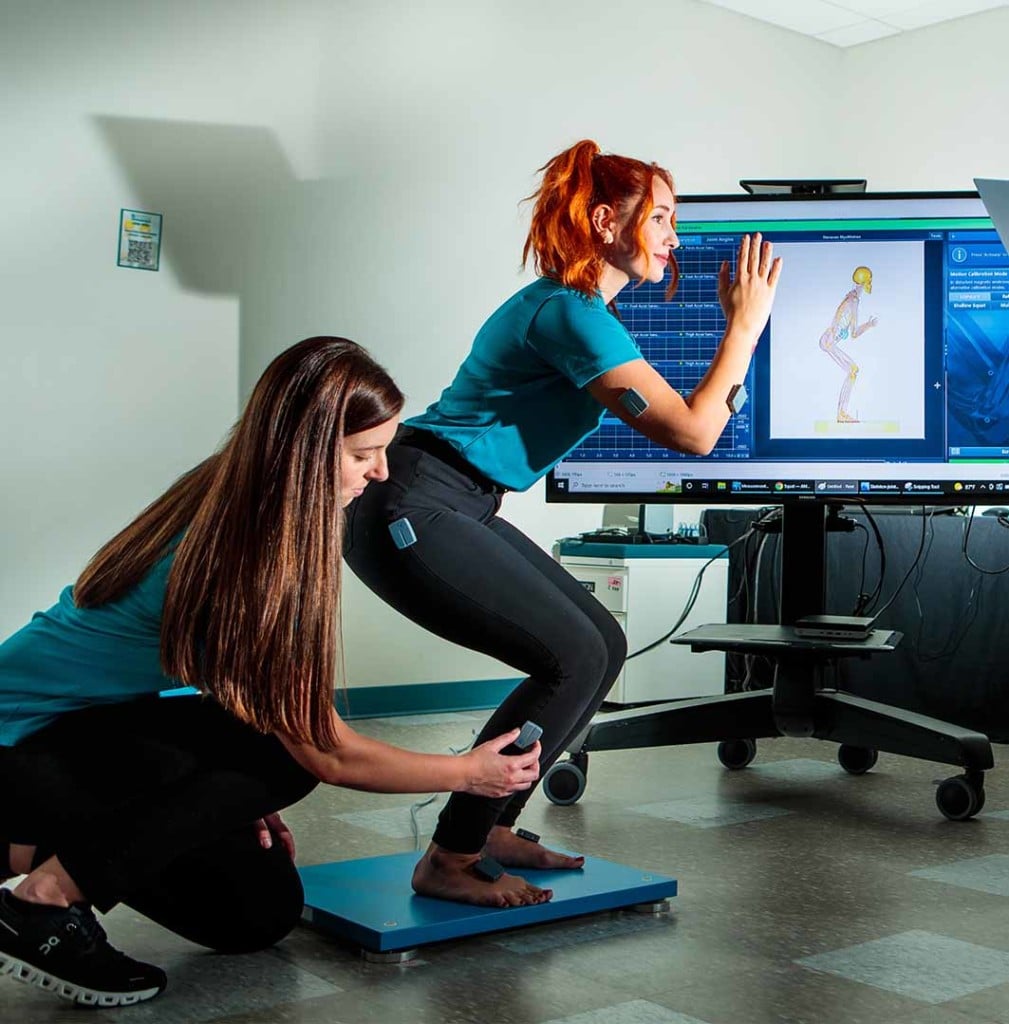
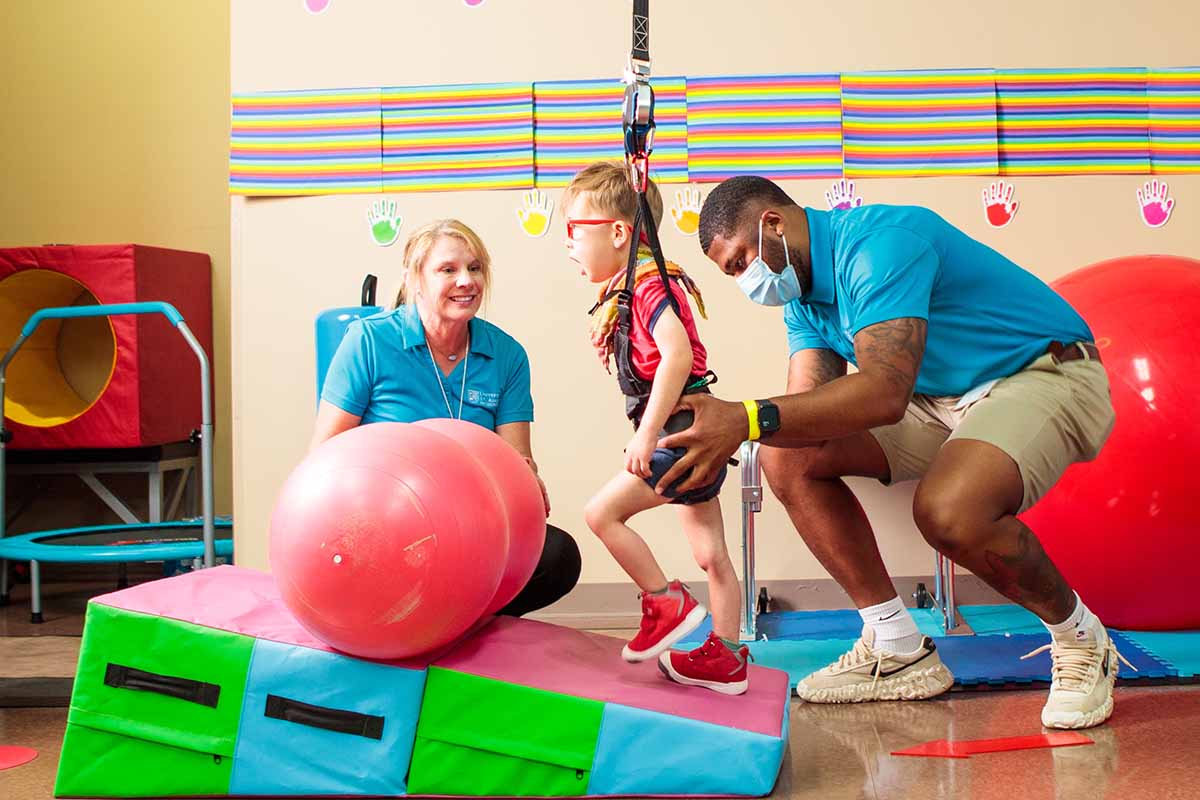
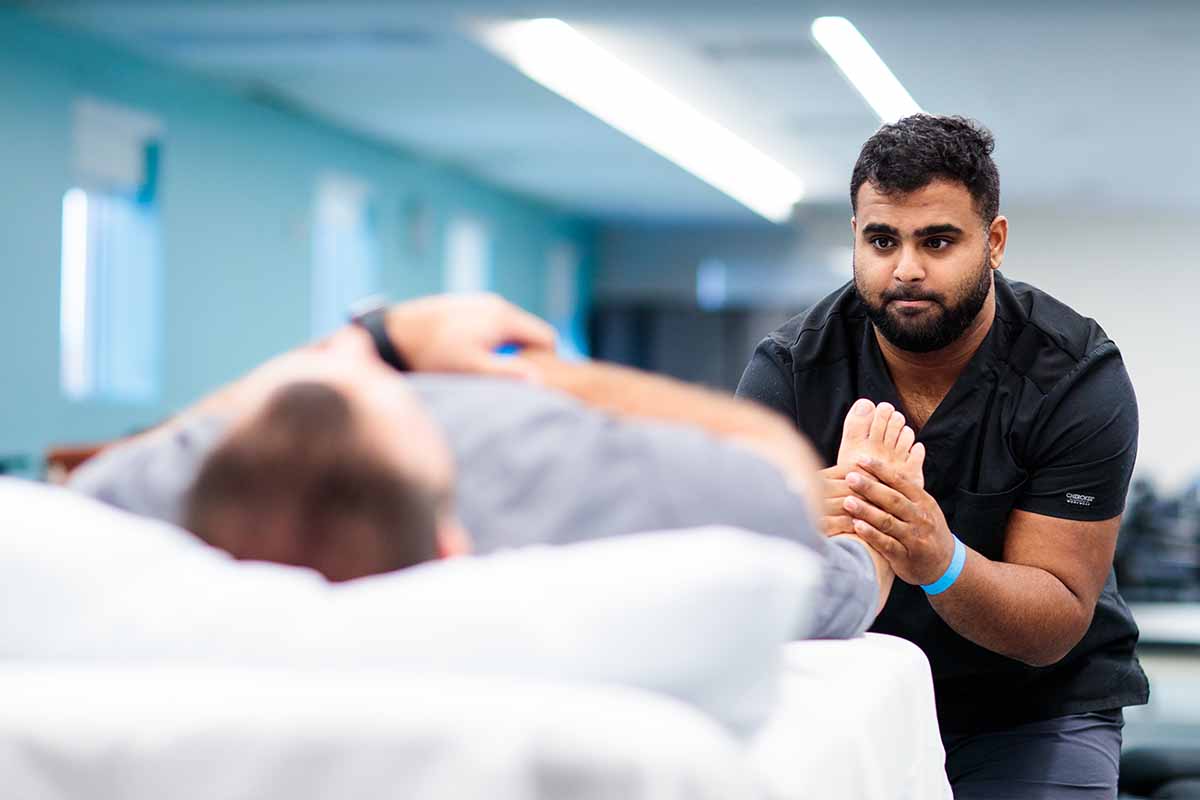
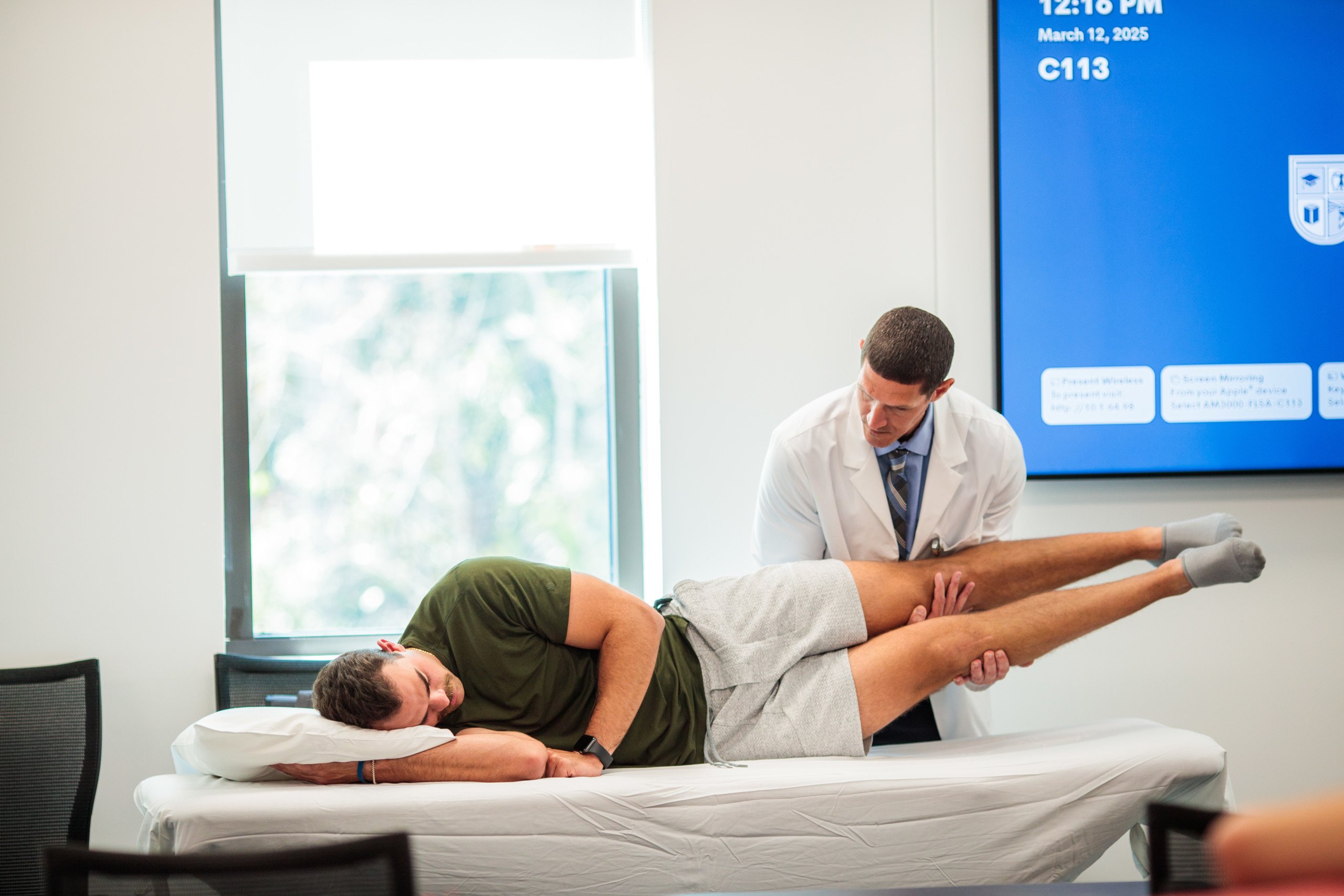
The DPT integrated curriculum is delivered in 7 trimesters for the Residential pathway and 9 trimesters for Flex. The Hybrid Immersion pathway will be delivered in 7 trimesters. Highlights include: innovative immersive lab experiences where students integrate and apply learnings from coursework to refine clinical skills, clinical simulations, pro bono clinical experiences and faculty mentoring. A newly designed Integrated Foundational Science course covers anatomy, physiology, neuroscience and biomechanics. Students can choose from electives in Sports Therapy, Neurology, Pelvic Health, Manual Therapy, and Business Leadership, enabling them to develop specialized skills and earn micro-credentials that enhance their career opportunities. For the Hybrid Immersion pathway, there are a total of 9 on-campus immersive learning experiences that will take place in trimesters 1-4. There are three on-campus learning experiences in trimester 1 and two on-campus learning experiences in trimesters 2, 3 and 4. For the Flex pathway, there are 7-9 on-campus immersive learning experiences each term that take place in trimesters 1-6.
Residential DPT (San Marcos, CA; St. Augustine and Miami, FL; Austin, TX; Dallas, TX) and
Hybrid Immersion DPT (San Marcos, CA; Miami, FL; Dallas, TX) Curriculum
| Courses | Hours | ||||||||||||||
|---|---|---|---|---|---|---|---|---|---|---|---|---|---|---|---|
| Curriculum – For Students Starting Fall 2025 and After | |||||||||||||||
| Effective with the start of the Summer 2026 Term, students complete 15-week courses (Term A) as well as 7.5-week courses occurring in the first part of the trimester (Subterm D) and in the second part of the trimester (Subterm E) with the exception of Trimester 3 in which all courses occur in Term A. | |||||||||||||||
| Trimester 1 | |||||||||||||||
| Term A | |||||||||||||||
PHT 5117C - Integrated Foundational SciencesThis course provides foundational knowledge of the development and integration of the anatomy, physiology, and biomechanics required for optimal human movement and function. This includes the interactions of cardiovascular, pulmonary, neurological, musculoskeletal, endocrine, gastrointestinal, genitourinary, reproductive, hematologic, lymphatic, immunologic, and integumentary systems and their influence on human movement and function. | 6 | ||||||||||||||
PHT 5161 - Professional Formation IThis course provides opportunities for students to develop the practical skills required for graduates to participate fully in professional life as a physical therapist. Students focus on the early development of skills in interprofessional collaboration, leadership, professional ethics, licensure, and scope of practice. The course also introduces the requirements of proper documentation in physical therapy practice. | 2 | ||||||||||||||
PHT 5162C - Health Promotion, Fitness, and WellnessThis course focuses on the foundational clinical skills required to select, perform, and interpret tests and measures in basic health, wellness, and fitness as well as to develop plans to address these areas across the lifespan. The physical therapist role in transforming society through health, fitness, and wellness is discussed. | 2 | ||||||||||||||
PHT 5166C - Integrated Clinical Lab IThis course integrates and applies the concepts presented in all concurrent coursework utilizing case-based scenarios in a hands-on environment. The learning activities focus on communication strategies, participation screening, tests & measures for healthy individuals, and exercise prescription for the promotion of health and wellness across the lifespan. Students participate in a clinically-based community learning activity that integrates learning during a patient/client experience. | 2 | ||||||||||||||
Subterm D
Subterm E
| |||||||||||||||
| Total Hours 18 | |||||||||||||||
| Trimester 2 | |||||||||||||||
| Term A | |||||||||||||||
PHT 5211C - Physical Therapy Tests and MeasuresThis course presents general examination principles with an emphasis on tests and measures utilized in physical therapy practice. The patient/client management model is incorporated into the examination process for accurate performance and interpretation of tests and measures.Prior to the Spring 2026 Term, course was Patient Examination I, which Residential and Hybrid Immersion students completed in Subterm D as a 7.5-week course and Flex students completed in Term A as a 15-week course. | 2 | ||||||||||||||
PHT 5222C - Physical Therapy Examination Across Clinical SettingsThis course expands on the information from Patient Examination I to apply elements of the patient examination across the lifespan and in a variety of clinical environments. Students learn to adapt, perform, and interpret appropriate tests and measures in acute care, intensive care units, home health, and long-term care hospitals. A lifespan approach is utilized throughout the course and in the various practice settings. Communication strategies for various practice settings are emphasized.Prior to the Spring 2026 Term, course was Patient Examination II, which Residential and Hybrid Immersion students completed in Subterm D as a 7.5-week course and Flex students completed in Term A as a 15-week course. | 2 | ||||||||||||||
PHT 5241 - Medical Screening and PathologyThis course provides foundational knowledge of common pathologies, congenital and developmental disorders, and oncological conditions that impact human movement and function through disease and dysfunctions of the musculoskeletal, neurological, hematologic, cardiovascular, pulmonary, gastrointestinal, hepatic and biliary, urogenital, endocrine and metabolic, and immunologic body systems. Emphasis is placed on the clinical detection of their presence through medical screening as part of the physical therapy examination. The use of imaging and the pharmacological management of these common conditions are introduced and integrated into the medical screening process. Screening for psychosocial factors and knowledge of the neurophysiological mechanisms of pain are introduced and integrated into the physical therapy examination process as well. Students will engage through case-based applications to develop the clinical knowledge and skills necessary to perform a medical screening that ensures safe and effective physical therapy practice. | 4 | ||||||||||||||
PHT 5262 - Professional Formation IIThis course provides opportunities for exploration of significant issues in physical therapy and healthcare and builds on the practical skills needed by graduates for full participation in professional life as introduced in Professional Formation I (or Professional Formation IA and IB). Acquisition of skills and knowledge in the focused areas of interprofessional collaboration, leadership, professional ethics, licensure, and scope of practice are documented in a professional portfolio.Professional formation seminar is a required component of each professional formation course, providing time for discussion, expansion of exposure, and engagement in topics of professionalism in Physical Therapist practice. It is intended to provide exposure to outside experts and provide time for additional development of professional interaction skills. Participation is a professional expectation of the program required for graduation. | 1 | ||||||||||||||
PHT 5266C - Integrated Clinical Lab IIThis course integrates the concepts presented in all simultaneous coursework utilizing cases in a hands-on environment. The learning activities focus on the patient examination process using the patient management model. Movement and task analysis are incorporated into the examination process. Exercise principles are applied to treatment plans for exercise-based programs. Students participate in a clinically-based community learning activity that integrates prior learning during a patient/client experience. | 2 | ||||||||||||||
Subterm D
Subterm E
| |||||||||||||||
| Total Hours 19 | |||||||||||||||
| Trimester 3 | |||||||||||||||
| Term A | |||||||||||||||
PHT 5303 - IntegumentaryThis course applies knowledge of anatomy, physiology, and pathophysiology to the examination, evaluation, and delivery of interventions for patients with integumentary and lymphatic pathologies. | 1 | ||||||||||||||
PHT 5311C - Neuromuscular Physical Therapy IThis course provides the learner with the foundational clinical knowledge and skills necessary for the physical therapy management of individuals with neuromuscular conditions, including those that result in deficits of the cerebral cortex, basal ganglia, cerebellum, and demyelination of the central and peripheral nervous systems. The Physical Therapist Management Process from the Guide to Physical Therapy Practice and the International Classification of Function, Disability, and Health (ICF) Framework are integrated with task analysis and the principles of neuroplasticity to inform safe, effective, and evidence-based clinical reasoning and decision-making in the physical therapy care of diverse patient populations with these neurological conditions in a variety of practice settings. | 4 | ||||||||||||||
PHT 5321C - Orthopedic Physical Therapy IThis course provides the learner with the foundational clinical knowledge and skills necessary for the physical therapy management of individuals of diverse patient/client populations with musculoskeletal conditions (both surgical and non-surgical) of the craniomandibular, cervicothoracic spine, rib cage, shoulder, elbow, wrist, and hand in a variety of practice settings. The Physical Therapist Management Process from the Guide to Physical Therapy Practice and the International Classification of Function, Disability, and Health (ICF) Framework are integrated with the principles of evidence-based practice to inform safe and effective clinical reasoning and decision-making. Learners refine their ability to differentially diagnose, screen for conditions that may warrant a referral to other healthcare practitioners, and provide effective orthopedic care through case-based applications. | 4 | ||||||||||||||
PHT 5332C - Cardiovascular and Pulmonary Physical TherapyThis course builds on prerequisite knowledge of anatomy, physiology, and exercise science to provide learners with the foundational clinical knowledge and skills necessary for the prevention, screening, and physical therapy management of cardiovascular and pulmonary conditions for individuals across the continuum of care. The Physical Therapist Management Process from the Guide to Physical Therapy Practice and the International Classification of Function, Disability, and Health (ICF) Framework are integrated with the principles of evidence-based practice to inform safe and effective clinical reasoning and decision-making. Students apply their learning through case-based applications and clinical simulation experiences. | 4 | ||||||||||||||
PHT 5342 - Clinical Reasoning & Decision Making IThis course expands on foundational concepts of critical thinking and clinical reasoning by incorporating systems thinking, dialectical thinking, and metacognitive and reflective practices into the clinical decision-making process. Learners apply these concepts and critical thinking strategies to the management of patient cases that include individuals with a musculoskeletal, neurological, or cardiovascular condition and reflect on their clinical decision making throughout the physical therapist management process to further develop skills for adaptive expertise. Principles of evidence-based practice are incorporated into the clinical decision-making processes. | 1 | ||||||||||||||
PHT 5363 - Professional Formation IIIThe core values of professionalism and leadership are expanded upon to emphasize the importance of patient advocacy and ethical and legal responsibilities of documentation and billing. | 1 | ||||||||||||||
PHT 5366C - Integrated Clinical Lab IIIThis course integrates the concepts presented in all simultaneous coursework, utilizing cases in a hands-on environment. The learning activities focus on the interventions for the patient with multisystem involvement. The clinical cases utilized within the integrated lab are explored further in the concurrent Clinical Reasoning and Decision-Making I course. Students are expected to integrate their knowledge and skills from previous courses when engaging in the patient/client examination, evaluation, determining a physical therapy diagnosis, prognosis, plan of care, and intervention strategies consistent with evidence-based clinical decision making. Students participate in a clinically-based community learning activity that integrates prior learning during a patient/client experience. | 2 | ||||||||||||||
| Total Hours 17 | |||||||||||||||
| Trimester 4 | |||||||||||||||
| Term A | |||||||||||||||
PHT 5403C - Orthopedic Physical Therapy IIThis course provides the learner with the foundational clinical knowledge and skills necessary for the physical therapy management of individuals of diverse patient/client populations with musculoskeletal conditions (both surgical and non-surgical) of lumbopelvic spine, hip, knee, ankle, and foot in a variety of practice settings. The Physical Therapist Management Process from the Guide to Physical Therapy Practice and the International Classification of Function, Disability, and Health (ICF) Framework are integrated with the principles of evidence-based practice to inform safe and effective clinical reasoning and decision-making. Learners refine their ability to differentially diagnose, screen for conditions that may warrant a referral to other healthcare practitioners, and provide effective orthopedic care through case-based applications. | 4 | ||||||||||||||
PHT 5423C - Neuromuscular Physical Therapy IIThis course expands on the neuropathology and diagnosis-specific physical therapy management for individuals with common neurological conditions, including impairments of the cerebral cortex, basal ganglia, cerebellum, spinal cord, and vestibular system; cortical deficits related to concussion; adult developmental disorders; and other rare neurologic health conditions. The Physical Therapist Management Process from the Guide to Physical Therapy Practice and the International Classification of Function, Disability, and Health (ICF) Framework are integrated with the principles of evidence-based practice to inform safe and effective clinical reasoning and decision-making in the physical therapy care of diverse patient populations with these neurological conditions in a variety of practice settings. | 4 | ||||||||||||||
PHT 5442 - Clinical Reasoning and Decision Making IIThis course expands on the foundational concepts of critical thinking and clinical reasoning by incorporating collaborative decision-making, self-assessment within the master adaptive learning process, critical appraisal of literature for evidence-based practice, and systems thinking to address social and structural determinants of health beyond the level of the individual. Learners apply these concepts to the management of patient cases across various clinical settings that include individuals with an acute, musculoskeletal, or neurological condition. Learners reflect on their clinical decision-making throughout the physical therapist management process to further develop skills for adaptive expertise. | 1 | ||||||||||||||
PHT 5464 - Professional Formation IVIn this course, students prepare for their professional career through exploration of employability skills, identifying and evaluating potential employment opportunities, and leadership of communities and organizations through professional advocacy. Communication skills are further cultivated to foster successful interactions with future employers and colleagues. Students engage with a professional mentor and reflect on the impact of that mentorship for professional identify formation. | 1 | ||||||||||||||
PHT 5466C - Integrated Clinical Lab IVThis course integrates the concepts presented in all simultaneous coursework utilizing cases in a hands-on environment. The learning activities focus on the examinations and interventions for patients across the lifespan including those with orthotic and prosthetic considerations. The clinical cases utilized within the integrated lab are explored further in the concurrent clinical reasoning and decision-making course. Students are expected to integrate their knowledge and skills from previous classes when engaging in the patient/client examination, evaluation, determining a physical therapy diagnosis, prognosis, plan of care, and intervention strategies consistent with evidence-based clinical decision making. Students participate in a clinically-based community learning activity that integrates prior learning during a patient/client experience. | 2 | ||||||||||||||
Subterm D
Subterm E
| |||||||||||||||
| Total Hours 20 | |||||||||||||||
| Trimester 5 | |||||||||||||||
| Term A | |||||||||||||||
PHT 5540 - Terminal Clinical IThis course is the first 12-week, full-time terminal clinical experience in which the student begins to apply didactic knowledge, professional practice skills, and patient management skills in the clinical setting under the direct supervision of a licensed physical therapist. | 10 | ||||||||||||||
Subterm D
| |||||||||||||||
| Total Hours 12 | |||||||||||||||
| Trimester 6 | |||||||||||||||
| Term A | |||||||||||||||
PHT 5640 - Terminal Clinical IIThis is a 10-week, full-time terminal clinical experience in which students apply physical therapy knowledge and skills in a clinical setting under the direct supervision of a licensed physical therapist to progress toward entry-level professional practice and patient management. | 8 | ||||||||||||||
Subterm E
| |||||||||||||||
| Total Hours 12 | |||||||||||||||
| Trimester 7 | |||||||||||||||
| Term A | |||||||||||||||
PHT 5740 - Terminal Clinical IIIThis course is a 10-week, full-time terminal clinical experience in which students apply physical therapy knowledge and skills in a clinical setting under the direct supervision of a licensed physical therapist to progress toward entry-level professional practice and patient management. | 8 | ||||||||||||||
Subterm E
| |||||||||||||||
| Total Hours 12 | |||||||||||||||
| Degree Credit Hours 110 | |||||||||||||||
**Note – Students are required to take 1 elective course in Trimester 6 and 2 elective courses in Trimester 7; elective offerings will cover topics in Sports Therapy, Neurology, Pelvic Health, Manual Therapy, and Business Leadership.
Flex DPT (San Marcos, CA; St. Augustine, FL and Austin, TX) Curriculum
| Courses | Hours | ||||||||||||||
|---|---|---|---|---|---|---|---|---|---|---|---|---|---|---|---|
| Curriculum – For Students Starting Summer 2025 and After | |||||||||||||||
| Effective with the start of the Summer 2026 Term, students complete 15-week courses (Term A) as well as 7.5-week courses occurring in the first part of the trimester (Subterm D) and in the second part of the trimester (Subterm E) with the exception of Trimester 5 in which all courses occur in Term A. | |||||||||||||||
| Trimester 1 | |||||||||||||||
| Term A | |||||||||||||||
PHT 5117C - Integrated Foundational SciencesThis course provides foundational knowledge of the development and integration of the anatomy, physiology, and biomechanics required for optimal human movement and function. This includes the interactions of cardiovascular, pulmonary, neurological, musculoskeletal, endocrine, gastrointestinal, genitourinary, reproductive, hematologic, lymphatic, immunologic, and integumentary systems and their influence on human movement and function. | 6 | ||||||||||||||
PHT 5161 - Professional Formation IThis course provides opportunities for students to develop the practical skills required for graduates to participate fully in professional life as a physical therapist. Students focus on the early development of skills in interprofessional collaboration, leadership, professional ethics, licensure, and scope of practice. The course also introduces the requirements of proper documentation in physical therapy practice. | 2 | ||||||||||||||
PHT 5162C - Health Promotion, Fitness, and WellnessThis course focuses on the foundational clinical skills required to select, perform, and interpret tests and measures in basic health, wellness, and fitness as well as to develop plans to address these areas across the lifespan. The physical therapist role in transforming society through health, fitness, and wellness is discussed. | 2 | ||||||||||||||
PHT 5164C - Integrated Clinical Lab I XThis course integrates and applies the concepts presented in all concurrent coursework, utilizing case-based scenarios in a hands-on environment. The learning activities focus on communication strategies, participation screening, tests and measures for healthy individuals, and exercise prescription for the promotion of health and wellness across the lifespan. Students participate in a clinically-based community learning activity that integrates learning during a patient/client experience. | 1 | ||||||||||||||
Subterm D
Subterm E
| |||||||||||||||
| Total Hours 14 | |||||||||||||||
| Trimester 2 | |||||||||||||||
| Term A | |||||||||||||||
PHT 5211C - Physical Therapy Tests and MeasuresThis course presents general examination principles with an emphasis on tests and measures utilized in physical therapy practice. The patient/client management model is incorporated into the examination process for accurate performance and interpretation of tests and measures.Prior to the Spring 2026 Term, course was Patient Examination I, which Residential and Hybrid Immersion students completed in Subterm D as a 7.5-week course and Flex students completed in Term A as a 15-week course. | 2 | ||||||||||||||
PHT 5237 - Medical Screening & Pathology IThis course provides foundational knowledge of pathologies that impact human movement/function with emphasis on the neurological, musculoskeletal, gastrointestinal, hepatic, and biliary systems. Psychosocial considerations and pain neurophysiological sciences are introduced and integrated into the system pathologies. Medical screening and pharmacological management are discussed within the presentation of each system. | 2 | ||||||||||||||
PHT 5264C - Integrated Clinical Lab II XThis course integrates the concepts presented in all simultaneous coursework utilizing cases in a hands-on environment with emphasis on social determinants of health. The learning activities focus on the patient examination process using the patient management model. Movement and task analysis are incorporated into the examination process. Exercise principles are applied to treatment plans for exercise-based programs. Students participate in a clinically-based community learning activity that integrates prior learning during a patient/client experience. | 2 | ||||||||||||||
Subterm D
Subterm E
| |||||||||||||||
| Total Hours 13 | |||||||||||||||
| Trimester 3 | |||||||||||||||
| Term A | |||||||||||||||
PHT 5222C - Physical Therapy Examination Across Clinical SettingsThis course expands on the information from Patient Examination I to apply elements of the patient examination across the lifespan and in a variety of clinical environments. Students learn to adapt, perform, and interpret appropriate tests and measures in acute care, intensive care units, home health, and long-term care hospitals. A lifespan approach is utilized throughout the course and in the various practice settings. Communication strategies for various practice settings are emphasized.Prior to the Spring 2026 Term, course was Patient Examination II, which Residential and Hybrid Immersion students completed in Subterm D as a 7.5-week course and Flex students completed in Term A as a 15-week course. | 2 | ||||||||||||||
PHT 5247 - Medical Screening & Pathology IIThis course provides foundational knowledge of pathologies that impact human movement/function with emphasis on the cardiovascular, pulmonary, hematological, urogenital, endocrine and metabolic, and immune systems. The implications of pain neurophysiological sciences are applied to different pathologies. Various oncologic conditions and the resultant sequelae are considered. Medical screening, imaging, and pharmacological management are discussed within the presentation of each system. | 2 | ||||||||||||||
PHT 5262 - Professional Formation IIThis course provides opportunities for exploration of significant issues in physical therapy and healthcare and builds on the practical skills needed by graduates for full participation in professional life as introduced in Professional Formation I (or Professional Formation IA and IB). Acquisition of skills and knowledge in the focused areas of interprofessional collaboration, leadership, professional ethics, licensure, and scope of practice are documented in a professional portfolio.Professional formation seminar is a required component of each professional formation course, providing time for discussion, expansion of exposure, and engagement in topics of professionalism in Physical Therapist practice. It is intended to provide exposure to outside experts and provide time for additional development of professional interaction skills. Participation is a professional expectation of the program required for graduation. | 1 | ||||||||||||||
PHT 5332C - Cardiovascular and Pulmonary Physical TherapyThis course builds on prerequisite knowledge of anatomy, physiology, and exercise science to provide learners with the foundational clinical knowledge and skills necessary for the prevention, screening, and physical therapy management of cardiovascular and pulmonary conditions for individuals across the continuum of care. The Physical Therapist Management Process from the Guide to Physical Therapy Practice and the International Classification of Function, Disability, and Health (ICF) Framework are integrated with the principles of evidence-based practice to inform safe and effective clinical reasoning and decision-making. Students apply their learning through case-based applications and clinical simulation experiences. | 4 | ||||||||||||||
PHT 5364C - Integrated Clinical Lab III XThis course integrates the concepts presented in all simultaneous coursework, utilizing cases in a hands-on environment. The learning activities focus on examinations and interventions for the patient with multisystem involvement with emphasis on the cardiovascular system in a variety of practice settings. Students are expected to integrate their knowledge and skills from previous courses when engaging in the patient/client examination, evaluation, diagnosis, prognosis, plan of care, and intervention strategies consistent with evidence-based clinical decision making. Students participate in a clinically-based community learning activity that integrates prior learning during a patient/client experience. | 2 | ||||||||||||||
Subterm D
Subterm E
| |||||||||||||||
| Total Hours 14 | |||||||||||||||
| Trimester 4 | |||||||||||||||
| Term A | |||||||||||||||
PHT 5311C - Neuromuscular Physical Therapy IThis course provides the learner with the foundational clinical knowledge and skills necessary for the physical therapy management of individuals with neuromuscular conditions, including those that result in deficits of the cerebral cortex, basal ganglia, cerebellum, and demyelination of the central and peripheral nervous systems. The Physical Therapist Management Process from the Guide to Physical Therapy Practice and the International Classification of Function, Disability, and Health (ICF) Framework are integrated with task analysis and the principles of neuroplasticity to inform safe, effective, and evidence-based clinical reasoning and decision-making in the physical therapy care of diverse patient populations with these neurological conditions in a variety of practice settings. | 4 | ||||||||||||||
PHT 5321C - Orthopedic Physical Therapy IThis course provides the learner with the foundational clinical knowledge and skills necessary for the physical therapy management of individuals of diverse patient/client populations with musculoskeletal conditions (both surgical and non-surgical) of the craniomandibular, cervicothoracic spine, rib cage, shoulder, elbow, wrist, and hand in a variety of practice settings. The Physical Therapist Management Process from the Guide to Physical Therapy Practice and the International Classification of Function, Disability, and Health (ICF) Framework are integrated with the principles of evidence-based practice to inform safe and effective clinical reasoning and decision-making. Learners refine their ability to differentially diagnose, screen for conditions that may warrant a referral to other healthcare practitioners, and provide effective orthopedic care through case-based applications. | 4 | ||||||||||||||
PHT 5342 - Clinical Reasoning & Decision Making IThis course expands on foundational concepts of critical thinking and clinical reasoning by incorporating systems thinking, dialectical thinking, and metacognitive and reflective practices into the clinical decision-making process. Learners apply these concepts and critical thinking strategies to the management of patient cases that include individuals with a musculoskeletal, neurological, or cardiovascular condition and reflect on their clinical decision making throughout the physical therapist management process to further develop skills for adaptive expertise. Principles of evidence-based practice are incorporated into the clinical decision-making processes. | 1 | ||||||||||||||
PHT 5467C - Integrated Clinical Lab IV XThis course integrates the concepts presented in all simultaneous coursework utilizing cases in a hands-on environment. The learning activities focus on the examinations and interventions for patients across the lifespan including those with orthotic and prosthetic considerations. The clinical cases utilized within the integrated lab are explored further in the concurrent clinical reasoning and decision-making course. Students are expected to integrate their knowledge and skills from previous classes when engaging in the patient/client examination, evaluation, determining a physical therapy diagnosis, prognosis, plan of care, and intervention strategies consistent with evidence-based clinical decision making. Students participate in a clinically-based community learning activity that integrates prior learning during a patient/client experience. | 1 | ||||||||||||||
Subterm D
| |||||||||||||||
| Total Hours 11 | |||||||||||||||
| Trimester 5 | |||||||||||||||
| Term A | |||||||||||||||
PHT 5303 - IntegumentaryThis course applies knowledge of anatomy, physiology, and pathophysiology to the examination, evaluation, and delivery of interventions for patients with integumentary and lymphatic pathologies. | 1 | ||||||||||||||
PHT 5363 - Professional Formation IIIThe core values of professionalism and leadership are expanded upon to emphasize the importance of patient advocacy and ethical and legal responsibilities of documentation and billing. | 1 | ||||||||||||||
PHT 5403C - Orthopedic Physical Therapy IIThis course provides the learner with the foundational clinical knowledge and skills necessary for the physical therapy management of individuals of diverse patient/client populations with musculoskeletal conditions (both surgical and non-surgical) of lumbopelvic spine, hip, knee, ankle, and foot in a variety of practice settings. The Physical Therapist Management Process from the Guide to Physical Therapy Practice and the International Classification of Function, Disability, and Health (ICF) Framework are integrated with the principles of evidence-based practice to inform safe and effective clinical reasoning and decision-making. Learners refine their ability to differentially diagnose, screen for conditions that may warrant a referral to other healthcare practitioners, and provide effective orthopedic care through case-based applications. | 4 | ||||||||||||||
PHT 5423C - Neuromuscular Physical Therapy IIThis course expands on the neuropathology and diagnosis-specific physical therapy management for individuals with common neurological conditions, including impairments of the cerebral cortex, basal ganglia, cerebellum, spinal cord, and vestibular system; cortical deficits related to concussion; adult developmental disorders; and other rare neurologic health conditions. The Physical Therapist Management Process from the Guide to Physical Therapy Practice and the International Classification of Function, Disability, and Health (ICF) Framework are integrated with the principles of evidence-based practice to inform safe and effective clinical reasoning and decision-making in the physical therapy care of diverse patient populations with these neurological conditions in a variety of practice settings. | 4 | ||||||||||||||
PHT 5442 - Clinical Reasoning and Decision Making IIThis course expands on the foundational concepts of critical thinking and clinical reasoning by incorporating collaborative decision-making, self-assessment within the master adaptive learning process, critical appraisal of literature for evidence-based practice, and systems thinking to address social and structural determinants of health beyond the level of the individual. Learners apply these concepts to the management of patient cases across various clinical settings that include individuals with an acute, musculoskeletal, or neurological condition. Learners reflect on their clinical decision-making throughout the physical therapist management process to further develop skills for adaptive expertise. | 1 | ||||||||||||||
PHT 5564C - Integrated Clinical Lab V XThis course integrates the concepts presented in all simultaneous coursework utilizing cases in a hands-on environment. The learning activities focus on the examinations and interventions for patients with multisystem involvement including the integumentary system. The clinical cases utilized within the integrated lab are explored further in the concurrent clinical reasoning and decision-making course. Students are expected to integrate their knowledge and skills from previous classes when engaging in the patient/client examination, evaluation, determining a physical therapy diagnosis, prognosis, plan of care and intervention strategies consistent with evidence-based, clinical decision making. Students participate in a clinically-based community learning activity that integrates prior learning during a patient/client experience. | 1 | ||||||||||||||
| Total Hours 12 | |||||||||||||||
| Trimester 6 | |||||||||||||||
| Term A | |||||||||||||||
PHT 5464 - Professional Formation IVIn this course, students prepare for their professional career through exploration of employability skills, identifying and evaluating potential employment opportunities, and leadership of communities and organizations through professional advocacy. Communication skills are further cultivated to foster successful interactions with future employers and colleagues. Students engage with a professional mentor and reflect on the impact of that mentorship for professional identify formation. | 1 | ||||||||||||||
PHT 5664C - Integrated Clinical Lab VI XThis course integrates the concepts presented in all simultaneous coursework utilizing cases in a hands-on environment. The learning activities focus on the examinations and interventions for patients across the lifespan including those with orthotic and prosthetic considerations. Students are expected to integrate their knowledge and skills from previous courses when engaging in the patient/client examination and evaluation and determining a physical therapy diagnosis, prognosis, plan of care, and intervention strategies consistent with evidence-based clinical decision making. Students participate in a clinically-based community learning activity that integrates prior learning during a patient/client experience. | 1 | ||||||||||||||
Subterm D
Subterm E
| |||||||||||||||
| Total Hours 10 | |||||||||||||||
| Trimester 7 | |||||||||||||||
| Term A | |||||||||||||||
PHT 5540 - Terminal Clinical IThis course is the first 12-week, full-time terminal clinical experience in which the student begins to apply didactic knowledge, professional practice skills, and patient management skills in the clinical setting under the direct supervision of a licensed physical therapist. | 10 | ||||||||||||||
Subterm D
| |||||||||||||||
| Total Hours 12 | |||||||||||||||
| Trimester 8 | |||||||||||||||
| Term A | |||||||||||||||
PHT 5640 - Terminal Clinical IIThis is a 10-week, full-time terminal clinical experience in which students apply physical therapy knowledge and skills in a clinical setting under the direct supervision of a licensed physical therapist to progress toward entry-level professional practice and patient management. | 8 | ||||||||||||||
Subterm E
| |||||||||||||||
| Total Hours 12 | |||||||||||||||
| Trimester 9 | |||||||||||||||
| Term A | |||||||||||||||
PHT 5740 - Terminal Clinical IIIThis course is a 10-week, full-time terminal clinical experience in which students apply physical therapy knowledge and skills in a clinical setting under the direct supervision of a licensed physical therapist to progress toward entry-level professional practice and patient management. | 8 | ||||||||||||||
Subterm E
| |||||||||||||||
| Total Hours 12 | |||||||||||||||
| Degree Credit Hours 110 | |||||||||||||||
**Note – Students are required to take 1 elective course in Trimester 8 and 2 elective courses in Trimester 9; elective offerings will cover topics in Sports Therapy, Neurology, Pelvic Health, Manual Therapy, and Business Leadership.