
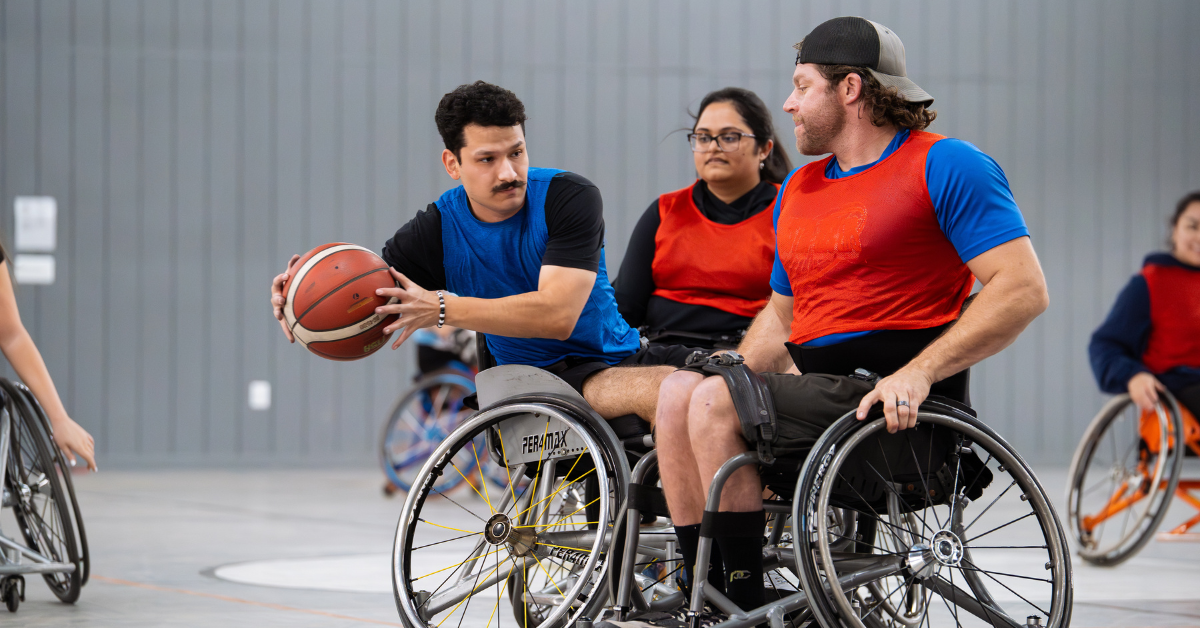
One afternoon in Austin, Texas, the squeak of rubber wheels replaced the familiar sound of sneakers on hardwood. Inside the gym, occupational therapy (OT) graduate students from the University of St. Augustine for Health Sciences (USAHS) Austin campus lined up in specialized sports wheelchairs, passing a basketball back and forth as they learned to maneuver, pivot and shoot, all while using only their upper bodies.
Within minutes, the competitive energy picked up. Laughter echoed across the court as students raced toward the hoop, discovering firsthand that wheelchair basketball is both exhilarating and far more physically demanding than it looks.
The OT Adaptive Sports Clinic is a hands-on learning experience built into the third-term OT assistive technology course led by Christopher Ebner, EdD, MS, OTR, USAHS assistant professor of OT programs at the Austin campus. Each term, new groups of students partner with the Austin nonprofit Lone Star Paralysis Foundation (LSPF) to explore how adaptive sports can transform rehabilitation and promote quality of life for people living with spinal cord injuries and other mobility challenges.
“Through the Adaptive Sports Clinic, our OT students are learning more about the utilization and impact adaptive sports can have in the lives of our clients,” Dr. Ebner shares.
Check out a video about the adaptive sports clinic.
Where rehabilitation meets recreation
LSPF works across the Austin community to support individuals living with spinal cord paralysis. Through funding research, offering therapy scholarships, sharing recovery resources and organizing adaptive sports and recreation programs, the organization helps individuals rebuild autonomy and stay active after life-changing injuries.
For Dr. Ebner, integrating that mission into the classroom creates a powerful learning moment. “I preach to students that adaptive sports are a rehab multiplier,” he explains. “All those things we work on collectively as OTs and physical therapists (PTs) on a day-to-day basis in a clinical environment, from strength and balance to endurance and coordination, those capabilities can be developed through lived experiences like adaptive sports.”
Rather than simply reading about adaptive equipment or rehabilitation strategies, students get into the chairs themselves. They learn how difficult it can be to turn, pass and move quickly across the court. They also see how meaningful recreation can become a motivator for clients during recovery.
“Learning about the opportunity to continue to play and engage in recreational activities such as these is huge,” Dr. Ebner advocates. “Hopefully, students take lessons like these into their clinical fieldwork and practice.”
Building empathy and advocacy through experience
For many students, the clinic is their first time playing a sport in a wheelchair.
Jordy Lopez, USAHS Doctor of Occupational Therapy (OTD) student, says the experience directly aligns with his personal interests. He loves watching football, basketball and golf. Lopez’s OTD Capstone project focuses on adaptive sports advocacy.
“Today was so much fun. There are a lot of barriers with adaptive sports that make it hard for someone with a spinal injury to get involved,” he says.
That realization is what drives his passion for the field. “I want to advocate for it,” Lopez explains. “I see the value in helping someone fulfill their needs and have a meaningful life by engaging in leisure activities.”
Getting on the court gave Lopez a new perspective. “It’s hard to maneuver in a wheelchair,” he says.
More importantly, the activity highlighted the role therapists can play in inspiring patients. “Making the client feel empowered, that’s something I learned during the game,” Lopez shares.
For USAHS Master of Occupational Therapy (MOT) student Riley Guzzino, the clinic reinforced the importance of empathy when working with future clients.
Using adaptive equipment helps people continue playing sports like basketball. “Understanding their journey and getting a feel for what they’re going through requires trying it for yourself,” Guzzino says.
Beyond the fun, the game facilitated connections with the adaptive sports community. “Being here and building relationships with individuals experiencing these challenges is really important for us,” Guzzino explains.
Community partnership in action
Helping to create the community link is Ryan Sproull, director of outdoor recreation for Lone Star Paralysis Foundation. The organization offers a wide range of adaptive activities designed to get people active and outdoors.
Weekly, LSPF does everything from archery and hand cycling to kayaking. They also coordinate several camping, paddling and hunting trips each year, with hunts for turkey, pigs, pheasants and deer. “We go outside to get people out of their comfort zone, build independence and enjoy everything that Mother Nature has to offer,” Sproull says.
What impact does Sproull see on the OT students? “It’s a great chance to work with OT students because they already understand disabilities. It’s nice to show them a different world of wheelchair basketball,” he says.
Sproull’s own journey with adaptive sports began after a life-changing injury in 2006.
“You can do all the rehab, but actually doing things by yourself outside the hospital setting is a different challenge,” he elaborates. “Adaptive sports opened my eyes to a different realm.”
Being surrounded by others with full, active lives helped shift his perspective, and that’s something he hopes students witness. “I want them to know that adaptive sports are important for a lot of our community,” Sproull explains. “It’s a big part of how we stay involved and maintain independence.”
Lessons that last beyond the court
As the basketball game wrapped up, students wheeled off the court with a new appreciation for the challenge and the joy of adaptive sports.
“Students are always a little apprehensive at first,” Sproull says. “Once they get up and down the court a couple of times, the competitiveness comes out. If a ball goes in the bucket, everyone cheers.”
Those moments help future therapists understand something essential: their role is more than helping patients regain function; it’s helping them rediscover possibility.
“Hopefully they’ll draw on this experience when they’re working hands-on with patients,” Sproull reflects. “Challenge them. Empower them. Show them they’re capable.”
For Dr. Ebner, that’s exactly the outcome the program hopes to achieve. “I’m sure students saw the impact this experience can have,” he says. “Hopefully they’ll carry that forward into their clinical practice and into the lives of the clients they serve.”
Learn more about Lone Star Paralysis Foundation and how to join an upcoming adaptive sports event at https://www.lonestarparalysis.org/adapted-sports.