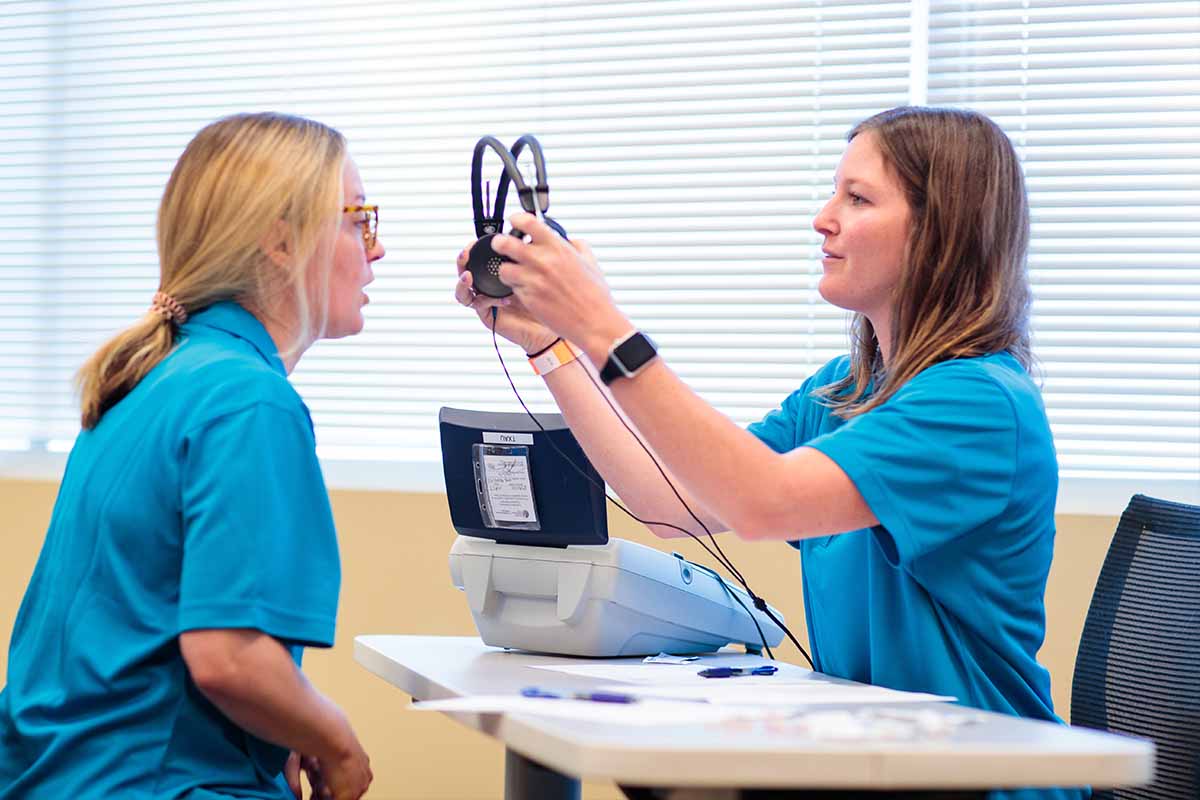
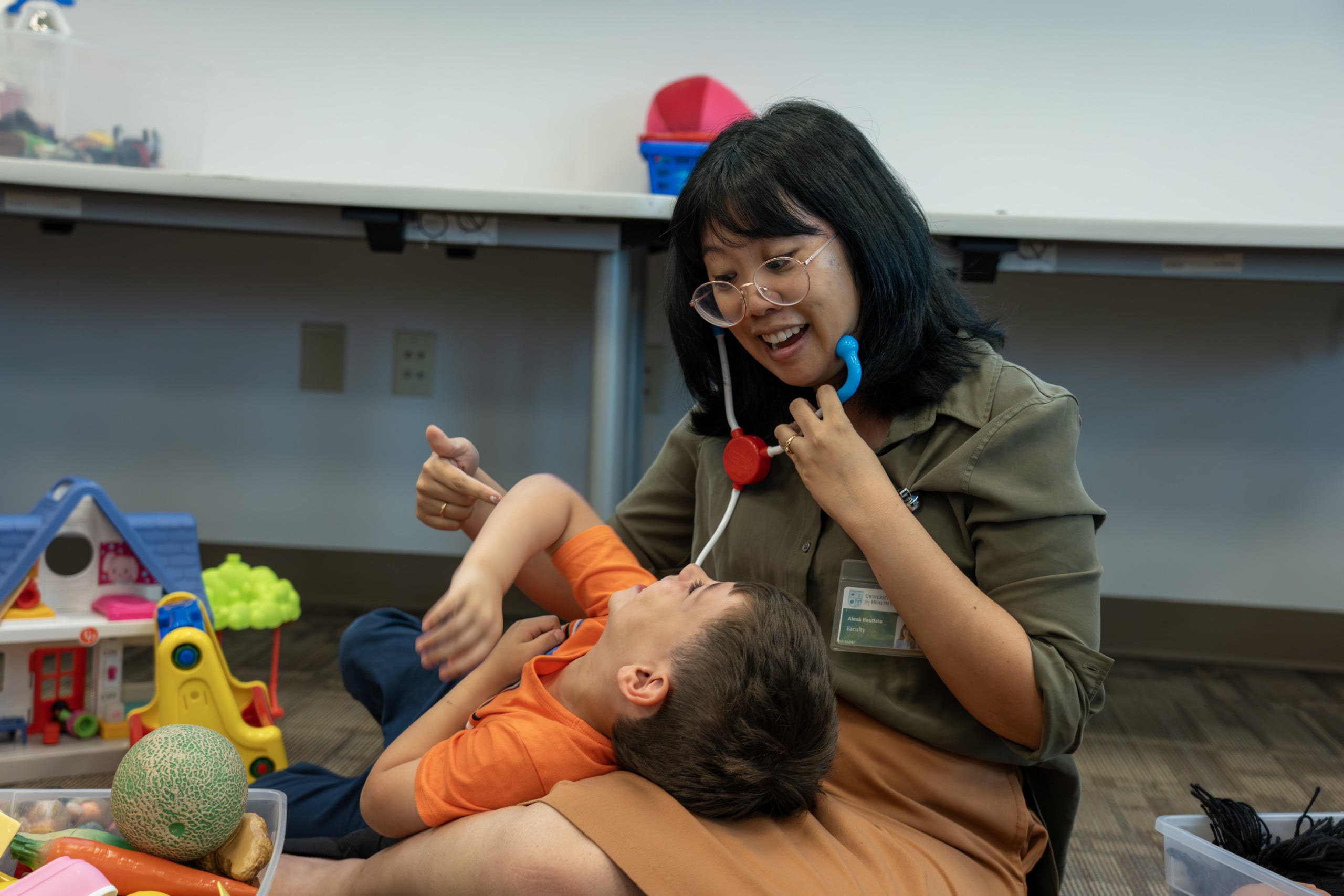
A pediatric speech pathologist, also known as a pediatric speech-language pathologist (SLP), is a licensed healthcare professional who works with children and teenagers who experience communication, feeding or swallowing challenges. Pediatric SLPs support children with speech disorders, language delays, fluency issues and voice concerns in clinical and educational settings.1
This career path may be for you if you enjoy working with children and are ready to complete the required education, clinical training, certification and licensure. We’ll discuss each step to becoming a pediatric speech pathologist, and how the University of St. Augustine for Health Sciences’ (USAHS) Master of Science in Speech-Language Pathology (MS-SLP) program can help you launch your journey.
Earn a Bachelor’s Degree and Build a Pediatric-Friendly Foundation
To become a licensed SLP, you must complete graduate-level education in speech-language pathology. According to the American Speech-Language-Hearing Association (ASHA), applicants for certification must hold a post-baccalaureate degree, typically at least a master’s degree, in speech-language pathology, supported by appropriate undergraduate preparation.2,3
Choosing an Undergraduate Major
At USAHS, you must earn a bachelor’s degree from an accredited institution to apply to the MS-SLP program. While a bachelor’s degree in communication sciences and disorders (CSD) or speech-language pathology is preferred, it is not required for admission to our MS-SLP graduate program. Applicants with a science degree in a field outside of speech-language pathology may need to complete prerequisite coursework before applying.
Prerequisite Coursework
To apply to the USAHS MS-SLP program, you must complete or have completed ASHA basic courses and prerequisite leveling speech-language pathology courses.
ASHA basic speech pathology prerequisite course requirements (minimum 3 credits each) for all applicants include:
- Biology
- Chemistry or physics
- Statistics
- Behavioral or social science
If you discovered speech-language pathology later in your academic journey, that’s okay. Many graduate programs, including USAHS, offer SLP leveling courses designed to get you up to date before entering the MS-SLP program.
Complete a CAA-Accredited Master’s in Speech-Language Pathology
ASHA requires all graduate academic and clinical coursework used toward certification be completed in a program accredited by the Council on Academic Accreditation in Audiology and Speech-Language Pathology (CAA) or one holding candidacy status.4
CAA accreditation ensures that programs meet rigorous standards for curriculum, faculty qualifications and clinical education across the lifespan.3
USAHS MS-SLP
Ready to pursue the education you need to become a pediatric SLP? Designed to prepare graduates for professional practice across a variety of settings, including pediatric environments, USAHS’ MS-SLP program makes getting a higher education accessible to you.
USAHS MS-SLP features include:
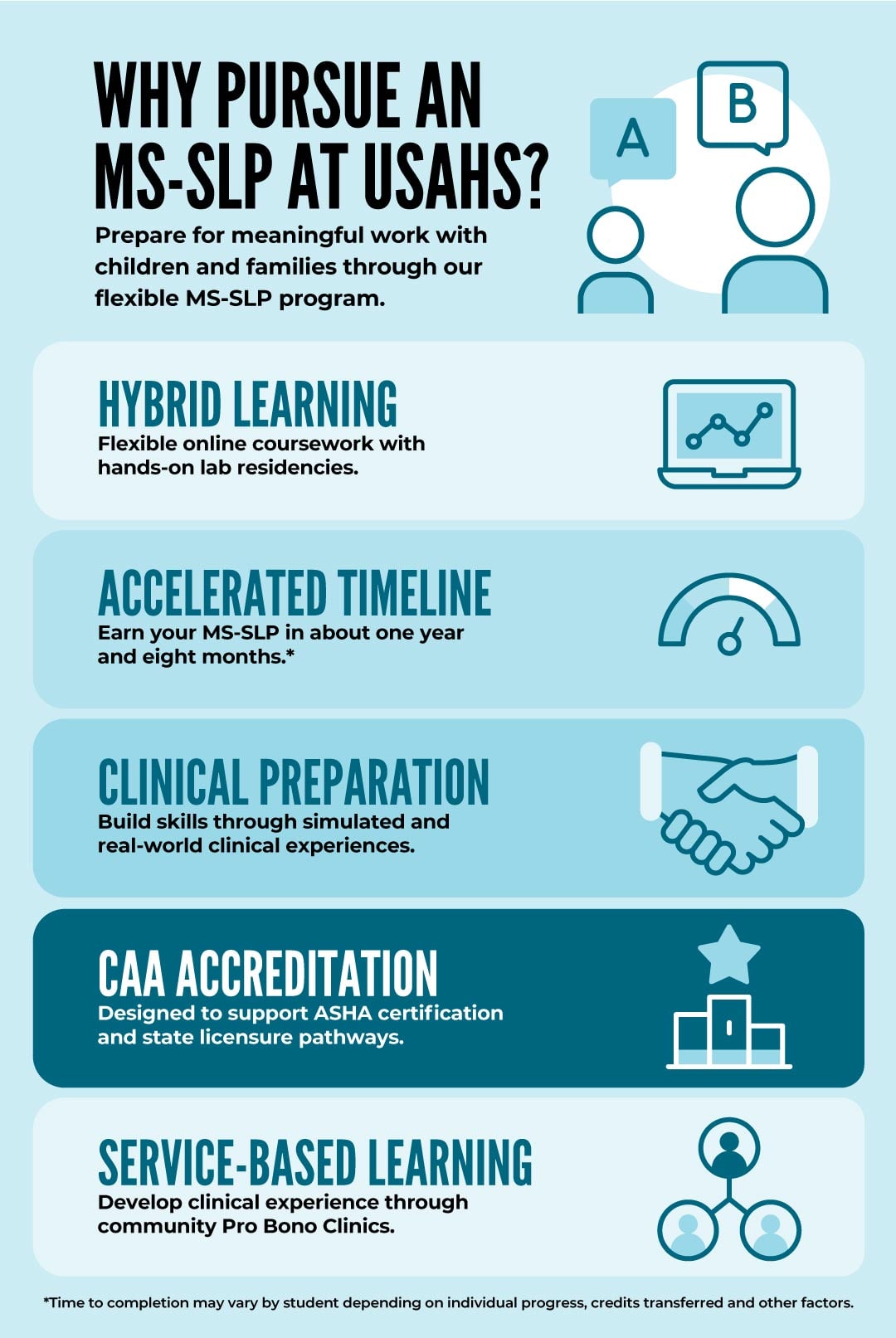
- A hybrid format. Students move through our program with a flexible blend of online coursework and select live weekday sessions, paired with hands-on training during three-day on-campus lab residencies each trimester in the first four terms.
- An accelerated design. The program is designed to be completed in about five trimesters, approximately one year and eight months.*
- Clinical preparation. You’ll gain experience in simulated and real clinical environments, including telepractice and the use of advanced clinical tools.
- Our MS-SLP program holds CAA accreditation, allowing graduates to pursue ASHA certification and state licensure.
At USAHS, we also emphasize service-based learning. Through our speech-language pathology Pro Bono Clinics, students can provide supervised teletherapy services to individuals and families in the community while developing their clinical skills. While pediatric placements are sometimes available through these experiences, working with children during training is not guaranteed.
Complete a Graduate Clinical Practicum
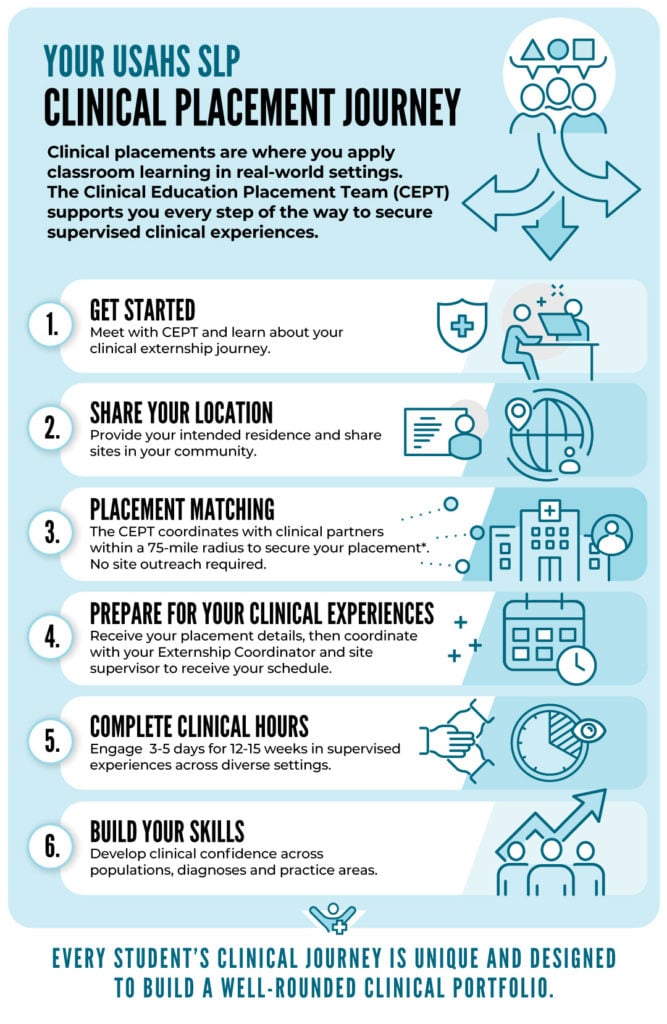
At USAHS, part of your pediatric speech pathology journey will include clinical training. You will engage in clinical practica, virtually and in person, with populations of all ages as you work toward earning 400 clinical clock hours.
Pediatric Clinical Experience
USAHS MS-SLP students engage in supervised clinical practica with clients of various ages and communication needs. In some cases, students may work with pediatric populations through community-based placements or the Pro Bono Clinics while progressing toward required clinical hours. Availability of pediatric placements can vary by location and term.
Pass the Praxis® Exam in Speech-Language Pathology
As part of the ASHA certification process, candidates must pass the Praxis Examination in Speech-Language Pathology (5331).5 This national exam checks your knowledge and skills across important areas of speech-language pathology practice.
ASHA currently requires a passing score of 162 on a 100-200 scale for certification purposes. Depending on the state in which you practice, there might be additional requirements or higher standards.
If the thought of passing a national exam overwhelms you, don’t worry. Many graduate programs, including the MS-SLP path at USAHS, integrate Praxis preparation into coursework and academic advising to help students feel prepared to sit for the exam.
Complete a Clinical Fellowship (CF)
After earning a master’s degree, aspiring pediatric SLPs must complete a Clinical Fellowship (CF).6
According to ASHA, the CF allows new graduates to:
- Apply academic knowledge in real-world practice
- Refine clinical skills and professional judgment
- Transition from close supervision to more independent practice
Clinical Fellowship Requirements
ASHA guidelines usually require:
- At least 36 weeks and 1,260 hours to meet the ASHA CF experience requirement
- Ongoing mentorship from a qualified speech-language pathologist
Many states and employers follow ASHA’s CF framework, though exact requirements may vary by state.
Obtain State Licensure and ASHA CCC-SLP
State Licensure
All states require speech-language pathologists to be licensed. Requirements vary by state, but licensure usually includes:7
- A graduate degree in speech-language pathology
- Completion of supervised clinical hours
- A passing Praxis exam score
- Completion of a clinical fellowship
If you plan to work in the school system, double-check with your state to find out if additional credentials are required.
ASHA Certificate of Clinical Competence in Speech-Language Pathology (CCC-SLP)
The Certificate of Clinical Competence in Speech-Language Pathology (CCC-SLP) is widely recognized as the profession’s gold-standard credential. To earn it, you must meet all ASHA requirements, including:8
- A master’s degree from a CAA-accredited program
- Completion of required clinical hours
- A passing Praxis score
- Successful completion of the Clinical Fellowship
It’s not legally required in every state, but the CCC-SLP is commonly expected by employers and may help you out substantially in your career goals.
Speech-Language Pathologist Work Settings
Once you know how to become a pediatric speech pathologist, you can explore pediatric speech pathologist career opportunities. As a speech-language pathologist, you may work in a variety of environments.
Common work settings include:9
- Public and private schools
- Hospitals
- Offices of physical, occupational and speech therapists, and audiologists
- Nursing and residential care facilities
According to the U.S. Bureau of Labor Statistics (BLS), speech-language pathologists work across healthcare and educational environments, with a wide range of responsibilities.9
Pediatric Speech Pathologist Salary
Salary for pediatric speech pathologists can vary based on different factors, like location, work setting and experience. Payscale reports that the average annual salary for pediatric speech-language pathologists is $73,402.**†10
Start Your Journey with USAHS
Becoming a pediatric speech pathologist involves academic study, hands-on clinical training and professional growth. If you’re drawn to working with children and supporting communication development, the journey can be a rewarding one.
The Master of Science in Speech-Language Pathology (MS-SLP) program at USAHS is designed to support you as you develop the clinical skills, knowledge and confidence for professional practice across the lifespan, including with pediatric populations.
*Time to completion may vary by student depending on individual progress, credits transferred and other factors.
**The information provided on this website is based on self-reported data and is intended for general informational purposes only. PayScale is a limited data source that relies on voluntary submissions from individuals and employers. Please be aware that the accuracy, completeness, and reliability of the data may vary due to its voluntary nature and limited scope. While efforts are made to maintain the data’s accuracy, we cannot guarantee its absolute correctness or currency.
†This data represents national figures, is not based on school-specific data, and represents national median annual wages, not starting pay for recent grads. Conditions in your area may vary. USAHS does not guarantee salary levels.
FAQs
How long does it take to become a pediatric speech pathologist?
The timeline varies, but most individuals complete a bachelor’s degree, a master’s program in speech-language pathology and a clinical fellowship and licensure requirements. This process often takes several years from start to finish.
Do I need a special pediatric degree to work with children?
No. Pediatric speech pathologists usually earn a Master of Science in Speech-Language Pathology (MS-SLP) and gain pediatric experience through clinical training, fellowships and professional practice.
Is an ASHA CCC-SLP required to work as a pediatric SLP?
Requirements vary by employer and state. It’s not always legally required; however, the CCC-SLP is widely recognized and often preferred or expected in pediatric speech-language pathology roles.
References:
- “Pediatric Speech-Language Pathologist Career Guide | Education, Skills, and Career Outlook,” Healthcare Careers, 2026,https://healthcarecareer.org/speech-therapy/pediatric-speech-language-pathologist.
- “Certification Standards for Speech-Language Pathology Frequently Asked Questions: Implementation Date and Degree/Accreditation Requirement y,” The American Speech-Language-Hearing Association (ASHA), 2026, https://www.asha.org/Certification/Certification-Standards-for-SLP-Implementation-Date-and-Degree-or-Accreditation-Requirement/.
- “Standards for Accreditation of Graduate Education Programs in Audiology and Speech-Language Pathology,” The Council on Academic Accreditation in Audiology and Speech-Language Pathology (CAA), October 2025, https://caa.asha.org/siteassets/files/accreditation-standards-for-graduate-programs.pdf.
- “Committed to Quality,” The Council on Academic Accreditation in Audiology and Speech-Language Pathology (CAA), 2026, https://caa.asha.org/.
- American Speech-Language-Hearing Association. “Speech-Language Pathology Praxis Exam.” https://www.asha.org/Certification/praxis/About-the-Speech-Language-Pathology-Praxis-Exam.
- “A Guide to the ASHA Clinical Fellowship Experience,” The American Speech-Language-Hearing Association (ASHA), 2026, https://www.asha.org/certification/clinical-fellowship.
- “Occupational Outlook Handbook: Speech-Language Pathologists: How To Become One,” The U.S. Bureau of Labor Statistics (BLS), August 28, 2025, https://www.bls.gov/ooh/healthcare/speech-language-pathologists.htm#tab-4.
- “Apply for Certification in Speech-Language Pathology,” The American Speech-Language-Hearing Association (ASHA), 2026, https://www.asha.org/certification/SLPCertification/.
- “Occupational Outlook Handbook: Speech-Language Pathologists,” U.S. Bureau of Labor Statistics (BLS), August 28, 2025, https://www.bls.gov/ooh/healthcare/speech-language-pathologists.htm.
- “Average Pediatric Speech-Language Pathologist Salary,” Payscale, 2026, https://www.payscale.com/research/US/Job=Pediatric_Speech-Language_Pathologist/Salary.