

Occupational therapy (OT) shadowing is when students observe licensed occupational therapists (OTs), who may also hold the title of registered/licensed (OTR/L), as they evaluate, treat and document client care. In some cases, a student may shadow an occupational therapy assistant (OTA). Shadowing reveals what OT looks like in action, outside of a program page or job description.1
One of the best things about occupational therapy is its broad scope, and real-world observation is one of the best ways to experience that firsthand. From acute care to pediatric occupational therapy, OT shadowing opportunities can allow for deeper insight.
Observation hours can also play a role in the application process. Some Master of Occupational Therapy (MOT) and Doctor of Occupational Therapy (OTD) programs require them, ensuring applicants have a grounded understanding of what OTs do across different settings and populations. Others strongly recommend the experience even when it isn’t mandatory. Either way, the time you spend observing before you apply is time well invested.1
At the University of St. Augustine for Health Sciences (USAHS), we don’t require observation hours for admission to OT graduate-level programs, though they are recommended. Shadowing can help you make a more informed decision about which path you want to take.
The Importance of Occupational Therapy Shadowing Opportunities
OT shadowing provides context. Reading about OT can tell you the profession helps with participation, independence and quality of life. Observing it can show you how. You’ll begin to see how OTs break down daily routines, identify barriers and plan interventions around the activities that matter most to their clients.
You may observe how OTs help with participation in school or work and help clients build or regain skills that affect their everyday life. Shadowing can also help you decide if OT is the right fit for you. Earning a degree takes time, money and energy. Before committing to anything, it helps to know whether the profession matches your interests, working style and long-term goals. Observing professional OTs may help make that decision feel less overwhelming.
Observation hours can be one of the most valuable steps you take on your path to becoming an occupational therapist, even if they aren’t a formal requirement. While USAHS doesn’t require observation hours for admission to our graduate-level OT programs, we strongly recommend that applicants observe OT practice in at least two different settings.
What Counts as OT Shadowing?
OT shadowing is a structured observation of OT services under the supervision of a licensed OT or OTA.1 This may include evaluations, interventions, documentation processes and team conversations, depending on site rules and privacy limitations.
You aren’t just around OT, you’re intentionally observing OT practice. Programs that require observation hours want exposure that helps you understand the profession itself, not just general healthcare volunteering.
Potential shadowing sites include hospitals, clinics, and school-based OT settings that employ OT practitioners.1
You may also wonder whether observation under an OTA counts. In some cases, yes, especially when the site structures the experience appropriately. However, requirements vary across programs, so be sure to check the admissions pages before assuming a setting or supervisor type will meet a program’s expectations.1
Ideal Hours of OT Shadowing
There is no universal minimum for OT shadowing. Some programs require applicants to document a set number of hours, while others do not. There are also programs, like USAHS’, that don’t require observation hours but recommend related experience through volunteer work, healthcare roles or direct exposure to OT practice. Because of this, it’s important to review the expectations of the specific program you’re applying to.
If you’re applying to USAHS, observation hours aren’t required for MOT or OTD program admission, but experience with OT through shadowing, work or volunteer roles is recommended.
How Can I Find Occupational Therapy Shadowing Near Me?
Finding OT shadowing can feel intimidating at first, mostly because many students are unsure of who to contact or how formal the process should be. Look at local hospitals, inpatient rehabilitation units, skilled nursing facilities, outpatient clinics, home health agencies and school district special education departments.
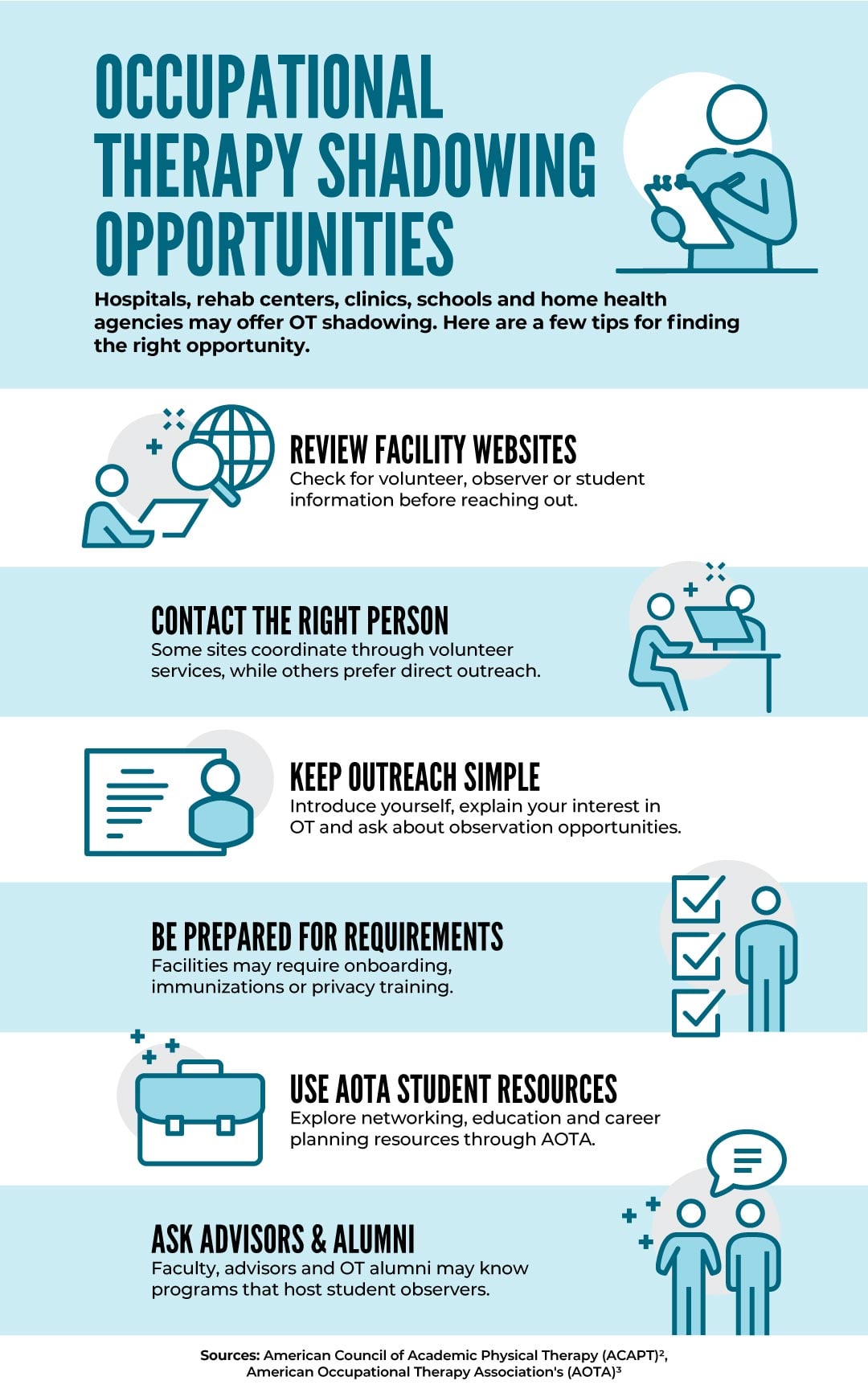
Many organizations post volunteer information, student observer instructions or general contact information on their websites. Before contacting a facility, review the organization’s website. Healthcare systems and clinical facilities often arrange observation hours through offices or individuals, such as volunteer services, clinic managers or site coordinators.2
Some sites want student observers to go through volunteer services, while others prefer a manager, site coordinator or direct practitioner. Checking first saves time and helps you appear more professional. When you reach out, keep your message short, respectful and specific.
Introduce yourself, explain that you’re exploring OT, then ask whether the site allows observation or shadowing. Highlight your availability and be flexible. Facilities may have privacy, onboarding or immunization requirements that need to be met, so be prepared.
You can also explore the American Occupational Therapy Association’s (AOTA) student resources. AOTA’s student hub includes resources related to OT and OTA school, fieldwork and capstone experiences, certification and licensure and networking opportunities that can help you understand the profession while planning your next steps.3
It’s also a good idea to speak with an academic advisor, the pre-health office or faculty members who are connected to health professions advising. They often know which hospitals, pediatric programs, rehab centers or school systems regularly host student observers. Pediatric programs may offer pediatric occupational therapy shadowing opportunities. If your school has alumni in OT, ask whether you can connect for informational interviews or shadowing leads.
USAHS Perspective and Support
Observation hours aren’t required for MOT or OTD program admission at USAHS, but they’re strongly recommended. OT is broad, collaborative and context specific. The more clearly you understand that before applying, the more prepared you’ll be to choose the right path.
When you explore our OT admissions pages, you’ll find everything you need to understand what we’re looking for: prerequisites, GPA requirements, and application components. You’ll also find our encouragement to seek out meaningful OT exposure before you apply, whether through shadowing, paid work or volunteer experience. These experiences can help inform your application and provide a better understanding of the profession.
Our OT programs are clinical and community-focused by design. That means from the moment you enter our graduate programs, you’re working toward Level I and Level II fieldwork experiences across a variety of real practice settings.
Shadowing before you begin is one of the best ways to prepare—giving you a foundation of professional exposure that will make your fieldwork feel less like a first step and more like a next one.
OT Shadowing: Wrapping Up
OT shadowing is one of the most valuable ways to understand what OTs do. Its purpose is to expose students beyond the broader definition of the field and into real-world practice, including evaluation, treatment planning, documentation, collaboration and day-to-day problem-solving with clients.
Not sure where to start? That’s what we’re here for. Contact one of our enrollment advisors. They can walk you through prerequisites, break down the differences between our MOT and OTD programs and determine a realistic timeline for applying. Whatever your goals look like, we’ll help you find the path that gets you there.

FAQs
How many occupational therapy shadowing hours do I need?
It depends on which programs you plan to apply to. Some programs don’t require shadowing hours at all. Others require a specific number of hours.1
If you’re applying to USAHS, observation hours aren’t required. Still, USAHS highly recommends that applicants gain OT exposure and observe practice in at least two areas of practice.
Which OT shadowing settings look strongest to admissions?
Admissions teams, like USAHS’, may want you to understand OT isn’t limited to one population or one clinic model. Observing an adult medical setting and a school or community setting, for example, can demonstrate this.
Hospitals, inpatient rehab, outpatient clinics, skilled nursing facilities, school-based services, early intervention and mental health programs can all provide meaningful exposure when OT is part of the experience.1
Can virtual OT shadowing count?
Sometimes. Every program has its own set of rules. Some schools may accept virtual shadowing, especially if it provides meaningful insight into OT practice. Other programs may prefer or require in-person observation since it offers a closer look at clinical routines, environments and interactions. Always check the admissions page of the program you’re applying for to confirm.
References:
- “Shadowing an Occupational Therapy Professional,” Why Choose OT?, https://whychooseot.com/shadowing-an-occupational-therapy-professional/.
- “Clinical Site Resource: Guidelines for Prospective Student Applicant Requesting Observation Hours,” American Council of Academic Physical Therapy (ACAPT), https://acapt.org/docs/default-source/consortium-%28ncce%29/site-guide-for-observation-hours.pdf?sfvrsn=634585d8_2.
- “Become an Occupational Therapist or Occupational Therapy Assistant,” American Occupational Therapy Association (AOTA), 2026, https://www.aota.org/career/become-an-ot-ota.