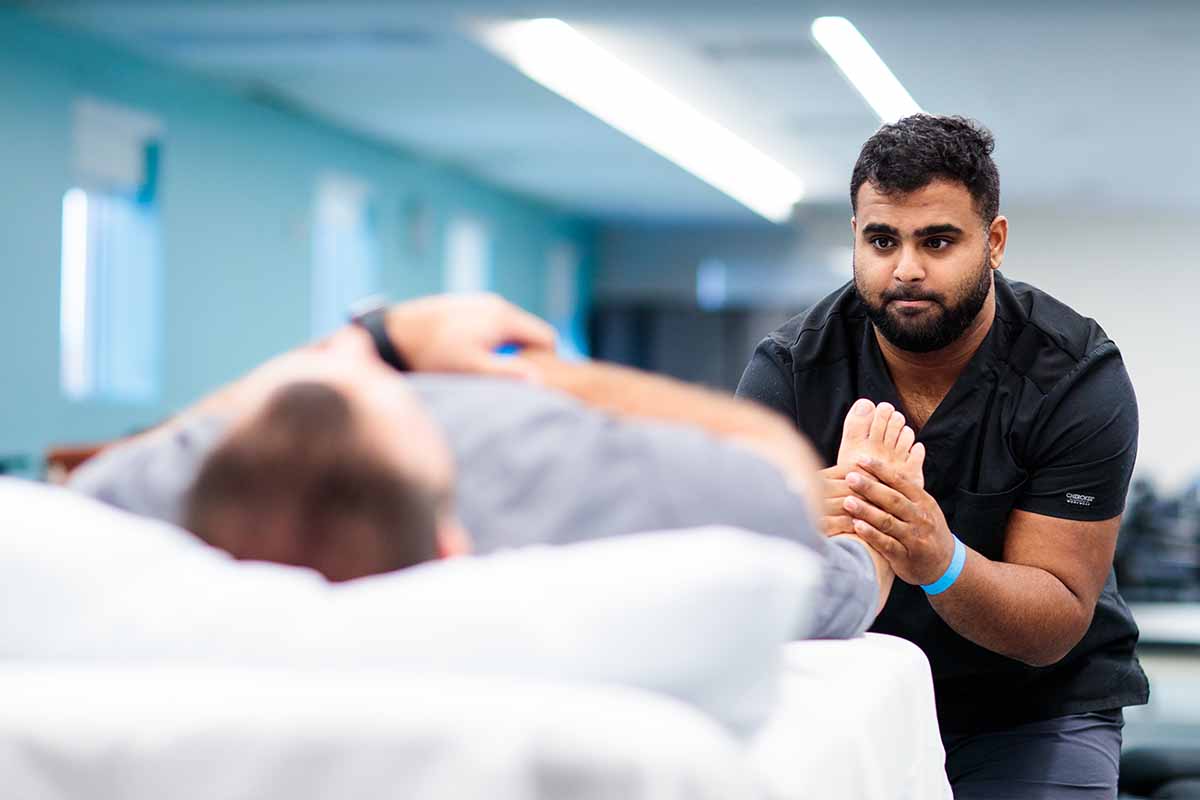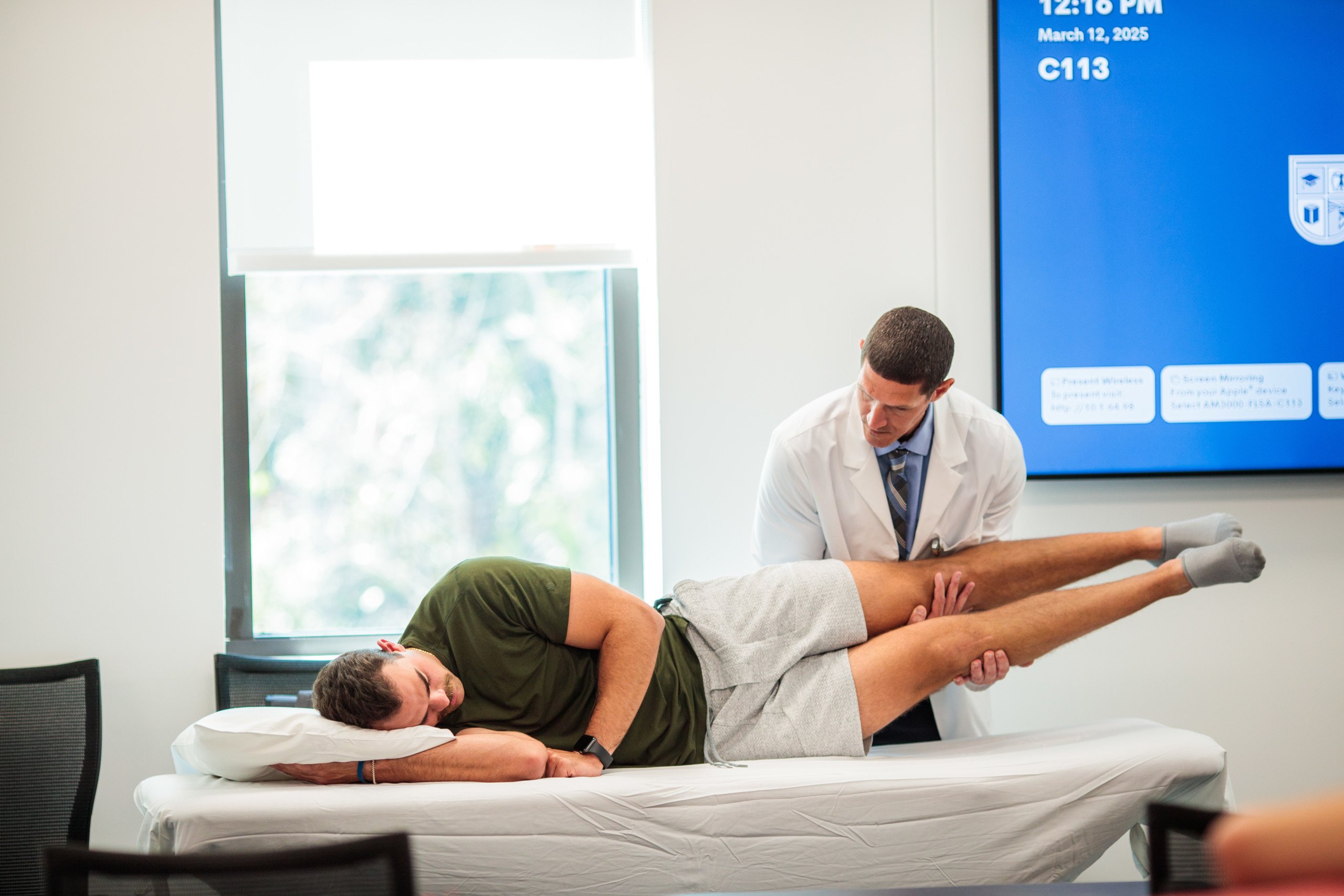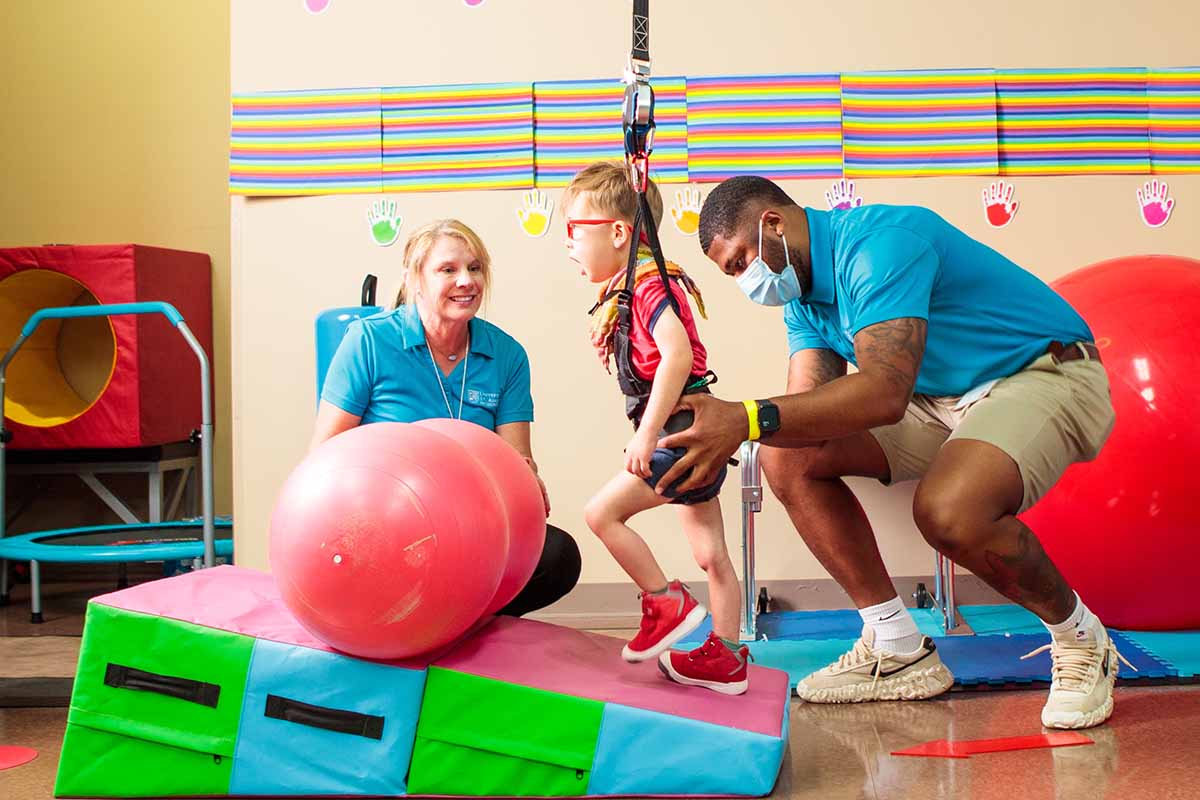

Ranked the seventh best healthcare career by U.S. News & World Report, physical therapy (PT) offers a rich opportunity for people who want to help patients lead better lives.1 Physical therapists treat injuries, disabilities and other health conditions through personalized treatment plans that include exercise and hands-on rehabilitation.2
How do you become a physical therapist? What are the steps to becoming a physical therapist?
A Doctor of Physical Therapy (DPT) is the entry-level degree for this position, so read on to discover the typical pathway for how to become a physical therapist.2
Table of Contents:
- Earn a Bachelor’s Degree in a Related Field
- What Degree Do You Need to Be a Physical Therapist?
- Pass the National Physical Therapy Exam (NPTE)
- Obtain a License to Practice
- Complete a Residency (Optional)
- Earn Board Certification (Optional)
- FAQ
- Launch Your Physical Therapy Career With USAHS
1. Earn a Bachelor’s Degree in a Related Field
Typically, the first step for how to become a physical therapist is to earn a bachelor’s degree, which most DPT programs require for application.2 Most DPT programs do not require a specific undergraduate degree as long as your coursework satisfies their admission requirements. At the University of St. Augustine for Health Sciences (USAHS), DPT admission course requirements include anatomy, chemistry and physics, which are common prerequisites for this program.3 Some of the best undergraduate degrees for physical therapy include biology, kinesiology and exercise science.
2. What Degree Do You Need to Be a Physical Therapist?
Next on the list of steps to become a physical therapist, you’ll likely need to complete a DPT degree, which can take about three years.2
What to Look for in a DPT Program
When looking at DPT programs to become a physical therapist, choose a program that fits your needs.
Ensure your DPT program is CAPTE accredited.*
Make sure the DPT program you choose is accredited by the Commission on Accreditation in Physical Therapy Education (CAPTE). Without CAPTE accreditation, you won’t be eligible to sit for the National Physical Therapy Exam (NPTE), which is required for licensure in all states.4
Accreditation also ensures that the program meets national standards for education and clinical training, giving you confidence in the quality of your education.
Explore DPT program total cost and financial aid opportunities.
Physical therapy programs can vary significantly in cost, so it’s critical to understand tuition, fees and any additional expenses you might incur, like textbooks or lab equipment.
Review the total cost of attendance and research financial aid options, including scholarships, grants and student loans to help offset these costs. Some universities offer need- or merit-based scholarships for DPT students. Planning financially and budgeting accordingly helps you to focus on your studies without unnecessary financial stress.
Check out USAHS’ tuition information and scholarships page.
Investigate how long the program is.
The duration of physical therapy programs plays a key role in how quickly you can begin your career as a PT. Most DPT programs take about three years to complete, but some offer accelerated programs that can shorten this timeline.2 These programs may allow you to graduate earlier and start earning a salary.
Choose a program that aligns with your lifestyle and commitments.
Visit potential campuses.
Location can impact your educational experience in a DPT program. As you explore potential campuses, consider factors like proximity to home, housing options, access to clinical sites and campus culture. A supportive environment like the one at USAHS, with the right opportunities and resources, can make a difference in your academic success.
USAHS offers physical therapy programs at five campuses in destination cities:
Focus on collaboration.
Team-based care is shaping the future of healthcare, making collaboration a key part of physical therapy programs. At USAHS, our curriculum is designed to facilitate teamwork as you explore how to become a PT. Students benefit from interprofessional education by learning alongside occupational therapists (OTs) and speech-language pathologists (SLPs).
This integrated approach mirrors real-world clinical scenarios where physical therapists often work as part of a larger healthcare team.5 With these skills, you’ll be better prepared to communicate and deliver quality patient care.
Consider program pathways.
Each student has unique needs. USAHS’ physical therapy programs offer several pathways to become a physical therapist to accommodate diverse schedules and learning preferences.
- Residential DPT: This is the traditional pathway, which features in-person sessions, online coursework and weekday on-campus labs. Pursue this pathway at all five USAHS campuses.
- Hybrid Immersion DPT: This online and in-person pathway offers a flexible way to become a physical therapist while living almost anywhere in the U.S. It combines live, online coursework and, on average, two immersive, in-person labs per term.
- Flex DPT: This pathway to become a PT involves online coursework and in-person labs on select weekends.
The Flex DPT and Hybrid Immersion DPT pathways provide increased flexibility, with a blend of online learning and in-person labs to help you balance your studies with work or personal commitments. These options create a path for everyone to achieve their goal of becoming a physical therapist.
Why choose USAHS?:
- Student-centered philosophy: Our student-FIRST philosophy ensures you’ll receive the most up-to-date learning experience to fully prepare you to be a confident and successful PT and provide the best patient care now and in the future.
- Hands-on learning opportunities and simulation labs: Get the best of both worlds with convenient online courses plus in-person skills development through engaging hands-on labs featuring state-of-the-art simulation equipment.
- Access to cutting-edge technology: USAHS will prepare you with hands-on experience through diverse patient scenarios and the leading-edge technology you need for a successful future in physical therapy.
- Opportunities to engage professionally through conferences and research: USAHS’ graduate physical therapy programs offer opportunities to participate in academic conferences, research projects and scholarly presentations. Students can collaborate with faculty on innovative research and potentially present at regional and national professional events, helping to build their networks and strengthen their resumes.
Applying to DPT School

Once you’ve picked a DPT program, the next step in how to become a physical therapist is to apply. Getting into physical therapy school is pretty straightforward once you know your program’s admission requirements.
- If required, take the GRE.
- Apply to the DPT program using the Physical Therapist Centralized Application Services (PTCAS).6
- Submit any required documentation. At USAHS, we require:
- A current resume
- A statement of purpose
- Transcripts showing completion of prerequisite courses and a recommended minimum (GPA) of 3.0 calculated on the Doctor of Physical Therapy program’s prerequisites and a required grade of C or better earned in each DPT prerequisite course.
- A total of two (2) references from the following: Two licensed physical therapists (preferred) or one physical therapist and one faculty member or academic advisor.
- A minimum of 40 volunteer, observation, or work hours in a physical therapy setting. Applicants may apply with 20 hours completed. Please note that proof of 40 hours must be completed by your intended start date.
- A comprehensive background check, fingerprints and drug screen at the applicant’s expense must be completed upon acceptance into the program prior to matriculation.
DPT Curriculum
Once you’ve enrolled in the program, the DPT curriculum includes a range of coursework. At USAHS, our curriculum may include classes covering the following areas:
- Anatomy
- Patient care
- Physiology
- Biomechanics
- Musculoskeletal
- Neuroscience
- Clinical reasoning
Clinical education, which involves supervised experience in a clinical setting in different areas of physical therapy, should also be part of your curriculum.2

3. Pass the NPTE
To become a licensed physical therapist or physical therapist assistant in the United States, you’ll need to pass the NPTE.7 This standardized exam, administered by the Federation of State Boards of Physical Therapy (FSBPT), is a key part of the licensure process in all 50 states and includes key dates and deadlines.8 The PT exam is intended to evaluate your entry-level knowledge and skills following graduation from an accredited program or a recognized equivalent.9 You will need to register and submit the $485 exam fee for physical therapists.10
If you score lower than 600 on the NPTE exam, you may retake it and access resources to help you improve your performance.11
4. Obtain a License to Practice
Once you’ve received your NPTE scores, you’ll typically apply for your state’s license to practice.12 However, additional requirements may vary by state. For instance, some states require a law exam and a background check to complete the process.7 Contact your state board of physical therapy for more information about how to apply for a physical therapist license in your state.13
Remember that if you wish to work as a travel physical therapist or virtual physical therapist, you’ll need a license to practice wherever your patients live.14
5. Complete a Residency or Fellowship (Optional)
Once you have your license, you can practice or choose to take a few extra steps in the process of how to become a PT to deepen your knowledge.2

You may pursue a clinical residency or fellowship after getting your license. These optional programs are designed to increase the quality of your patient care and deepen your knowledge of best practices.15 Research shows that fellowship training for some physical therapists contributes to greater clinical effectiveness, while also enhancing job satisfaction, supporting career advancement and promoting clinical excellence.16
A clinical residency is a post-professional learning experience centered on developing knowledge, skills and responsibilities of advanced physical therapy practice.15 These typically last one year and help prepare a physical therapist for board certification.7 The American Board of Physical Therapy Residency and Fellowship Education (ABPTRFE) currently offers residencies in the following areas15:
- Acute Care
- Cardiovascular & Pulmonary
- Clinical Electrophysiology
- Geriatrics
- Neurology
- Oncology
- Orthopaedics
- Pediatrics
- Sports
- Women’s Health
- Wound Management
A clinical fellowship is a post-professional learning experience, but the goal is to expand a physical therapist’s knowledge, skills and responsibilities in a specific subspecialty.15 The candidate will need to have already completed a residency or specialty certification, or they must have board certification in the specialty area.15
ABPTRFE currently offers fellowships in the following areas15:
- Critical Care
- Hand Therapy
- Neonatology
- Neurologic Movement Disorders
- Orthopaedic Manual Physical Therapy
- Performing Arts
- Spine
- Sports Division 1
- Upper Extremity Athlete
The application and admissions process for residencies and fellowships vary based on individual state requirements, so if you wish to follow these steps to become a physical therapist, consult each program’s admission guidelines.17,15
6. Earn Board Certification (Optional)
Another option in the process of becoming a physical therapist is getting board-certified through the American Board of Physical Therapy Specialties (ABPTS).18,2 Earning your board certification involves passing an exam and completing the required hours of clinical work within your chosen specialization.7
Employers prefer to hire board-certified physical therapists.19 Many physical therapists who become board-certified may experience a salary increase or non-financial rewards such as promotions or increased authority and responsibility, although this depends on the setting.
Currently, ABPTS offers board certification in the following areas20:
- Cardiovascular & Pulmonary
- Clinical Electrophysiology
- Geriatrics
- Neurology
- Orthopaedics
- Oncology
- Pediatrics
- Sports
- Women’s Health
- Wound Management
Board certification applications are due no later than September 30.21 You’ll also need to complete specialty-specific requirements.22

FAQ
Now that you know how to become a physical therapist, learn more about what it entails to be a physical therapist. Read through the questions and answers below.
What Do Physical Therapists Do?
Physical therapists are doctors in the sense that they earn a Doctor of Physical Therapy (DPT) degree, which is required to practice in the U.S., but they are not medical doctors (MDs). They are licensed healthcare professionals who prescribe treatment plans to improve mobility and manage pain related to movement.23 They may ask patients to perform exercises or show them how to use adaptive equipment, such as a cane.5
They work as part of a healthcare team that may include other physical therapists, surgeons, doctors, physician assistants and specialists.
Where Do Physical Therapists Work?
Physical therapists typically work in the following settings24:
- Offices of physical, occupational and speech therapists and audiologists
- Hospitals
- Home healthcare
- Nursing or residential care facilities
Some physical therapists are self-employed or may offer virtual physical therapy
services, while others may work as travel physical therapists and work where needed.
How Much Do Physical Therapists Make?
Are you wondering: How much do physical therapists make? According to the U.S. Bureau of Labor Statistics (BLS), the 2024 median physical therapist salary is $101,020 per year.25 Factors like experience, location and specialty can impact a doctor of physical therapy salary.
How Many Years Does It Take to Become a Physical Therapist?
If you are looking into how many years to become a physical therapist, the process typically takes about seven years, including four years for an undergraduate degree and about three years for a DPT degree.7
So, how long is PT school? DPT programs typically last three years. USAHS’ DPT program offers pathways that range from 2.3 to 3 years.*** During this time, students complete coursework and clinical rotations in areas such as acute and orthopedic care. All states require physical therapists to be licensed, which includes passing a qualifying exam.7
After earning a DPT, some may choose to complete a one-year clinical residency or become board-certified. How long to become a physical therapist depends on the program and pathway that you choose, as well as any additional specialty training you may choose to pursue.
Launch Your Physical Therapy Career with USAHS
USAHS has been a leader in physical therapy education since its founding in 1979 and is now the largest physical therapy school in the United States.**
Our student-first philosophy means you’ll experience an immersive education and graduate as a practice-ready professional. Hands-on simulation labs and state-of-the-art technology, combined with our unrivaled faculty practitioners, will prepare you to offer high-quality patient care now and in the future.
Learn more about our DPT degree program and apply today.
*The University of St. Augustine for Health Sciences is institutionally accredited by the WASC Senior College and University Commission (WSCUC), 1080 Marina Village Parkway, Suite 500, Alameda, CA 94501, (510) 748-9001, www.wscuc.org.
For programmatic accreditation, https://www.usa.edu/about/accreditation/.
**Based on total DPT degrees conferred during 2020-2023, as reported by the Integrated Postsecondary Education Data System (IPEDS). Data is captured by IPEDS through interrelated surveys conducted annually by the Department of Education’s National Center for Educational Statistics (NCES) and from USAHS’ internal graduation data.
***Time to completion may vary by student, depending on individual progress, credits transferred and other factors.
Salary data may not reflect starting pay for recent graduates.
Sources
- S. News & World Report, “Best Health Care Jobs,” U.S. News & World Report, 2024, https://money.usnews.com/careers/best-jobs/rankings/best-healthcare-jobs.
- American Physical Therapy Association, “Becoming a Physical Therapist,” APTA, 2024, https://www.apta.org/your-career/careers-in-physical-therapy/becoming-a-pt.
- American Physical Therapy Association, “DPT Admissions Process,” APTA, DPT 2024, https://www.apta.org/your-career/careers-in-physical-therapy/pt-admissions-process.
- Federation of State Boards of Physical Therapy, “Eligibility Requirements,” FSBPT, 2023, https://www.fsbpt.org/Secondary-Pages/Exam-Candidates/National-Exam-NPTE/Eligibility-Requirements.
- S. Bureau of Labor Statistics, “Physical Therapists: What Physical Therapists Do,” BLS, April 17, 2024, https://www.bls.gov/ooh/healthcare/physical-therapists.htm#tab-2.
- “Physical Therapist Centralized Application Service,” PTCAS, 2023, https://ptcas.cas.myliaison.com/applicant-ux/#/login.
- S. Bureau of Labor Statistics, “Physical Therapists: How To Become a Physical Therapist,” BLS, April 17, 2024, https://www.bls.gov/ooh/healthcare/physical-therapists.htm#tab-4.
- Federation of State Boards of Physical Therapy, “Future Key dates and deadlines,” FSBPT, 2023, https://www.fsbpt.org/Secondary-Pages/Exam-Candidates/National-Exam-NPTE/Dates-and-Deadlines/Future-Test-Dates.
- Federation of State Boards of Physical Therapy, “National Exam (NPTE®),” FSBPT, 2023, https://www.fsbpt.org/Secondary-Pages/Exam-Candidates/National-Exam-NPTE.
- Federation of State Boards of Physical Therapy, “Exam Registration and Payment,” FSBPT, 2023, https://www.fsbpt.org/Our-Services/Candidate-Services/Exam-Registration-Payment.
- Federation of State Boards of Physical Therapy, “Retake Exam,” FSBPT, 2023, https://www.fsbpt.org/Secondary-Pages/Exam-Candidates/National-Exam-NPTE/Retake-Exam.
- American Physical Therapy Association, “About PT and PTA Licensure,” APTA, 2024, https://www.apta.org/your-practice/licensure/pt-and-pta-licensure.
- Federation of State Boards of Physical Therapy, “Licensing Authorities Contact Information,” FSBPT, 2023, https://www.fsbpt.org/Free-Resources/Licensing-Authorities-Contact-Information.
- “Telehealth Physical Therapy (PT) – Your Guide,” The Non-Clinical PT, September 5, 2023, https://thenonclinicalpt.com/telehealth-physical-therapy/.
- American Board of Physical Therapy Residency & Fellowship Education, “For Physical Therapist Residency & Fellowship Participants or Prospective Participants,” ABPTRFE, 2024, https://abptrfe.apta.org/for-participants.
- Matthew R. Schumacher, Joshua A. Clark, et al, “Exploring the personal and professional outcomes of pursuing fellowship training in orthopedic manual physical therapy: a mixed-methods analysis,” Journal of Manual & Manipulative Therapy, December 24, 2024, https://www.tandfonline.com/doi/full/10.1080/10669817.2024.2448203?af=R.
- American Board of Physical Therapy Residency & Fellowship Education, “Online Directory of Programs,” ABPTRFE, https://accreditation.abptrfe.org/#/directory.
- American Physical Therapy Association, “APTA Specialist Certification – Governed by ABPTS,” APTA, 2024, https://specialization.apta.org/?_ga=2.63550319.1175286054.1700158593-28393261.1699481062
- American Physical Therapy Association, “Employer View of Specialist Certification,” APTA, 2024, https://specialization.apta.org/for-specialists/marketing/employers.
- American Physical Therapy Association, “Become an ABPTS-Certified Specialist,” APTA, 2024, https://specialization.apta.org/become-a-specialist.
- American Physical Therapy Association, “From Application to Celebration: The Path to Your Specialist Credential,” APTA, 2024, https://specialization.apta.org/become-a-specialist/from-start-to-finish.
- American Physical Therapy Association, “Minimum Eligibility Requirements and General Information for All Physical Therapist Specialist Certification,” APTA, 2024, https://specialization.apta.org/become-a-specialist/minimum-requirements.
- Cleveland Clinic, “Physical Therapist,” Cleveland Clinic, March 7, 2024, https://my.clevelandclinic.org/health/articles/24625-physical-therapist.
- S. Bureau of Labor Statistics, “ Physical Therapists: Work Environment,” BLS, April 17, 2024, https://www.bls.gov/ooh/healthcare/physical-therapists.htm#tab-3.
- S. Bureau of Labor Statistics, “Occupational Outlook Handbook: Physical Therapists,” BLS, August 28, 2025, https://www.bls.gov/ooh/healthcare/physical-therapists.htm.