

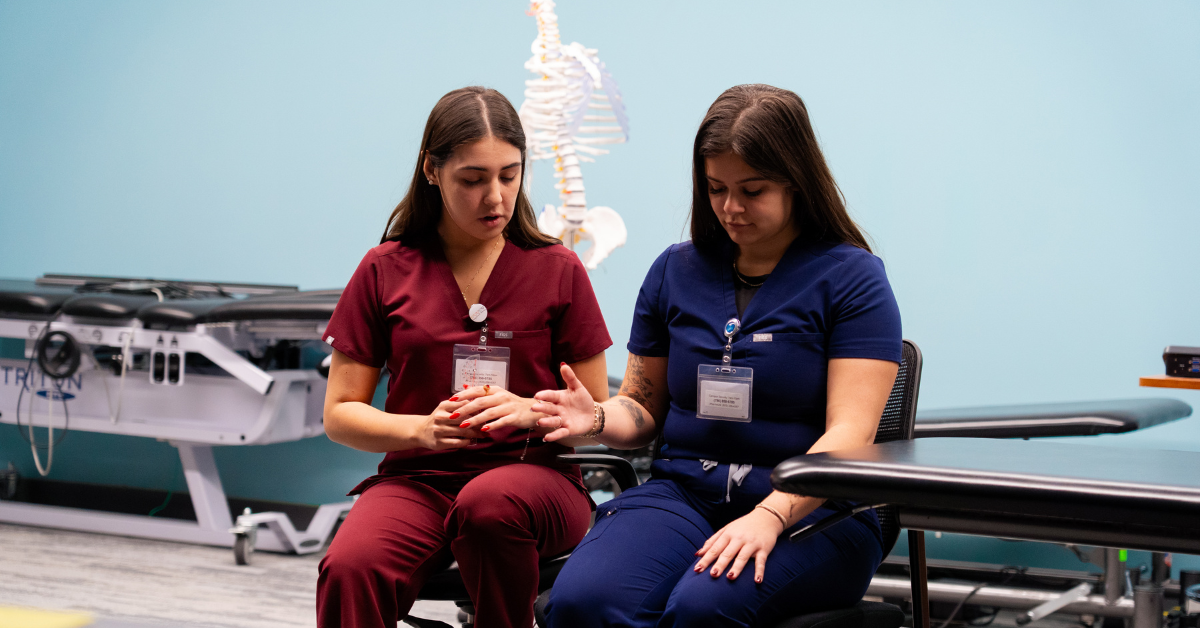
The healthcare field is expected to continue to grow at an above-average rate.1 Working in healthcare is a wise choice because of the long-term stability of this growing industry.
A career in healthcare offers a diverse range of professional paths and work environments, ensuring that you can find a setting and role that aligns with your interests and preferences.1 All of this is paired with the sense of purpose that comes with working in healthcare—a career where you truly have the opportunity to make a meaningful impact.2
Is Healthcare a Good Career Path?
Yes, pursuing a healthcare career is a great idea. Based on current industry trends, the demand for healthcare professionals is expected to continue to rise. The U.S. Bureau of Labor Statistics (BLS) predicts that employment within healthcare is expected to grow much faster than the average of all occupations from 2023 to 2033, with around 1.9 million job openings projected each year.1
Part of the reason for this growth is that there is always a need for professionals who can help improve health and well-being. The population is aging, leading to an increase in those susceptible to age-related health conditions, which in turn results in a greater demand for healthcare careers.3 For those working in healthcare, this demand translates to greater job security, even during uncertain economic times.
Healthcare is a field where you spend each day improving the health and well-being of others, making it a highly fulfilling profession.2
With multiple entry points depending on education levels, a career in healthcare can be a seamless transition.1 There are several opportunities for advancement for those looking to expand their career.
Pros and Cons of Working in Healthcare
As with all fields, there are pros and cons of working in healthcare. Whether or not healthcare is a good profession for you depends on whether the pros outweigh the cons. Since you need a degree for most healthcare careers, and degree programs for many healthcare professions can be time-intensive, it is especially important to be honest with yourself about what to expect.
While the following are some general pros and cons of working in healthcare, only you can decide how much weight each holds and, ultimately, whether a career in healthcare is worth it.
Pros of Working in Healthcare
The benefits of pursuing a career in healthcare include:
- Job stability. There is a high demand for healthcare jobs, which is why it is one of the fastest-growing sectors.1 A strong opportunity equates to greater job security, making healthcare a wise career path.
- High salaries. Many healthcare roles offer above-average compensation, making healthcare a promising career path.1
- Meaningful, purpose-driven work. Those working in healthcare positions often enter the field because they want to help others experience better health and well-being.3 Through these positions, you have an opportunity to improve lives.

Cons of Working in Healthcare
Some of the cons of working in healthcare can include:
- Emotional stress and burnout. Working in healthcare means that, depending on your profession, you may be exposed to trauma, death or patient suffering. This, along with compassion fatigue in high-intensity roles, can contribute to burnout, a common challenge among healthcare professionals.4
- Long or irregular hours. Those in the healthcare field may work long hours as well as irregular shifts, such as night shifts, weekends and holidays. Depending on your personal obligations, these hours can be burdensome.
- High responsibility and pressure. When you pursue a career in healthcare, the lives and well-being of others can be dependent on your decisions, which comes with significant responsibility. Individuals in the healthcare field require emotional resilience and the ability to think quickly under pressure.5
- Physical demands. Some roles may require physical demands, especially those that involve lifting patients or standing for extended periods. Those who work in emergency response scenarios must be ready to respond accordingly and act quickly.
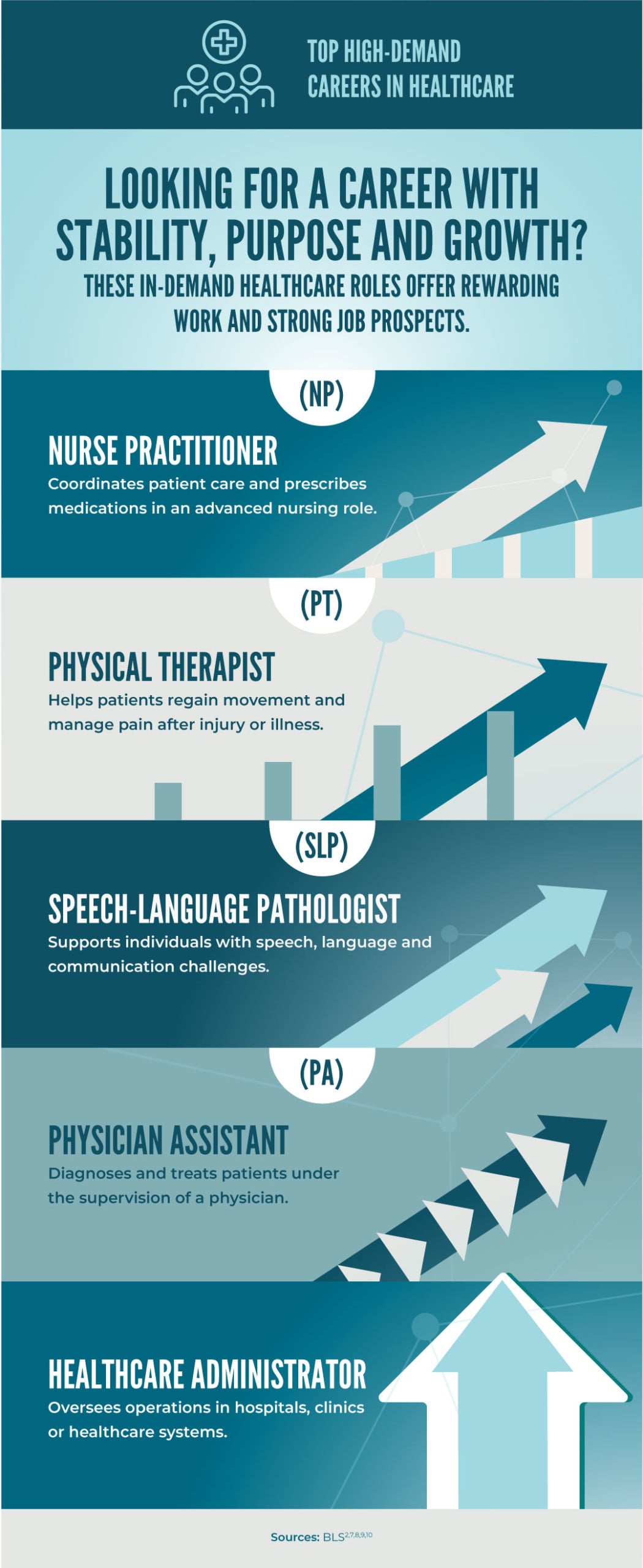
The following are some of the best careers in healthcare for those seeking jobs with high demand.
Nurse Practitioner (NP)6
- Primary duties: Advanced nursing role that allows nurses to coordinate patient care and prescribe medications.
- Median annual salary: $132,050
- Requirements: Master of Science in Nursing (MSN), state licensure and certification
Physical Therapist (PT)7
- Primary duties: Helps individuals with an injury or illness improve movement and manage pain.
- Median annual salary: $101,020
- Requirements: Doctor of Physical Therapy (DPT), state licensure
Speech-Language Pathologist (SLP)8
- Primary duties: Assesses and treats individuals with communication disorders.
- Median annual salary: $95,410
- Requirements: Master of Science in Speech-Language Pathology (MS-SLP), state licensure and the Certificate of Clinical Competence in Speech-Language Pathology (CCC-SLP)
Physician Assistant (PA)9
- Primary duties: Examines, diagnoses and treats patients under a physician’s supervision.
- Median annual salary: $133,260
- Requirements: A master’s degree and state licensure
Healthcare Administrator10
- Primary duties: Plans, directs and coordinates business activities in hospitals, clinics or health systems.
- Median annual salary: $117,960
- Requirements: A bachelor’s or master’s degree in health administration or business and state licensure (if required for the role)
Pursue a Healthcare Career with USAHS
The University of St. Augustine for Health Sciences (USAHS) offers graduate health sciences programs designed for modern healthcare leaders. Whether you aspire to be a nurse practitioner and need an MSN program, are passionate about movement science and want to complete a or aspire to become a speech-language pathologist after earning your MS-SLP degree, USAHS offers programs to help you meet your healthcare aspirations.
USAHS is more than a place to earn a degree. It’s where passionate individuals go to prepare for a fulfilling career in healthcare.
Through hands-on training in real and simulated clinical settings, USAHS ensures you have the experience to be competent and prepared following graduation. The flexible pathways, including online options, for USAHS programs allow everyone to find time to further their career, and the expert faculty create lasting mentorships.
If you’re ready to pursue a rewarding healthcare career, explore USAHS programs, request more information or start your application today.
Salary data may not reflect starting pay for recent graduates.
Sources
- “Healthcare Occupations,” Bureau of Labor Statistics, 2025, https://www.bls.gov/ooh/healthcare/.
- William E Rosa, et al. “The Critical Need for a Meaning-Centered Team-Level Intervention to Address Healthcare Provider Distress Now,” International Journal of Environmental Research and Public Health, June 25, 2022, 19(13):7801, https://www.ncbi.nlm.nih.gov/pmc/articles/PMC9265276/.
- “Ageing: Global population,” WHO, February 21, 2025, https://www.who.int/news-room/questions-and-answers/item/population-ageing.
- “Health Worker Face a Mental Health Crisis,” Centers for Disease Control and Prevention, 2023, https://www.cdc.gov/vitalsigns/health-worker-mental-health/index.html
- “6 Reasons Why Emotional Resilience Is Demanded in Healthcare,” Your Health Magazine, May 2024, https://yourhealthmagazine.net/article/mental-health/6-reasons-why-emotional-resilience-is-demanded-in-healthcare.
- “Nurse Anesthetists, Nurse Midwives, and Nurse Practitioners,” Bureau of Labor Statistics, 2025, https://www.bls.gov/ooh/healthcare/nurse-anesthetists-nurse-midwives-and-nurse-practitioners.htm.
- “Physical Therapists,” Bureau of Labor Statistics, 2025, https://www.bls.gov/ooh/healthcare/physical-therapists.htm.
- “Speech-Language Pathologists,” Bureau of Labor Statistics, 2025 https://www.bls.gov/ooh/healthcare/speech-language-pathologists.htm.
- “Physician Assistants,” Bureau of Labor Statistics, 2025, https://www.bls.gov/ooh/healthcare/physician-assistants.htm.
- “Medical and Health Services Managers,” Bureau of Labor Statistics, 2025 https://www.bls.gov/ooh/management/medical-and-health-services-managers.htm.