
You are staring at a dozen occupational therapy (OT) programs, each with slightly different requirements, essays and deadlines. It’s exciting but also requires your effort and attention. That’s where OTCAS comes in.
If you have asked, “What is OTCAS?” or are wondering how to navigate the process, this guide is for you. Think of it as a roadmap, from your first OTCAS login to submitting your application with confidence.
What Is OTCAS?
The Occupational Therapy Centralized Application Service (OTCAS) is a platform that allows you to apply to multiple OT programs using one centralized online application.1
Instead of filling out separate applications for every school, you complete one OTCAS application and send it to participating programs or OT schools.2
So, what do I need to know about the OTCAS application?
- It’s run by Liaison, in collaboration with the American Occupational Therapy Association (AOTA).2
- It’s not a government agency.
- It’s not a school and does not make admissions decisions.
- Each program still reviews your application independently.
Start your OTCAS application here: https://otcas.cas.myliaison.com/applicant-ux/#/login.
OTCAS at a Glance
Let’s explore the big picture of the OTCAS process.
Most accredited and developing OT master’s and doctoral programs in the U.S. use OTCAS.2 However, not all do, so always double-check each school’s admissions page.
At the University of St. Augustine for Health Sciences (USAHS), applicants have flexibility. You can apply either directly through the University using our free application or through OTCAS for programs like the Master of Occupational Therapy (MOT) or Doctor of Occupational Therapy (OTD).
What’s Included in the OTCAS Application?
The OTCAS application is comprehensive but manageable when you break it down.
It includes the following core sections:1
- Personal information: Basic details, background questions and contact information.
- Academic History: Self-reported coursework and official transcripts sent directly to OTCAS.
- Prerequisites and Coursework: You’ll include completed coursework in subject areas such as Anatomy and Physiology, Statistics and Psychology.
- Observation and Experience: This includes shadowing, volunteer work and employment. You may need to submit an OTCAS observation hours form with supervisor contact information.
- Evaluations (Letters of Recommendation): Some programs require two to three evaluators, such as licensed occupational therapists (OTs), professors and supervisors. Review an OTCAS letter of recommendation example to help guide you through this process.
- Essays and Program Materials: Your OTCAS personal statement as well as school-specific questions and answers.
- Fees: The OTCAS application fee is typically $169 for the first program and $71 for each additional program.1 Check for any school-specific supplemental fees.
Why Students Choose OTCAS
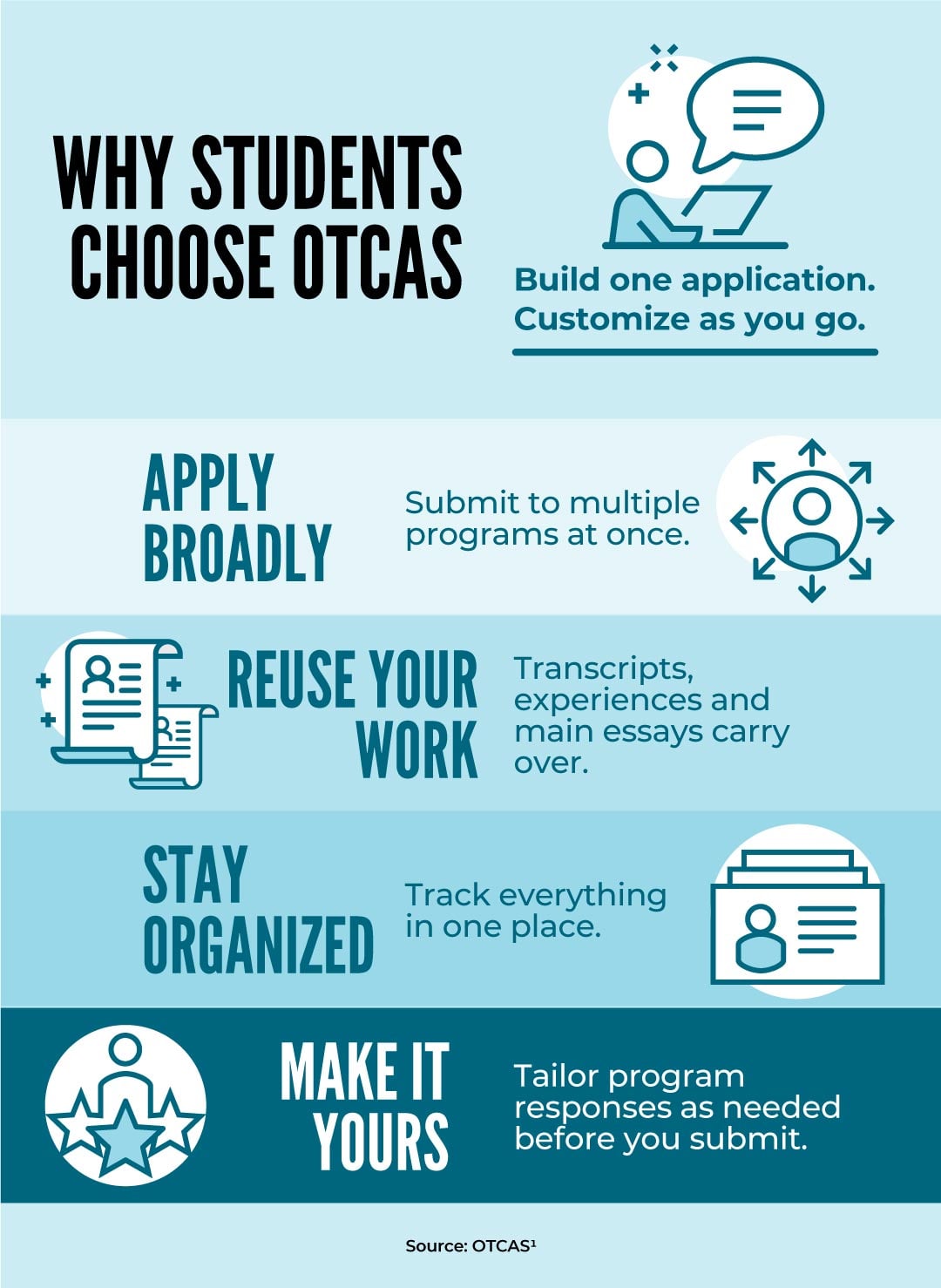
There’s a reason why OTCAS is so widely adopted. It simplifies a commonly used process.1
Key Benefits:
- Apply to multiple programs at once
- Reuse core materials like transcripts, experience entries and main essays
- Track application progress in one place
- Customize program-specific sections
Instead of starting from scratch for each school, you build once and tailor as needed.
OTCAS Deadlines and Timeline
Timing matters more than applicants may realize.
How the Cycle Works
OTCAS runs on an annual application cycle, typically opening in mid-July. However, each program sets its own priority, regular and final deadlines. These are clearly listed inside OTCAS when you add programs.1
Rolling Admissions
Some OT programs use rolling admissions. That means that applications are reviewed as they are completed, and interview invites will be sent continuously. In this case, seats may fill up early, so it’s a good idea to submit as soon as possible.
How to Fund Your OT Journey
Applying to a graduate occupational therapy program is an investment, but planning helps. Common costs include OTCAS fees, transcript request fees, GRE fees (if required) and travel for interviews or campus visits.
Financial Support Options
- OTCAS Fee Assistance Program
- OTCAS offers fee reductions for eligible applicants.1
- Free Application for Federal Student Aid (FAFSA)3
- Complete it early to access federal loans and need-based aid.
- School-Based Aid
- Some programs, like those at USAHS, offer scholarships or merit-based awards.4
Explore USAHS financial aid options: https://www.usa.edu/admissions-aid/.
USAHS Perspective and Support
USAHS’ MOT and OTD programs are designed to prepare students for NBCOT certification eligibility and Level I and II fieldwork experiences.
At USAHS, the MOT and OTD application process is designed to be flexible and student-focused. Students may apply directly through the University’s free MOT and OTD applications or apply through the OTCAS application.
USAHS basic admissions requirements include:5,6
- A bachelor’s degree from an accredited institution
- With a minimum overall cumulative GPA of 3.0
- Completed prerequisite coursework
- With a grade of “C” (2.0) or better
- Resume
- Statement of purpose
- OT supplemental questions
- OTD essay
- For USAHS OTD applicants only
The USAHS Occupational Therapy department does not require observation hours to apply for our graduate programs; however, it is highly recommended that all applicants observe occupational therapy in at least two areas of practice. This will not only support your submission essays; it will also help to ensure that you are well suited for this field of study.
Your effort in navigating OTCAS directly supports your path into hands-on clinical practice.

Final Thoughts on OTCAS
OTCAS is a powerful tool. It streamlines the process of applying to multiple OT programs, but it still requires careful planning.
It’s important to stay on top of:
- Program-specific deadlines
- Prerequisite requirements
- Observation hours (if required)
- Financial planning
If you are considering USAHS, you don’t have to figure it out alone. Contact an enrollment advisor for help deciding how to apply, reviewing your materials and aligning your goals with the right program.
FAQs
Do all OT programs use OTCAS?
No. Most do, but some require direct applications. Verify on each program’s admissions page.1
What are the most common prerequisites?
Common prerequisite coursework at USAHS includes anatomy and physiology, sociology or anthropology, psychology, statistics and medical terminology. Some programs may require additional coursework.
How many observation hours should I have, and do they need verification?
Requirements vary by program. Are you wondering, “Is there an OTCAS observation hours form?” While OTCAS allows applicants to enter observation hours and supervisor contact information within the application, OTCAS does not verify these hours or provide a standardized observation hours form. 1 Check each program’s requirements or contact them directly to see if they require documentation or have minimum observation hours.
The USAHS Occupational Therapy department does not require observation hours to apply for our graduate programs; however, it is highly recommended that all applicants observe occupational therapy in at least two areas of practice. This will not only support your submission essays; it will also help to ensure that you are prepared for this field of study.
Is the GRE required?
Not always. Some programs, like USAHS, do not require the GRE, while others still do.
How long does OTCAS verification take?
It may take up to 10 business days to complete verification after all materials have been submitted.1
Sources
- OTCAS Quick Start Guide and FAQs, Liaison International,
https://help.liaisonedu.com/OTCAS_Applicant_Help_Center/Starting_Your_OTCAS_Application/Getting_Started_with_Your_OTCAS_Application/01_Quick_Start_Guide. - “Find an OT or OTA school,” American Occupational Therapy Association (AOTA), 2026, https://www.aota.org/education/find-a-school.
- “Free Application for Federal Student Aid (FAFSA),” USA.gov, April 1, 2026, https://www.usa.gov/fafsa.
- “Admissions & Aid, Your Path to Success,” the University of St. Augustine for Health Sciences (USAHS), 2026, https://www.usa.edu/admissions-aid/.
- “MOT Admission Requirements,” the University of St. Augustine for Health Sciences (USAHS), 2026, https://www.usa.edu/college-of-rehabilitative-sciences/master-of-occupational-therapy-mot/mot-admission-requirements/.
- “OTD Admission Requirements,” the University of St. Augustine for Health Sciences (USAHS), 2026, https://www.usa.edu/college-of-rehabilitative-sciences/doctor-occupational-therapy/otd-admission-requirements/.