
If you’re thinking about a career in physical therapy, one of your next steps is putting together your application for a Doctor of Physical Therapy (DPT) program.
We know that the process can feel overwhelming, especially if you’re applying to several schools. The good news is that most programs use the Physical Therapist Centralized Application Service (PTCAS), which streamlines your application into one system.
This guide will walk through what the PTCAS is, key dates in the DPT application timeline and what to know about our DPT program at the University of St. Augustine for Health Sciences (USAHS).
What Is PTCAS?
The PTCAS is the centralized application service for many DPT programs in the United States.1
The PTCAS helps streamline the application process by gathering your application materials, including personal information, essays, resumes, transcripts and more, verifying them and sending them to the schools you are applying to.
You are still responsible for checking the specific requirements for each program and making sure you send necessary information to each school. Because the requirements can vary slightly from program to program, keep track of the specific requirements for the programs you’re applying to.
PTCAS Application Timeline
Let’s take a closer look at some highlights of the PTCAS application timeline.
Annual Cycle Basics
At USAHS, our Doctor of Physical Therapy (DPT) program participates in the Physical Therapist Centralized Application Service (PTCAS). Application timelines and deadlines vary by start term and campus location.
We offer multiple start dates throughout the year, and application deadlines are posted for each term on our website. Make sure to review the deadlines for your intended program. Because space is limited in each cohort, applicants are encouraged to submit their PTCAS application and all required materials as early as possible.
Milestones
When preparing to apply for a DPT program, it’s beneficial to plan backward from the intended start term.
About one to two years before you want to start, begin researching programs, such as USAHS’ DPT degree path, and mapping out any prerequisite courses you need to complete. As you plan, be sure to check the USAHS prerequisite tool. The GRE is waived for USAHS program applicants with a 3.6 or higher overall cumulative GPA or a prior master’s degree, so many students can apply without needing to take the exam.
As you move closer to applying, make sure you’re completing DPT admissions requirements, including the observation hours and hands-on experiences that will strengthen your application. For USAHS, you’ll ultimately need at least 40 volunteer, observation or work hours in a physical therapy setting. You can apply with 20, but 40 must be completed by your start date. This is also the time to start reaching out to professors, mentors, employers and licensed physical therapists (PTs) who might be willing to write letters of recommendation.
In early fall, before your application deadline, start drafting and revising your personal statement. For USAHS, that includes a short statement of purpose about what draws you to the university and its DPT program. Around this time, you can also contact your undergraduate institution to order official transcripts, since schools and registrars can be busy once the semester is in full swing.
From roughly September to November, many programs are in their peak window for early or priority applications. This is when you’ll ideally want to submit everything through PTCAS, making sure your GRE scores (if needed), observation hours, transcripts and recommendation letters are all in, and your USAHS application is marked complete.
Verification and Status Tracking
After you submit your PTCAS application, it will be placed in line for verification once all of your required application materials (including official transcripts and references) have been received and posted. Verification is the process PTCAS uses to ensure that all of your U.S. and English-Canadian coursework was entered correctly and consistently so that standardized GPAs can be calculated fairly for all applicants.2
During verification, PTCAS will:
- Assign each course you entered to a specific course subject category.
- Convert the grades you entered into standardized PTCAS grade values.
- Calculate GPAs using the converted grade values.
- Confirm that your degrees are awarded, if applicable.
If significant mistakes are found during verification (for example, inaccurate coursework entries), your application may be undelivered and returned to you for correction.
PTCAS processes verification in chronological order after your application status becomes “Complete,” and it can take up to 10 business days for verification to be finished. Once the process is complete, your status will change to Verified, and you will receive a notification.2
PTCAS Prerequisites and Academic Readiness
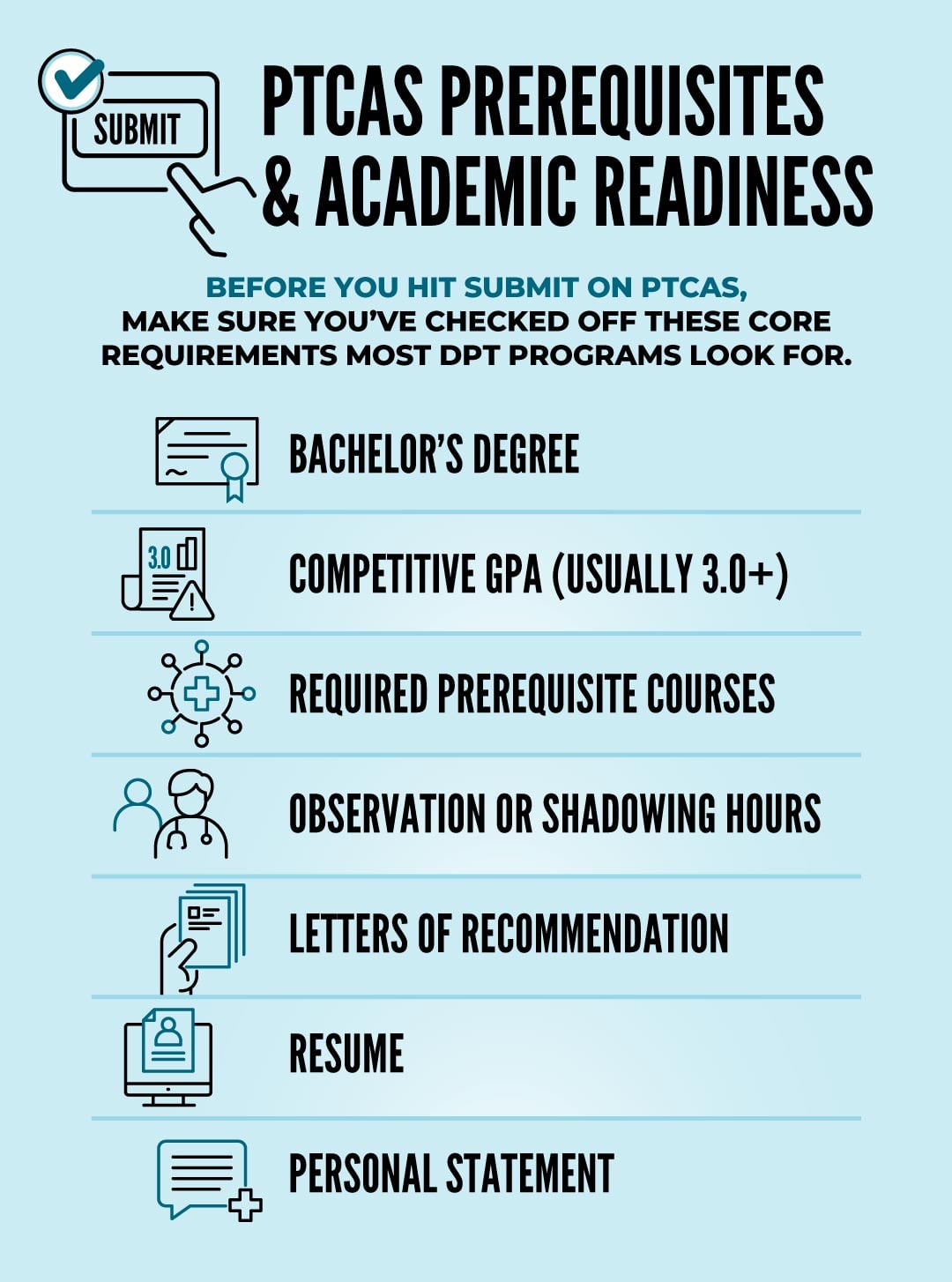
Although specific prerequisites and application requirements vary from program to program, there are some general requirements, also known as core requirements, that you must meet to be accepted into a DPT program via the PTCAS.
Generally, you need a bachelor’s degree, a minimum GPA of 2.75 to 3.0 and several prerequisite courses. Most programs require a minimum GPA of 3.0.3
Experience, Hours and References
In addition to academic readiness, you’ll also need to demonstrate experience in the field.
Observation/Shadowing Hours
Most DPT programs want to see that you’ve spent time in real-world PT settings—usually 40 hours or more of observation, volunteer work or paid experience. You can find opportunities through local clinics, hospitals, rehab centers and resources shared by the American Physical Therapy Association (APTA).4
For USAHS, you’ll need at least 40 hours in a physical therapy setting. You can apply with fewer, but the full 40 must be completed by your start date. Gaining experience in more than one setting can also strengthen your application.
Letters of Recommendation
You also need two to three letters of recommendation to send along with your other application materials. It’s best to ask someone who has seen you work in the field, such as a licensed physical therapist who has served as your mentor or instructor, to be a recommender.
You can also reach out to past professors or academic advisors who can speak to your academic capabilities.
Resume and Personal Statement
The final component that you will need to submit your application via PTCAS is a current, updated resume and a personal statement. The personal statement should speak to the past experiences you have had that make you a strong applicant and your aspirations in the field.
USAHS: Program Formats and What to Expect
At USAHS, we offer a variety of DPT program formats to fit different schedules and lifestyles.
On-Campus and Hybrid Learning
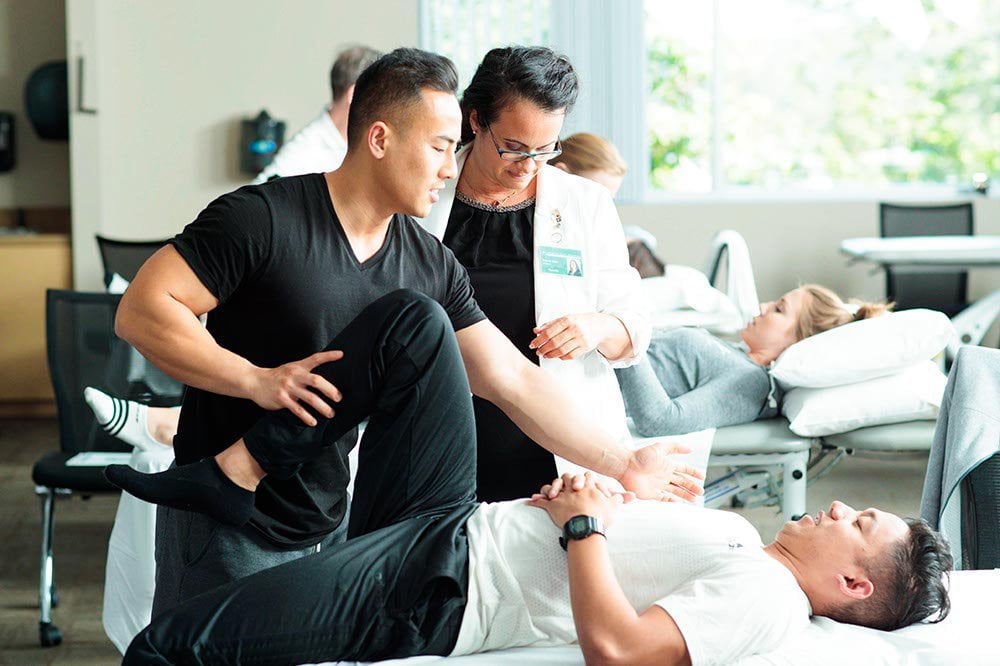
Our Residential DPT program offers an immersive, campus-based experience close to where you live and study primarily on campus, allowing you to complete your degree on a shorter timeline. You’ll engage in weekday classes and labs held in person, plus some online coursework to add flexibility.
Our Flex DPT is designed with busy schedules in mind, featuring online coursework, live evening and weekend sessions and on-campus labs on select weekends so you can keep moving forward in your career while you study.
Our Hybrid Immersion DPT blends the best of both worlds. Most coursework is online, paired with live virtual weekday sessions and two on-campus lab immersions each term to build hands-on skills with faculty and classmates.
Term Structure and Clinical Education
Our Residential and Hybrid Immersion DPT programs can be completed in about 2.3 years or 7 trimesters, while our Flex DPT is designed to be finished in about 3 years, or 9 trimesters.*
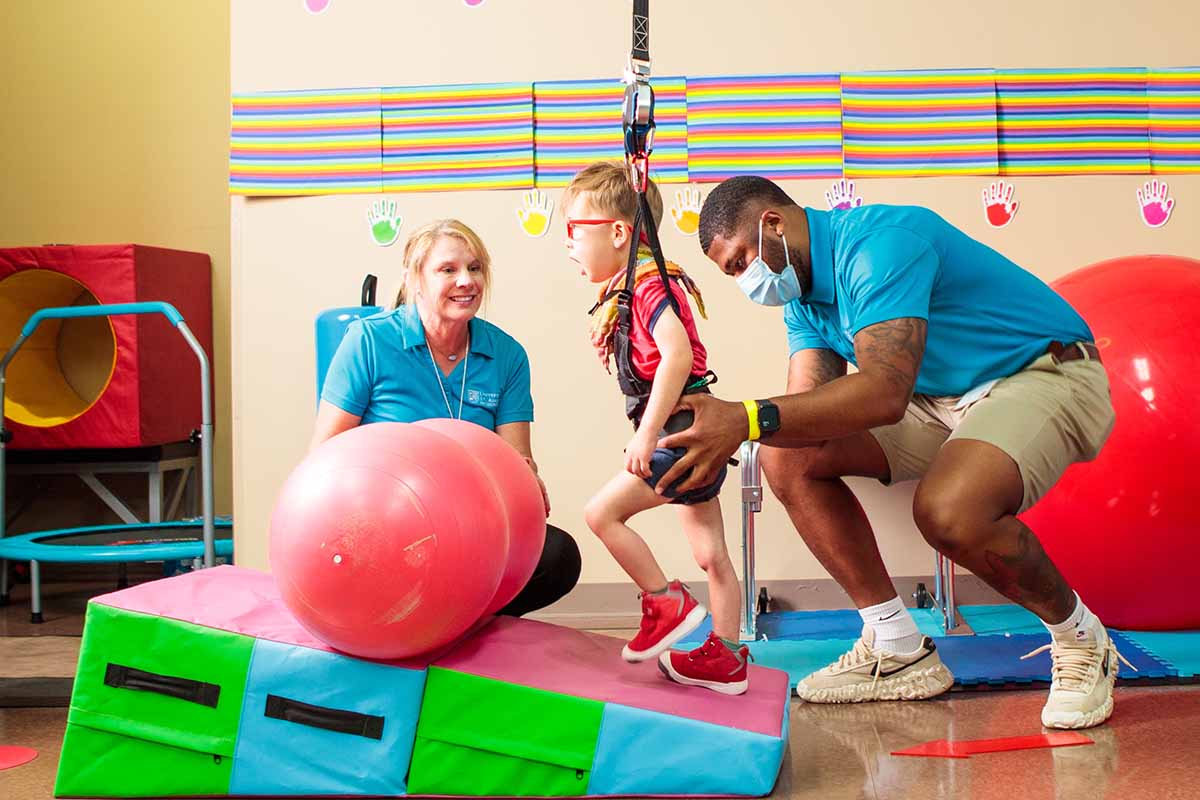
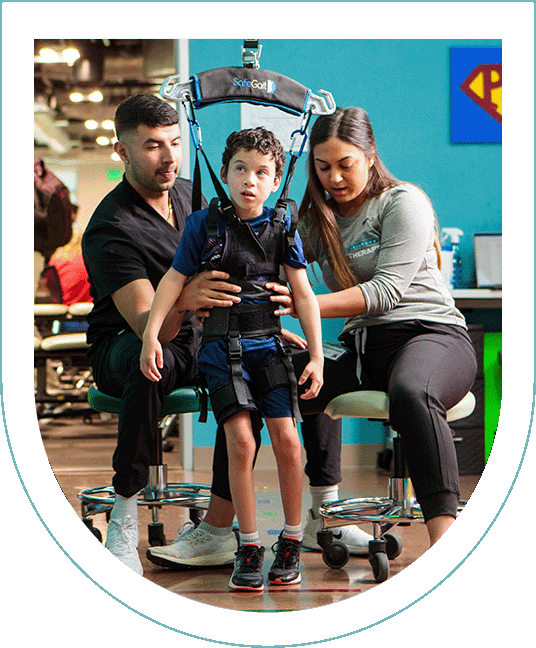
No matter which format feels like the best fit for your life, you’ll take part in in-person clinical education, gaining real-world experience with patients as an important part of your DPT journey.
Student Support
As a student at USAHS, you’ll receive structured guidance to make sure you succeed in your DPT program, no matter what format you choose . All students have Student Success Advisors who provide you with 1-on-1 support to ease the transition to graduate coursework and connect you with additional resources on campus.
You’ll also be invited to attend Virtual Meet-Ups to connect with faculty and other students, as well as USAHS Immersion Day, where you can come to campus and get acclimated in person with your chosen program.
FAQs
Do all DPT programs use PTCAS?
Not all programs are on the PTCAS list of programs. That said, many programs, including our DPT Program at USAHS, do use PTCAS. Make sure to double-check the information page for all the programs to which you’re applying.
What are the most common prerequisites?
The most common prerequisites for a DPT program are a bachelor’s degree in a relevant field, foundational science courses, a minimum GPA that varies depending on the program, PT observation hours, volunteer hours, essays and letters of recommendation.
Is the GRE required?
The GRE is generally required to apply to DPT programs. At USAHS, a combined minimum GRE score of 294 for the verbal and quantitative sections, obtained in the last five years, is recommended.
The GRE is not a universal requirement, so it’s important to check the specific requirements for each program you are planning to apply to.
The GRE is waived for USAHS program applicants with a 3.6 or higher overall cumulative GPA or a prior master’s degree, so many students can apply without needing to take the exam.
*Program designed to be completed in this time frame. Time to completion may vary by student, depending on individual progress, credits transferred and other factors.
References:
- “Physical Therapist Centralized Application Service Programs Directory,” American Physical Therapy Association (APTA), 2026 https://ptcasdirectory.apta.org/.
- “What Is Verification?” Liaison, https://help.liaisonedu.com/PTCAS_Applicant_Help_Center/Submitting_and_Monitoring_Your_PTCAS_Application/Verification_and_GPA_Calculations_for_PTCAS/1_What_is_Verification%3F.
- “Comparison By GPA,” American Physical Therapy Association (APTA), 2026 https://ptcasdirectory.apta.org/17951.aspx.
- “Volunteer Opportunities,” American Physical Therapy Association (APTA), 2026 https://www.apta.org/apta-and-you/volunteer-opportunities.