OTD Program Accreditation Status
San Marcos Campus
The entry-level occupational therapy doctoral degree (OTD) program at the San Marcos, California campus is accredited by the Accreditation Council for Occupational Therapy Education (ACOTE) of the American Occupational Therapy Association (AOTA), located at 7501 Wisconsin Avenue, Suite 510E, Bethesda, MD 20814. ACOTE’s telephone number c/o AOTA is (301) 652-AOTA and its web address is www.acoteonline.org. Graduates of the program will be eligible to sit for the national certification examination for the occupational therapist administered by the National Board for Certification in Occupational Therapy (NBCOT). After successful completion of this exam, the individual will be an Occupational Therapist, Registered (OTR). In addition, all states require licensure in order to practice; however, state licenses are usually based on the results of the NBCOT Certification Examination. A felony conviction may affect a graduate’s ability to sit for the NBCOT certification examination or attain state licensure.
Students must complete 24 weeks of Level II fieldwork within 24 months following completion of all prior didactic portions of the program. Students must complete an individual 14-week capstone experience within 18 months following completion of the remaining didactic portion of the program. The doctoral capstone experience must be started after completion of all coursework and Level II fieldwork as well as completion of preparatory activities defined in 2023 ACOTE OTD Standard D.1.3.
For more information about the occupational therapy accreditation process, contact the Accreditation Council for Occupational Therapy Education (ACOTE), 7501 Wisconsin Avenue, Suite 510E, Bethesda, MD 20814, 301-652-6611 or [email protected].
 |
St. Augustine Campus
The entry-level occupational therapy doctoral (OTD) degree program at the St. Augustine, Florida campus is accredited by the Accreditation Council for Occupational Therapy Education (ACOTE) of the American Occupational Therapy Association (AOTA), located at 7501 Wisconsin Avenue, Suite 510E, Bethesda, MD 20814. ACOTE’s telephone number c/o AOTA is (301) 652-AOTA and its web address is www.acoteonline.org. Graduates of the program will be eligible to sit for the national certification examination for the occupational therapist administered by the National Board for Certification in Occupational Therapy (NBCOT). After successful completion of this exam, the individual will be an Occupational Therapist, Registered (OTR). In addition, all states require licensure in order to practice; however, state licenses are usually based on the results of the NBCOT Certification Examination. A felony conviction may affect a graduate’s ability to sit for the NBCOT certification examination or attain state licensure.
Students must complete 24 weeks of Level II fieldwork within 24 months following completion of all prior didactic portions of the program. Students must complete an individual 14-week capstone experience 18 months following completion of the remaining didactic portion of the program. The doctoral capstone experience must be started after completion of all coursework and Level II fieldwork as well as completion of preparatory activities defined in 2023 ACOTE OTD Standard D.1.3.
For more information about the occupational therapy accreditation process, contact the Accreditation Council for Occupational Therapy Education (ACOTE), 7501 Wisconsin Avenue, Suite 510E, Bethesda, MD 20814, 301-652-6611 or [email protected].
|
Miami Campus
The entry-level occupational therapy doctoral degree (OTD) program at the Miami, Florida campus is accredited by the Accreditation Council for Occupational Therapy Education (ACOTE) of the American Occupational Therapy Association (AOTA), located at 7501 Wisconsin Avenue, Suite 510E, Bethesda, MD 20814. ACOTE’s telephone number c/o AOTA is (301) 652-AOTA and its web address is www.acoteonline.org. Graduates of the program will be eligible to sit for the national certification examination for the occupational therapist administered by the National Board for Certification in Occupational Therapy (NBCOT). After successful completion of this exam, the individual will be an Occupational Therapist, Registered (OTR). In addition, all states require licensure in order to practice; however, state licenses are usually based on the results of the NBCOT Certification Examination. A felony conviction may affect a graduate’s ability to sit for the NBCOT certification examination or attain state licensure.
Students must complete 24 weeks of Level II fieldwork within 24 months following completion of all prior didactic portions of the program. Students must complete an individual 14-week capstone experience within 18 months following completion of the remaining didactic portion of the program. The doctoral capstone experience must be started after completion of all coursework and Level II fieldwork as well as completion of preparatory activities defined in 2023 ACOTE OTD Standard D.1.3.
For more information about the occupational therapy accreditation process, contact the Accreditation Council for Occupational Therapy Education (ACOTE), 7501 Wisconsin Avenue, Suite 510E, Bethesda, MD 20814, 301-652-6611 or [email protected].
|
Austin Campus
The entry-level occupational therapy doctoral degree (OTD) program at the Austin, Texas campus is accredited by the Accreditation Council for Occupational Therapy Education (ACOTE) of the American Occupational Therapy Association (AOTA), located at 7501 Wisconsin Avenue, Suite 510E, Bethesda, MD 20814. ACOTE’s telephone number c/o AOTA is (301) 652-AOTA and its web address is www.acoteonline.org. Graduates of the program will be eligible to sit for the national certification examination for the occupational therapist administered by the National Board for Certification in Occupational Therapy (NBCOT). After successful completion of this exam, the individual will be an Occupational Therapist, Registered (OTR). In addition, all states require licensure in order to practice; however, state licenses are usually based on the results of the NBCOT Certification Examination. A felony conviction may affect a graduate’s ability to sit for the NBCOT certification examination or attain state licensure.
Students must complete 24 weeks of Level II fieldwork within 24 months following completion of all prior didactic portions of the program. Students must complete an individual 14-week capstone experience within 18 months following completion of the remaining didactic portion of the program. The doctoral capstone experience must be started after completion of all coursework and Level II fieldwork as well as completion of preparatory activities defined in 2023 ACOTE OTD Standard D.1.3.
For more information about the occupational therapy accreditation process, contact the Accreditation Council for Occupational Therapy Education (ACOTE), 7501 Wisconsin Avenue, Suite 510E, Bethesda, MD 20814, 301-652-6611 or [email protected].
|
Dallas Campus
The entry-level occupational therapy doctoral degree (OTD) program at the Dallas, Texas campus is accredited by the Accreditation Council for Occupational Therapy Education (ACOTE) of the American Occupational Therapy Association (AOTA), located at 7501 Wisconsin Avenue, Suite 510E, Bethesda, MD 20814. ACOTE’s telephone number c/o AOTA is (301) 652-AOTA and its web address is www.acoteonline.org. Graduates of the program will be eligible to sit for the national certification examination for the occupational therapist administered by the National Board for Certification in Occupational Therapy (NBCOT). After successful completion of this exam, the individual will be an Occupational Therapist, Registered (OTR). In addition, all states require licensure in order to practice; however, state licenses are usually based on the results of the NBCOT Certification Examination. A felony conviction may affect a graduate’s ability to sit for the NBCOT certification examination or attain state licensure.
Students must complete 24 weeks of Level II fieldwork within 24 months following completion of all prior didactic portions of the program. Students must complete an individual 14-week capstone experience within 18 months following completion of the remaining didactic portion of the program. The doctoral capstone experience must be started after completion of all coursework and Level II fieldwork as well as completion of preparatory activities defined in 2023 ACOTE OTD Standard D.1.3.
For more information about the occupational therapy accreditation process, contact the Accreditation Council for Occupational Therapy Education (ACOTE), 7501 Wisconsin Avenue, Suite 510E, Bethesda, MD 20814, 301-652-6611 or [email protected].
|
OTD (96 credits)
Post-Graduation Licensure
The OTD satisfies the educational requirements for licensure in all 50 states and the District of Columbia. For states denoted with clinical field experience and other on-the-ground activity restrictions, USAHS does not have the necessary state authorization approvals to offer on-the-ground activities of this kind in those states at this time. However, these restrictions should not impact a graduates’ eligibility for professional licensure in his/her state, provided all other requirements are met.
USAHS has not made a determination that its curriculum meets the educational requirements for licensure or certification in the following locations: American Samoa, the Commonwealth of Puerto Rico, Guam, the Virgin Islands, the Commonwealth of the Northern Mariana Islands, the Republic of the Marshall Islands, the Federated States of Micronesia, and the Republic of Palau.
State Approvals
USAHS is currently accepting applications for enrollment in the Doctor of Occupational Therapy for residents of the following states: Alabama, Alaska, Arizona, Arkansas, California, Colorado, Connecticut, Delaware, District of Columbia, Florida, Georgia, Hawaii, Idaho, Illinois, Indiana, Iowa, Kansas, Kentucky, Louisiana, Maine, Maryland, Massachusetts, Michigan, Minnesota, Mississippi, Missouri, Montana, Nebraska, Nevada, New Hampshire, New Jersey, New Mexico, New York, North Carolina, North Dakota, Ohio, Oklahoma, Oregon, Pennsylvania, Rhode Island, South Carolina, South Dakota, Tennessee, Texas, Utah, Vermont, Virginia, Washington, West Virginia, Wisconsin, and Wyoming.
USAHS is not accepting applications from prospective students residing in states where the institution does not have state authorization. However, prospective students are encouraged to check back in the near future as the program may be offered in additional states. Current and admitted students are also advised to monitor this page for any updates prior to relocating to another state, as this can have an impact on continued enrollment in the program and the ability to be placed for on-the-ground activities or clinical field experiences.
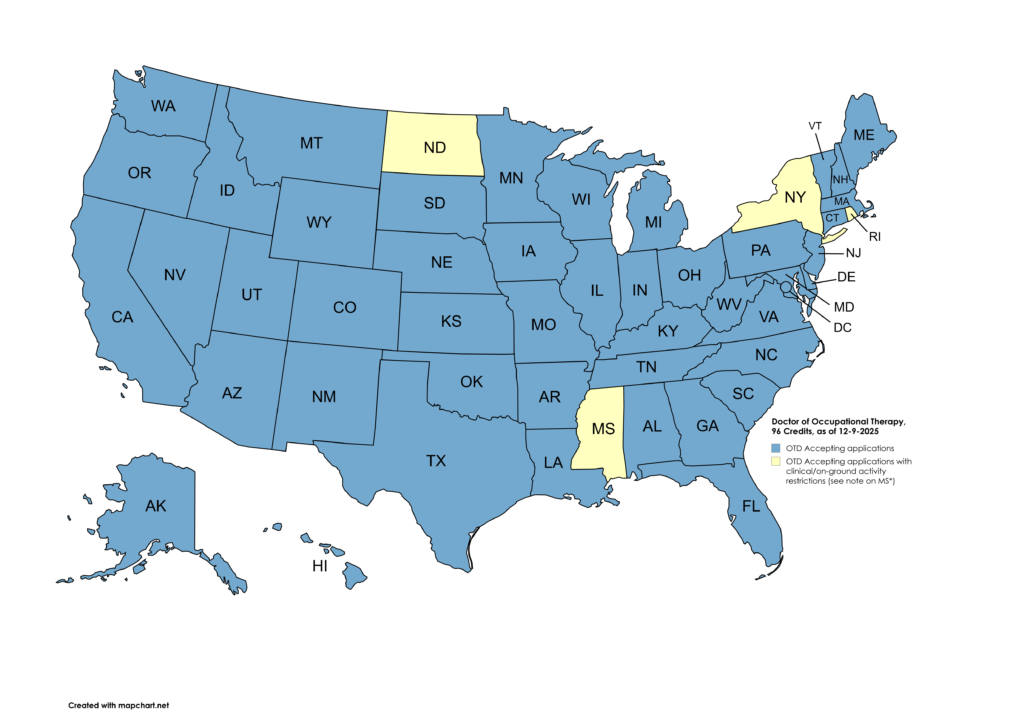
*Please note for field placements in Mississippi, the Mississippi Commission on College Accreditation (MCCA) requires submission of application materials prior to each commission meeting, typically held 3-4 times per year, for review and approval by the MCCA prior to the beginning of field placement.
It remains the student’s responsibility to understand, evaluate, and comply with all requirements relating to field education experiences, licensing or certification, authorization or endorsement for the state in which she or he resides.
OTD (Hybrid Immersion) (96 credits) Dallas
Post-Graduation Licensure
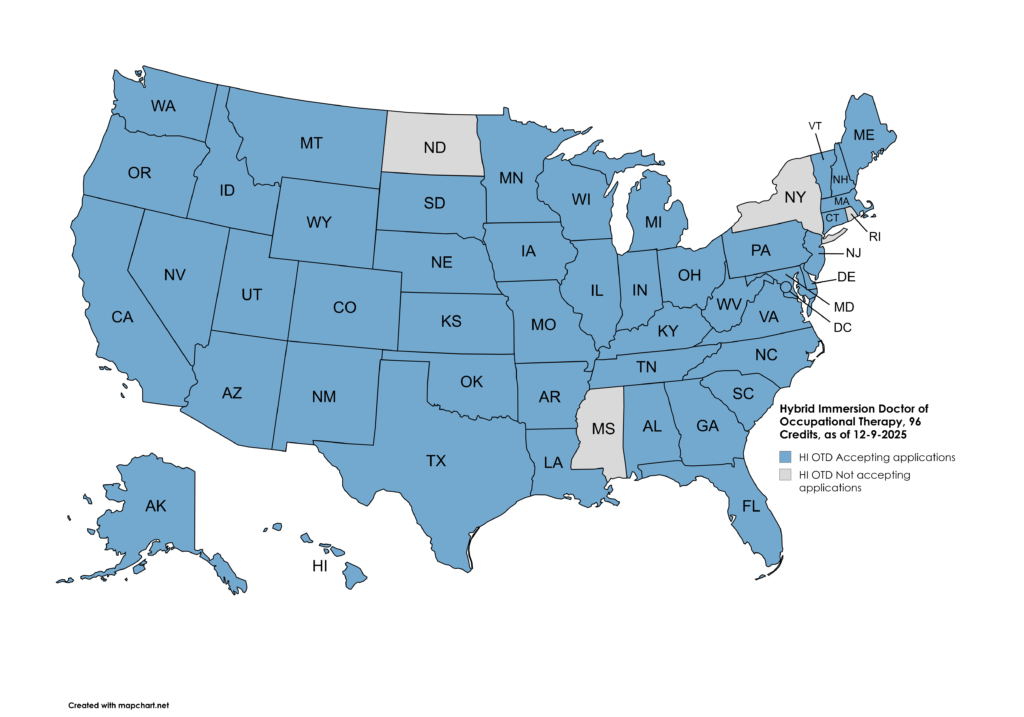
The OTD (Hybrid Immersion) satisfies the educational requirements for licensure in all 50 states and the District of Columbia. For states denoted with clinical field experience and other on-the-ground activity restrictions, USAHS does not have the necessary state authorization approvals to offer on-the-ground activities of this kind in those states at this time. However, these restrictions should not impact a graduates’ eligibility for professional licensure in his/her state, provided all other requirements are met.
USAHS has not made a determination that its curriculum meets the educational requirements for licensure or certification in the following locations: American Samoa, the Commonwealth of Puerto Rico, Guam, the Virgin Islands, the Commonwealth of the Northern Mariana Islands, the Republic of the Marshall Islands, the Federated States of Micronesia, and the Republic of Palau.
State Approvals
USAHS currently is accepting applications for enrollment in the OTD, Hybrid Immersion (Dallas) for residents of the following states: Alabama, Alaska, Arizona, Arkansas, California, Colorado, Connecticut, Delaware, District of Columbia, Florida, Georgia, Hawaii, Idaho, Illinois, Indiana, Iowa, Kansas, Kentucky, Louisiana, Maine, Maryland, Massachusetts, Michigan, Minnesota, Missouri, Montana, Nebraska, Nevada, New Hampshire, New Jersey, New Mexico, North Carolina, Ohio, Oklahoma, Oregon, Pennsylvania, South Carolina, South Dakota, Tennessee, Texas, Utah, Vermont, Virginia, West Virginia, Washington, Wisconsin and Wyoming.
USAHS is not accepting applications from prospective students residing in states where the institution does not have state authorization. However, prospective students are encouraged to check back in the near future as the program may be offered in additional states. Current and admitted students are also advised to monitor this page for any updates prior to relocating to another state, as this can have an impact on continued enrollment in the program and the ability to be placed for on-the-ground activities or clinical field experiences.
It remains the student’s responsibility to understand, evaluate, and comply with all requirements relating to field education experiences, licensing or certification, authorization or endorsement for the state in which she or he resides.
Flex Doctor of Occupational Therapy (Dallas) (96 credits)
Post-Graduation Licensure
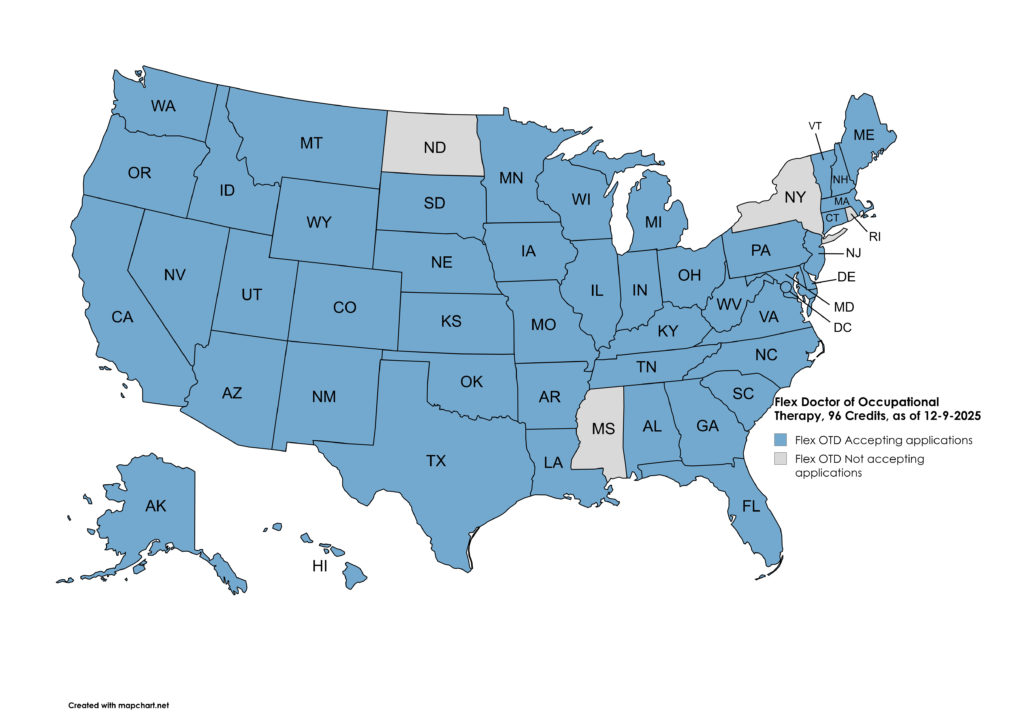
The Flex OTD satisfies the educational requirements for licensure in all 50 states and the District of Columbia. For states denoted with clinical field experience and other on-the-ground activity restrictions, USAHS does not have the necessary state authorization approvals to offer on-the-ground activities of this kind in those states at this time. However, these restrictions should not impact a graduates’ eligibility for professional licensure in his/her state, provided all other requirements are met.
USAHS has not made a determination that its curriculum meets the educational requirements for licensure or certification in the following locations: American Samoa, the Commonwealth of Puerto Rico, Guam, the Virgin Islands, the Commonwealth of the Northern Mariana Islands, the Republic of the Marshall Islands, the Federated States of Micronesia, and the Republic of Palau.
State Approvals
USAHS currently is accepting applications for enrollment in the Flex Doctor of Occupational Therapy for residents of the following states: Alabama, Alaska, Arizona, Arkansas, California, Colorado, Connecticut, Delaware, District of Columbia, Florida, Georgia, Hawaii, Idaho, Illinois, Indiana, Iowa, Kansas, Kentucky, Louisiana, Maryland, Massachusetts, Maine, Michigan, Minnesota, Missouri, Montana, Nebraska, Nevada, New Hampshire, New Jersey, New Mexico, North Carolina, Ohio, Oklahoma, Oregon, Pennsylvania, South Carolina, South Dakota, Tennessee, Texas, Utah, Virginia, Vermont, West Virginia, Washington, Wisconsin and Wyoming.
USAHS is not accepting applications from prospective students residing in states where the institution does not have state authorization. However, prospective students are encouraged to check back in the near future as the program may be offered in additional states. Current and admitted students are also advised to monitor this page for any updates prior to relocating to another state, as this can have an impact on continued enrollment in the program and the ability to be placed for on-the-ground activities or clinical field experiences.
It remains the student’s responsibility to understand, evaluate, and comply with all requirements relating to field education experiences, licensing or certification, authorization or endorsement for the state in which she or he resides.
Close