

Maybe you’ve recently graduated from college or decided to return to school and are drawn to careers where you can make a difference in people’s lives. You’ve thought about occupational therapy (OT) but aren’t ready to settle down in one place. So now you might be wondering how to become a travel occupational therapist (OT).
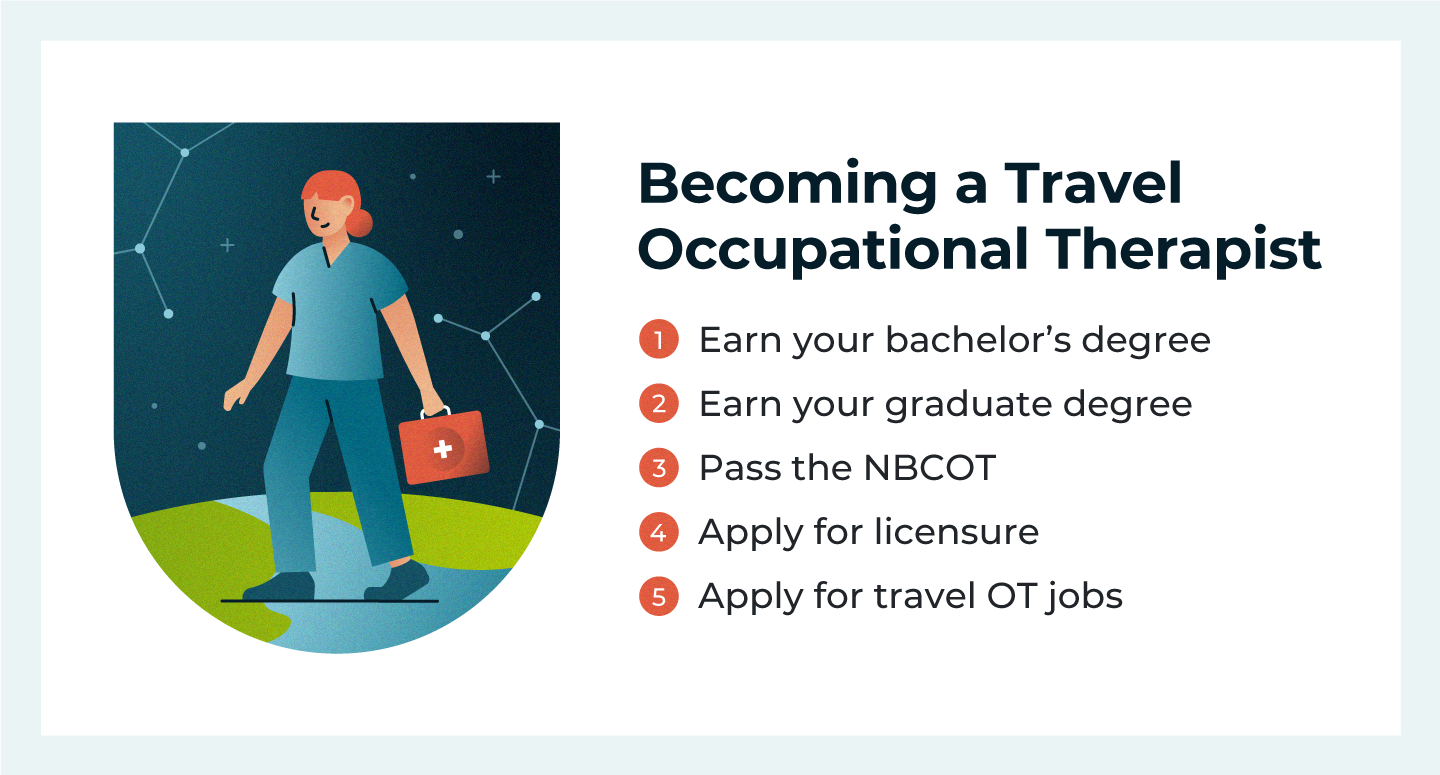
A travel occupational therapist must follow the professional path of other OTs to become certified and licensed to practice. First, you’ll earn your bachelor’s degree, then pursue a Master of Occupational Therapy (MOT) or Doctor of Occupational Therapy (OTD), pass the NBCOT and obtain licensure.
Learn how to practice traveling occupational therapy and everything you need to know about taking the next steps in your career.
Table of Contents
- What Is a Travel Occupational Therapist?
- Five Steps To Become a Travel Occupational Therapist
- Pros and Cons of Being a Travel Occupational Therapist
- Traveling Occupational Therapist Salary
What Is a Travel Occupational Therapist?
A travel occupational therapist has the same core responsibilities as a regular OT. The main difference is that a traveling occupational therapist visits different locations within the United States and works on short-term contracts, typically for thirteen weeks.
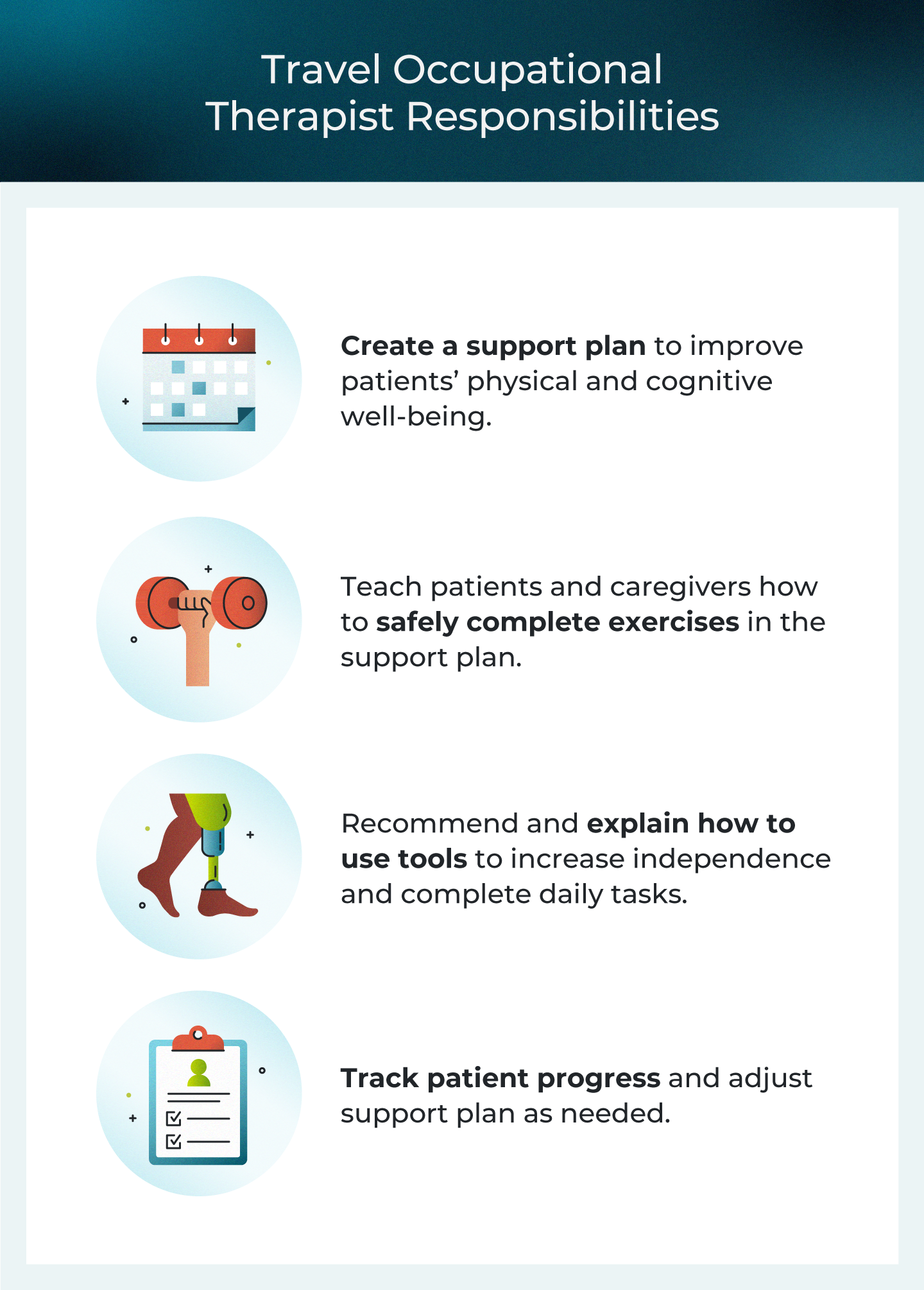
The main responsibilities of a travel occupational therapist include:
- Creating a support plan to help improve patients’ physical and cognitive well-being
- Teaching patients and caregivers how to safely and properly complete exercises in the support plan
- Recommending and explaining how patients can use tools to increase independence and complete daily tasks
- Tracking patient progress and adjusting the support plan as needed
A traveling occupational therapist typically finds new assignments in one of two ways:
- Work with an agency. A travel occupational therapy agency will interview you and decide if they will hire you. From there, you’ll match with a recruiter who will send you opportunities in travel occupational therapy and help you apply.
- Research opportunities independently. You’ll explore and apply for positions on your own.
Professionals in travel occupational therapy work in the same settings non-travel OTs work, including:
- Clinics
- Home healthcare
- Hospitals
- Nursing homes
- Mental health facilities
- Rehabilitation centers
- Schools
If you enjoy switching up your routine, traveling and meeting new coworkers around the country, a career as a traveling OT might be right for you.
How To Become a Travel Occupational Therapist
As with any healthcare profession, you must pursue an advanced degree and formal training and work under a mentor before starting your career. Keep reading for everything you need to know about becoming a traveling occupational therapist.
1. Earn Your Bachelor’s Degree
What degree do you need to be a travel therapist? The first step to a career in travel occupational therapy is earning a bachelor’s degree from an accredited university. If you wish to become an occupational therapy assistant (OTA) rather than an OT, you need an associate’s degree in OT. For OTAs seeking an MOT degree, USAHS offers an OTA to MOT bridge program.
While you can technically apply for a master’s or doctorate OT degree with any bachelor’s, there are prerequisites. It’s typically easier to apply for a graduate degree program if your bachelor’s requires classes such as:
- Human Anatomy
- Statistics
- Anthropology
- Human Physiology
- Psychology
There are often unique requirements for different OT programs, so if you’re considering a career as a traveling OT, review prospective programs in advance to see which classes you should prioritize to simplify your graduate school applications. Some of the best degrees for prospective occupational therapists include:
- Occupational Therapy
- Biology
- Psychology
- Education
- Child Development
- Kinesiology
If you graduate from a different program and want to pursue a career in travel occupational therapy, some universities offer classes to bridge the gap. This is called a post-baccalaureate, or post-bacc, program and allows students to complete required courses and apply for advanced degree programs, such as an MOT or OTD.
2. Earn Your Graduate Degree
Once you’ve earned your bachelor’s degree, you’ll need a master’s or doctoral degree to become a travel occupational therapist. The University of St. Augustine for Health Sciences (USAHS) is an accredited university that offers both program types:
An MOT is typically a two-year degree program that allows you to practice OT after you pass the National Board for Certification in Occupational Therapy (NBCOT) and obtain a license.1 An OTD is a more advanced program that allows you to practice or explore other OT-related professions, such as policymaking and teaching.
When you’re deciding where to attend OT school, consider your budget, career goals, accreditation and the level of support you want from a program.
3. Pass the NBCOT
To practice travel occupational therapy throughout the country, you’ll need to pass the NBCOT exam.
You’ll need to renew your NBCOT certification every three years, but you don’t need to retake the test. Instead, the NBCOT offers practice assessments and other activities you can complete.
4. Apply for Licensure
OT licensing requirements vary by state, but you’ll typically need to provide the following:2
- Proof of identification
- A licensing fee
- Proof you’ve worked under a licensed supervising OT (in some states)
- NBCOT certification
Some states require transcripts from your MOT or OTD program, background checks and more. Some states require work under a supervising OT, and the time requirement varies by state.
Traveling OTs will need licensure for each state they work in. The Occupational Therapy Licensure Compact (OT Compact) is a shared licensing agreement among several states that allows you to work in any participating state if you have a valid OT license in one of them.3 You can check the OT Compact Map to see which states participate.4
5. Apply for Travel OT Positions
Travel occupational therapy professionals either find assignments or work with a travel employment agency. Working independently is great for maximizing control over your work schedule.
Those who want to expand their OT travel career but do not enjoy searching for jobs might consider working with an agency. If you stick with an agency for an extended period, it gives your recruiter time to understand your strengths and goals so they can pick the best opportunities for you.
What Are the Benefits of Travel Occupational Therapy?
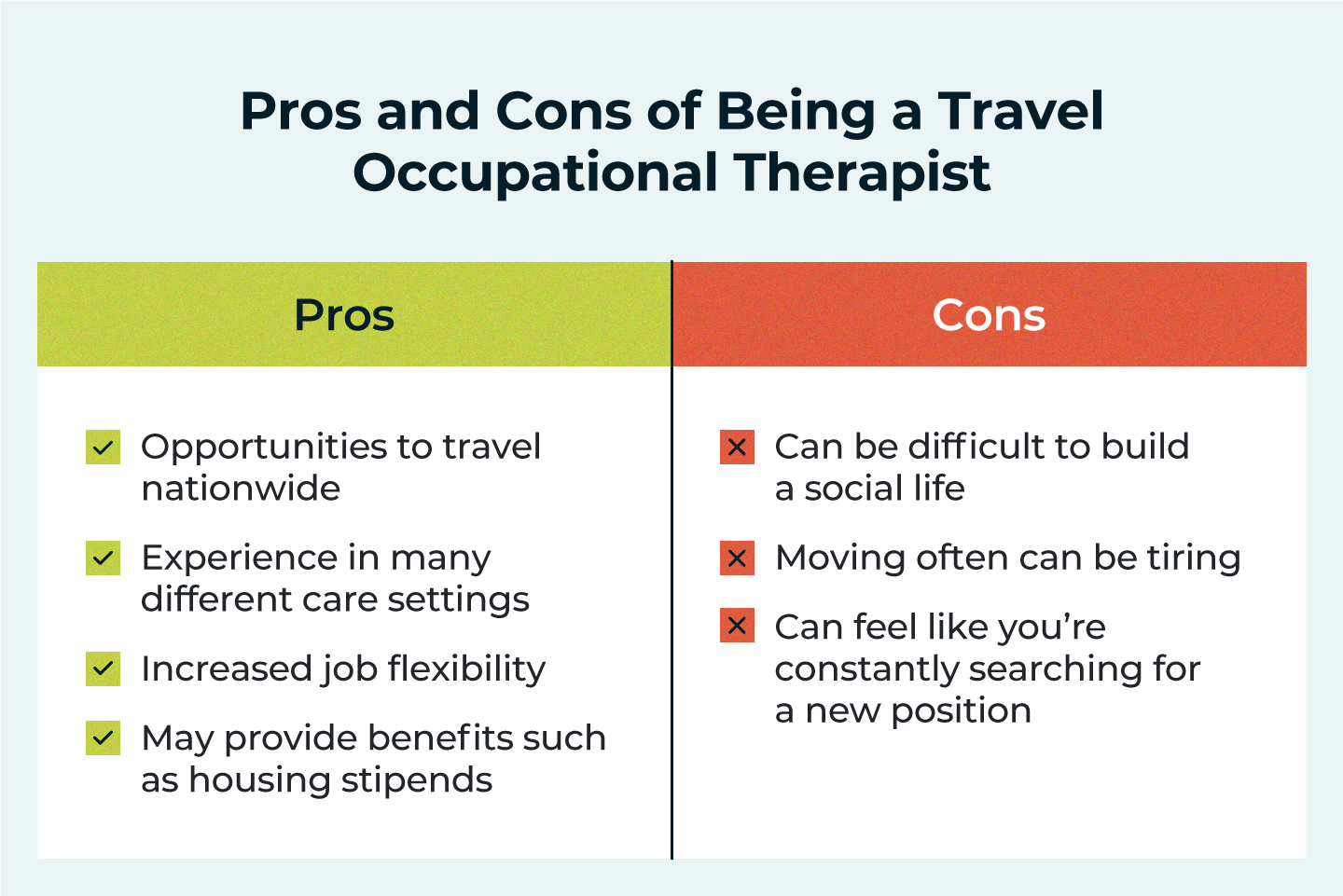
You might know what you want out of your OT career—freedom and flexibility are a few advantages of traveling OT assignments. Are you still wondering if a traditional or OT travel position is better for you? There are many reasons to be an OT, but here are some main pros of being a traveling occupational therapist:
- Opportunities to travel nationwide
- Experience in many different care settings
- Increased job flexibility
- May provide benefits such as housing stipends
However, a travel position isn’t for everyone. Here are some disadvantages of being an OT travel professional:
- It can be difficult to build a social life
- Moving often can be tiring
- It can feel like you’re constantly searching for a new position
Many full-time, non-travel OT positions require you to remain in the role for a few years before advancing your career. If you’re unsure about which area of OT to specialize in, the shorter work assignments of travel occupational therapy allow you to figure out your career preferences before committing.
How Much Do Travel OTs Make?
While there is no specific data on travel occupational therapy salary, according to the Bureau of Labor Statistics (BLS), the median OT salary is $98,340 per year.5 If you work with an agency, you might also have access to these benefits in a travel occupational therapy career:
- Referral bonuses
- 401(k) contributions
- Housing stipends
- Contract completion bonuses
Many OTs choose to travel at the beginning or end of their careers, valuing the competitive traveling occupational therapist salary and the ability to take time off between assignments.
Start Your Travel Occupational Therapy Career with USAHS
The stability of a traditional OT role is appealing, but an OT travel position offers unique benefits—including potentially higher pay, travel opportunities, paid housing and flexibility.
Are you ready to become a travel occupational therapist? Apply now to USAHS’ MOT program to take the next step in your career and help improve the quality of life for people across the U.S. We’re here to support you on your educational journey.
Salary data may not reflect starting pay for recent graduates.
Sources:
- National Board for Certification in Occupational Therapy, “National Board Certification in Occupational Therapy,” NBCOT, 2025, https://www.nbcot.org/.
- National Board for Certification in Occupational Therapy, “Find Your State Licensing Board’s Contact Information,” NBCOT, 2025, https://www.nbcot.org/state-boards.
- Occupational Therapy Licensure Compact, “About,” Occupational Therapy Licensure Compact, n.d., https://otcompact.gov/about/.
- Occupational Therapy Licensure Compact, “Compact Map,” Occupational Therapy Therapy Licensure Compact, n.d., https://otcompact.gov/compact-map/.
- U.S. Bureau of Labor Statistics, “Occupational Therapists, Summary,” BLS, April 18, 2025, https://www.bls.gov/ooh/healthcare/occupational-therapists.htm.