The Doctor of Nursing Practice (DNP) program gives working nurses additional education in competencies such as systems leadership, healthcare policy, interprofessional collaboration, evidence-based practice and health information systems. Our doctorate of nursing practice program is among the highest-level hands-on + online DNP degree programs available. We offer personalized support, popular role specialties, acceleration options and the flexibility of online + hands-on learning. Advance your career with a doctorate in nursing that prepares you for advanced practice nursing.
Doctor of Nursing Practice (DNP) Program at a Glance
Format: Online classes + hands-on
Start Dates: Sept., Jan., May, plus midterm starts
Duration: 2.3-4 years* (7-12 trimesters) depending on entry path and role specialty
Role Specialties (BSN-Entry): Family Nurse Practitioner, Psychiatric Mental Health Nurse Practitioner, Nurse Executive
Please note, the DNP-FNP program typically takes 3 years and 4 months to complete, based off the most recent 2-year graduate data (2022-2023 and 2023-2024); however, individual experiences will vary based on factors including, but not limited to, individual progress, traditional vs. accelerated pathway, credits transferred and other factors.
100%
Clinical Placements In 2022-2024. Future clinical education placement experience will vary based on individual student specialty and academic needs, as well as site availability for assignments from term to term.
97%
First-Time FNP Certification Pass Rate Based on 2023 USAHS MSN-FNP, DNP-FNP and PGC (FNP) graduates who took the ANCC or AANP certification exam. The 2023 AANPCB national first-time certification exam pass rate was 73%. First-time licensure pass rates are reported two years post-graduation; rates for 2024 graduates expected in early 2027.
100%
Doctoral-Prepared Faculty
40+
Years in Graduate Health Sciences Education
Nursing Program Grants
USAHS supports your nursing journey towards earning a DNP degree with Special Tuition Grant savings. The grant is calculated and applied on a per-credit basis. The total grant amount assumes the completion of the full number of credits in the program. Any transfer credits will reduce the amount of the grant awarded. This offer is not a guarantee that all candidates eligible for the offer will be granted acceptance or admission into USAHS. All prospective students will be subject to the same standard admission and registration process when applying to USAHS. The Grant is applicable to tuition only and does not apply toward books, materials, and other supplies or fees. This offer is only valid for eligible new students who enroll and start classes in the above programs at USAHS in Summer 2026. Please refer to the Financial Aid webpage for additional information.
Criteria Available to all eligible students No application is needed
DNP Professional Grant
All DNP Programs $2,500
Criteria Available to all eligible students No application is needed
The Doctor of Nursing Practice (DNP), Master of Science in Nursing (MSN), and Post-Graduate NP Certificate programs at the University of St. Augustine for Health Sciences are accredited by the Commission on Collegiate Nursing Education, 655 K Street NW, Suite 750, Washington, DC 20001, 202-887-6791.
Have an MSN?
Have an MSN? If you are seeking a DNP with a new role specialty, you can apply to the BSN-DNP and accelerate your path to completion with transfer credits for core MSN courses.
Students in the BSN-entry DNP degree program choose a role specialty and complete the required specialty courses, while students in the MSN-entry DNP degree program do not choose a role specialty. If you have an MSN and are seeking a DNP with role specialty, you can apply to the BSN-DNP with your preferred role specialty and accelerate your path to completion with transfer credits for core MSN courses.
Family nurse practitioners play a critical role in improving the primary patient care experience. As a FNP graduate with a DNP degree and advanced practice nurse, you will partner with families across the lifespan to promote preventative care, diagnose conditions and treat acute and chronic illnesses.
In our Psychiatric Mental Health Nurse Practitioner role specialty, you’ll prepare to deliver comprehensive, evidence-based mental health care across the lifespan. As a graduate of the DNP PMHNP program, you will gain advanced expertise in assessing, diagnosing, and managing psychiatric and behavioral health conditions using psychotherapy, psychopharmacology and holistic care approaches. The DNP PMHNP track emphasizes leadership, clinical excellence and systems thinking to address the rising demand for mental health services in primary care, community and acute care settings. Through immersive clinical practicum experiences and doctoral-level coursework, graduates are prepared to lead interprofessional teams, influence mental health policy and drive measurable improvements in population health while providing a full range of psychiatric services.
Are you a natural team leader? The Nurse Executive role specialty will help prepare you for a role as a manager, director, supervisor or chief nursing officer. With a doctorate in nursing you will be responsible for human resource management, as well as healthcare finance and economic operations.
Students who complete the Nurse Executive role specialty are eligible to receive the following certification:
Nurse Executive-Advanced (NEA-BC) by the American Nurses Credentialing Center (ANCC)
Close
DNP Curriculum
BSN-entry DNP Curriculum
Students who pursue their Doctor of Nursing Practice and choose the Family Nurse Practitioner role specialty will complete 71 credit hours and a total of 1,334 practicum hours to earn the DNP degree.
Students who pursue their Doctor of Nursing Practice and choose the Psychiatric Mental Health Nurse Practitioner role specialty will complete 77 credit hours and a total of 1,334 practicum hours to earn their DNP degree.
Students who pursue their Doctor of Nursing Practice and choose the Nurse Executive role specialty will complete 64 credit hours to earn the DNP degree and a total of 1,276 practicum hours.
Family Nurse Practitioner Role Specialty Courses
Students who pursue their Doctor of Nursing Practice and choose the Family Nurse Practitioner (FNP) role specialty will complete 71 credit hours to earn the DNP degree and a total of 1,334 practicum hours.
BSN-entry DNP Family Nurse Practitioner (FNP) Role Specialty Curriculum
Credit Hours
Trimester 1
IPE 7001 Interprofessional Education and Collaborative Practice ▀ IPE 7001B Interprofessional Education and Collaborative Practice ▀
3
IPE 7121 Organizational Leadership and Policy in Healthcare IPE 7121B Organizational Leadership and Policy in Healthcare
3
Trimester 2
NUR 7050 Evidence-Based Practice for Nurse Leaders (22.5 indirect contact hours)▀
3
IPE 7421 Interprofessional Approaches to Regional and Global Population Health IPE 7421B Interprofessional Approaches to Regional and Global Population Health
3
Trimester 3
NUR 7610 Advanced Physiology and Pathophysiology
3
NUR 7161 Theoretical and Scientific Underpinnings for Nursing Practice
3
Trimester 4
NUR 7560 Advanced Pharmacology
3
IPE 7400 Healthcare Informatics and Technology Management IPE 7400B Healthcare Informatics and Technology Management
3
Trimester 5
NUR 7580 Advanced Health Assessment and Differential Diagnosis
3
HSA 7236 Accounting, Finance and Economics for the Healthcare Leader
3
Trimester 6
NUR 7570 Primary Healthcare of the Family I REQUIRED INTENSIVE
3
HSA 7260 Operations and Quality Management in Healthcare
3
Trimester 7
NUR 7571 FNP Role Practicum I (4) (232 contact hours) ♦
4
NUR 7230 Program/Project Planning and Management for Evidence-Based Practice and Policy Change
3
Trimester 8
NUR 7575 Primary Healthcare of the Family II
3
NUR 7525 Data-Driven Evaluation and Clinical Analytics for Outcomes Improvement
3
Trimester 9
NUR 7572 FNP Role Practicum II (4) (232 contact hours) ♦
4
NUR 7801 DNP Practicum I (3) (174 contact hours) ♦
3
NUR 7455 Special Topics in Professional Nursing Practice* *Required only for Arkansas students who must complete at least one credit hour. This course is not eligible for Title IV Financial Aid.
1-4
Trimester 10
NUR 7585 Primary Healthcare of the Family III
3
NUR 7802 DNP Practicum II (3) (174 contact hours)♦
3
Trimester 11
NUR 7573 FNP Role Practicum III (5) (290 contact hours) ♦
5
Trimester 12
NUR 7803 DNP Practicum III (4) (232 contact hours) ♦
4
Total Credit Hours for Core Courses
Students in Arkansas must complete 72 degree credit hours
71
Psychiatric Mental Health Nurse Practitioner Role Specialty Courses
Students who pursue their Doctor of Nursing Practice and choose the Psychiatric Mental Health Nurse Practitioner (PMHNP) role specialty will complete 77 credit hours to earn the DNP degree and a total of 1,334 practicum hours.
BSN-entry DNP Psychiatric Mental Health Nurse Practitioner (PMHNP) Role Specialty Curriculum (subject to change)
Credit Hours
Trimester 1
IPE 7001 Interprofessional Education and Collaborative Practice
3
IPE 7121 Organizational Leadership and Policy in Healthcare
3
Trimester 2
NUR 7161 Theoretical and Scientific Underpinnings for Nursing Practice
3
IPE 7400 Healthcare Informatics and Technology Management
3
Trimester 3
NUR 7050 Evidence-based Practice for Nurse Leaders
3
IPE 7421 Interprofessional Approaches to Regional and Global Population Health
3
Trimester 4
NUR 7610 Advanced Physiology and Pathophysiology
3
NUR 7560 Advanced Pharmacology
3
Trimester 5
NUR 7580 Advanced Health Assessment and Differential Diagnosis
3
NUR 7310 Advanced Neurobiology and Psychopathophysiology
3
Trimester 6
NUR 7315 Advanced Psychopharmacology
3
NUR 7330 Psychotherapy for Psychiatric Mental Health Nurse Practitioner Practice
3
Trimester 7
NUR 7350 PMHNP: Acute and Chronic Management of Child/Adolescent with Psychiatric Mental Health Conditions - Required Intensive
3
NUR 7541 PMHNP Practicum I Child & Adolescent Populations (232 contact hours) ♦
4
Trimester 8
NUR 7375 PMHNP: Acute and Chronic Management of the Adult and Older Adult with Psychiatric Mental Health Conditions
3
NUR 7542 PMHNP Practicum II Adult and Older Adult Populations (232 contact hours) ♦
4
Trimester 9
NUR 7230 Program/Project Planning and Management for Evidence-Based Practice and Policy Change
3
NUR 7543 PMHNP Practicum III Diverse/ Special Populations (290 contact hours) ♦
5
Trimester 10
NUR 7525 Data-Driven Evaluation and Clinical Analytics for Outcomes Improvement
3
NUR 7801 DNP Practicum I (174 contact hours) ♦
3
Trimester 11
HSA 7260 Operations and Quality Management
3
NUR 7802 DNP Practicum II (174 contact hours) ♦
3
Trimester 12
HSA 7236 Accounting, Finance, and Economics for the Healthcare Leader
3
NUR 7803 DNP Practicum III (232 contact hours) ♦
4
Total Credit Hours for Core Courses
77
Nurse Executive Role Specialty Courses
Students who pursue their Doctor of Nursing Practice and choose the Nurse Executive role specialty will complete 64 credit hours to earn the DNP degree and a total of 1,276 practicum hours.
BSN-entry DNP Nurse Executive (NEx) Role Specialty Curriculum
Credit Hours
Trimester 1
IPE 7001 Interprofessional Education and Collaborative Practice ▀ IPE 7001B Interprofessional Education and Collaborative Practice ▀
3
IPE 7121 Organizational Leadership and Policy in Healthcare ▀ IPE 7121B Organizational Leadership and Policy in Healthcare ▀
3
Trimester 2
NUR 7050 Evidence-Based Practice for Nurse Leaders (22.5 indirect contact hours)▀
3
IPE 7421 Interprofessional Approaches to Regional and Global Population Health ▀ IPE 7421B Interprofessional Approaches to Regional and Global Population Health ▀
3
Trimester 3
NUR 7161 Theoretical and Scientific Underpinnings for Nursing Practice
3
IPE 7400 Healthcare Informatics and Technology Management IPE 7400B Healthcare Informatics and Technology Management
3
Trimester 4
HSA 7200 Foundations of Healthcare Administration
3
HSA 7250 Human Resource Mgt & Organizational Development in Healthcare
3
Trimester 5
IPE 7133 Foundations in Healthcare Administration with Strategic Planning
3
NUR 7461 DNP Indirect Care Role Practicum I (232 contact hours) ♦
4
Trimester 6
NUR 7230 Program/Project Planning and Management for Evidence-Based Practice and Policy Change
3
NUR 7462 DNP Indirect Care Role Practicum II (232 contact hours) ♦
4
Trimester 7
NUR 7525 Data-Driven Evaluation and Clinical Analytics for Outcomes Improvement
3
HSC 7470 Legal and Regulatory Issues
3
Trimester 8
HSA 7260 Operations and Quality Management in Healthcare
3
NUR 7801 DNP Practicum I (232 contact hours)♦
4
Trimester 9
HSA 7236 Accounting, Finance and Economics for the Healthcare Leader
3
NUR 7802 DNP Practicum II (232 contact hours) ♦
4
Trimester 10
NUR 7803 DNP Practicum III (348 contact hours) ♦
6
Total Credit Hours for Core Courses
64
MSN-entry DNP Curriculum
In order to earn a doctorate in nursing, students with an MSN degree from another accredited university need to complete between 42-52 credits and a total of 1,276 practicum hours. By request, MSN transcripts can be evaluated for potential transfer of credits, minimizing the number of credits required to complete this degree. The number of practicum hours required for a DNP will be determined by the number of practicum hours completed in the MSN program.
USAHS MSN graduates in Nurse Educator or Nurse Executive role specialties will only need to complete an additional 30 total credits to earn their DNP degree, while USAHS MSN FNP graduates will only need to complete an additional 22 credit hours since they will have completed 18 hours of core courses in their MSN program. These core courses are required in both our MSN and DNP degree programs and were designed to meet the MSN and DNP essential competencies.
MSN-entry DNP Curriculum
Credit Hours
Trimester 1
IPE 7001 Interprofessional Education and Collaborative Practice▀ IPE 7001B Interprofessional Education and Collaborative Practice▀
3
IPE 7121 Organizational Leadership and Policy in Healthcare ▀ IPE 7121B Organizational Leadership and Policy in Healthcare ▀
3
Trimester 2
NUR 7050 Evidence-Based Practice for Nurse Leaders (22.5 indirect contact hours)▀
3
IPE 7421 Interprofessional Approaches to Regional and Global Population Health ▀ IPE 7421B Interprofessional Approaches to Regional and Global Population Health ▀
3
Trimester 3
NUR 7161 Theoretical and Scientific Underpinnings for Nursing Practice
3
NUR 7230 Program/Project Planning and Management for Evidence-Based Practice and Policy Change
3
Trimester 4
NUR 7525 Data-Driven Evaluation and Clinical Analytics for Outcomes Improvement
3
IPE 7400 Healthcare Informatics and Technology Management IPE 7400B Healthcare Informatics and Technology Management
3
Trimester 5
NUR 7801 DNP Practicum I (232-406 contact hours) ♦
4-7
HSA 7260 Operations and Quality Management in Healthcare HSA 7260B Operations and Quality Management in Healthcare
3
Trimester 6
HSA 7236 Accounting, Finance and Economics for the Healthcare Leader
3
NUR 7802 DNP Practicum II (232-406 contact hours) ♦
4-7
Trimester 7
NUR 7803 DNP Practicum III (232-464 contact hours) ♦
4-8
Total Credit Hours for MSN to DNP Degree
42-52
♦ Course requires practicum hours.
▀ Course offers optional immersion.
Close
DNP Accreditation and State Approvals/Post-Graduation Licensure
Doctor of Nursing Practice (DNP) (Non – NP Role Specialty)
State Approvals
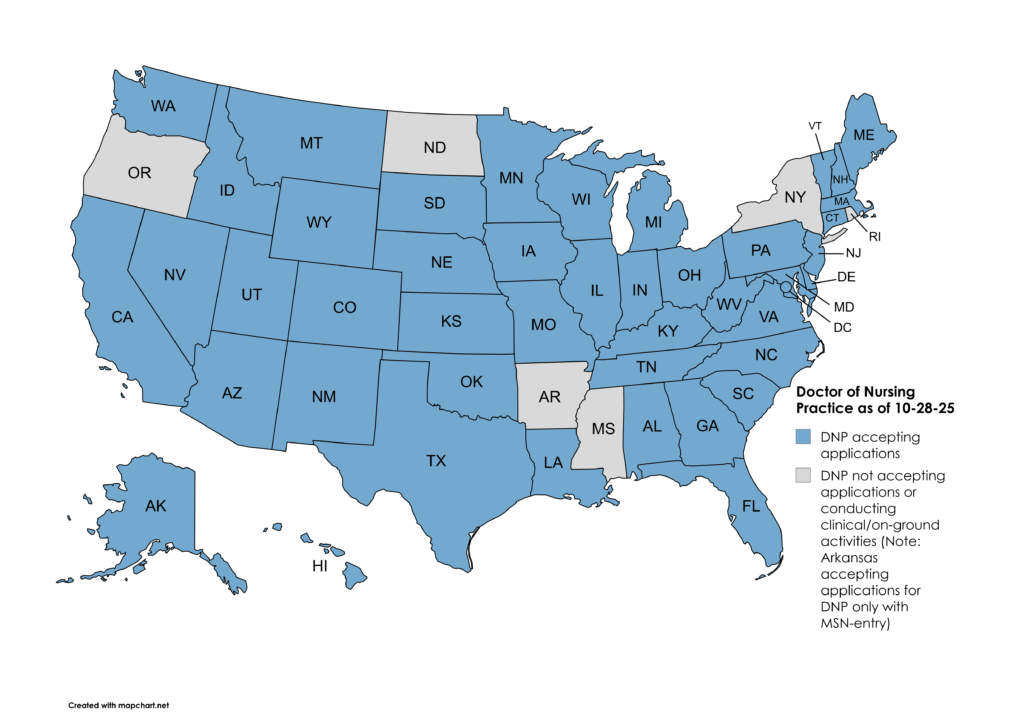
The University of St. Augustine for Health Sciences is currently accepting applications for enrollment to the Doctor of Nursing Practice program (except Nurse Practitioner role specialties) from the following states: Alabama, Alaska, Arizona, Arkansas (MSN-entry only), California, Colorado, Connecticut, Delaware, District of Columbia, Florida, Georgia, Hawaii, Idaho, Illinois, Indiana, Iowa, Kansas, Kentucky, Louisiana, Maine, Maryland, Massachusetts, Michigan, Minnesota, Missouri, Montana, Nebraska, New Hampshire, New Jersey, New Mexico, Nevada, North Carolina, Ohio, Oklahoma, Pennsylvania, South Carolina, South Dakota, Tennessee, Texas, Utah, West Virginia, Washington (MSN-entry only), Wisconsin, Wyoming, Vermont, and Virginia.
USAHS is currently not accepting applications from states where the program does not have state authorization. However, prospective students are encouraged to check back in the near future, as the program may be offered in additional states. Current and admitted students are also advised to monitor this page for any updates prior to relocating to another state, as this can have an impact on continued enrollment in the program and the ability to be placed for on-the-ground activities or practicum experiences.
Post-Graduation Licensure
The DNP (non-NP Role Specialties) program is not designed or intended to lead to professional licensure in any state.
The map below identifies the states from which the University is now accepting applications for the DNP (non-NP Role Specialties) program (indicated in blue).
It remains the student’s responsibility to understand, evaluate, and comply with all requirements relating to practicum experiences, authorization or endorsement for the state in which she or he resides.
Higher Education State Approvals
The University of St. Augustine for Health Sciences holds licensure/authorization to operate a physical campus in three states — California, Florida, and Texas. Please refer to the Licensure page for more detailed information. The University has additional state approvals and exemptions to provide distance education. Please visit the State Licensure page for more detailed information.
CCNE Accreditation
The Doctor of Nursing Practice (DNP) program at the University of St. Augustine for Health Sciences is accredited by the Commission on Collegiate Nursing Education, 655 K Street NW, Suite 750, Washington, DC 20001, 202-887-6791.
Doctor of Nursing Practice (DNP) Family Nurse Practitioner (FNP) – Role Specialty
State Approvals
USAHS is currently accepting applications for enrollment in the Doctor of Nursing Practice program with Family Nurse Practitioner (DNP-FNP) role specialty for residents in the following states: Alabama, Alaska, Arizona, Arkansas, California, Colorado, Connecticut, Delaware, Florida, Georgia, Hawaii, Idaho, Illinois, Indiana, Iowa, Kansas, Kentucky, Maine, Maryland, Massachusetts, Michigan, Minnesota, Missouri, Montana, Nebraska, Nevada, New Hampshire, New Jersey, New Mexico, North Carolina, Ohio, Oklahoma, Pennsylvania, South Carolina, South Dakota, Tennessee, Texas, Utah, Vermont, Virginia, Washington, West Virginia, Wisconsin, and Wyoming.
USAHS is currently not accepting applications from states where the program does not meet state licensure requirements and/or where the institution does not have state authorization. However, prospective students are encouraged to check back in the near future as the program may be offered in additional states. Current and admitted students are also advised to monitor this page for any updates prior to relocating to another state, as this can have an impact on continued enrollment in the program and the ability to be placed for on-the-ground activities or practicum experiences.
Post-Graduation Licensure
The map below identifies the states from which the University is now accepting applications for the DNP-FNP program. USAHS has not made a determination that its curriculum meets the educational requirements for licensure or certification in the following locations: American Samoa, the Commonwealth of Puerto Rico, Guam, the Virgin Islands, the Commonwealth of the Northern Mariana Islands, the Republic of the Marshall Islands, the Federated States of Micronesia, and the Republic of Palau.
For states denoted in blue, USAHS has determined the program satisfies the educational requirements for professional licensure in those states. USAHS has not made a determination regarding whether the DNP-FNP program satisfies the educational requirements for professional licensure in the states denoted in gray.
It remains the student’s responsibility to understand, evaluate, and comply with all requirements relating to practicum experiences, licensing or certification, authorization or endorsement for the state in which she or he resides. For more information, students should contact the appropriate state licensure board to understand state licensure requirements as regulations vary from state to state.
Notice to State of Washington Students: The University of St. Augustine for Health Sciences is approved by the Washington State Board of Nursing to conduct practice experiences for residents of Washington state for the MSN/Nurse Educator, MSN/Nurse Executive, MSN/FNP, MSN/AGNP, MSN/PMHNP, RN-MSN/FNP, RN-MSN/AGNP, RN-MSN/PMHNP, MSN-entry DNP, DNP/Nurse Executive, DNP/FNP, Post-Graduate Nursing Certificate (PMHNP), and Post-Graduate Nursing Certificate (FNP) program tracks. Learn more.
Doctor of Nursing Practice (DNP) Psychiatric Mental Health Nurse Practitioner (PMHNP) – Role Specialty
State Approvals
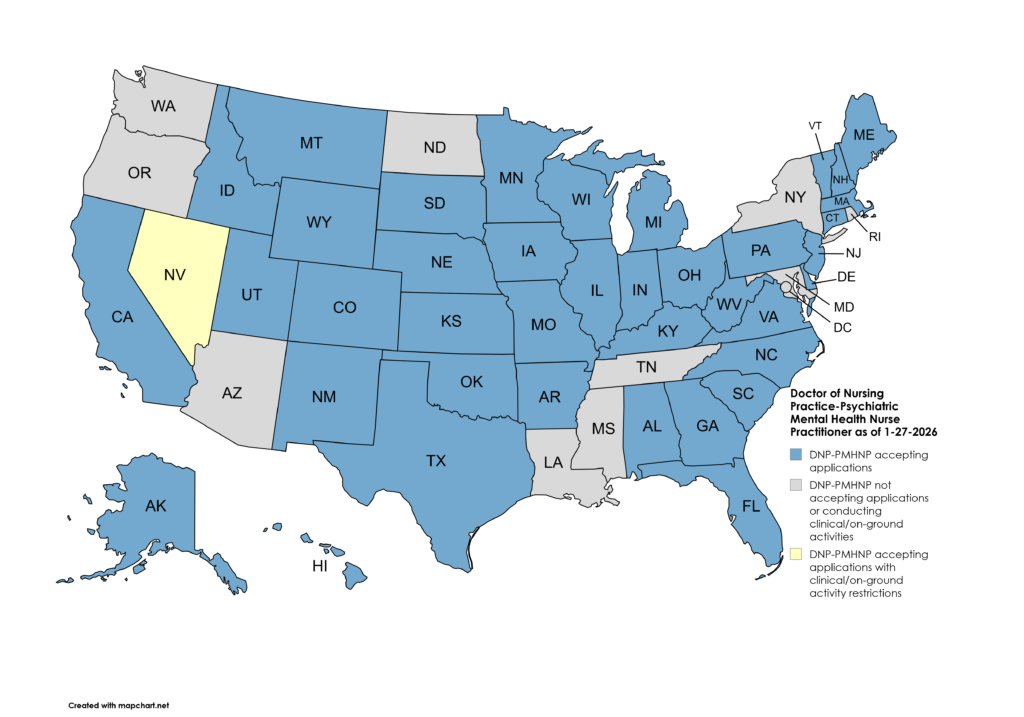
USAHS is currently accepting applications for enrollment in the Doctor of Nursing Practice program with Psychiatric Mental Health Nurse Practitioner (DNP-PMHNP) role specialty for residents in the following states: Alabama, Alaska, Arkansas, California, Colorado, Connecticut, Delaware, Florida, Hawaii, Idaho, Illinois, Indiana, Iowa, Kansas, Kentucky, Maine, Massachusetts, Michigan, Minnesota, Missouri, Montana, Nebraska, Nevada, New Hampshire, New Jersey, New Mexico, North Carolina, Ohio, Oklahoma, Pennsylvania, South Carolina, South Dakota, Texas, Utah, Vermont, Virginia, West Virginia, Wisconsin, and Wyoming.
USAHS is currently not accepting applications from states where the program does not meet state licensure requirements and/or where the institution does not have state authorization. However, prospective students are encouraged to check back in the near future as the program may be offered in additional states. Current and admitted students are also advised to monitor this page for any updates prior to relocating to another state, as this can have an impact on continued enrollment in the program and the ability to be placed for on-the-ground activities or practicum experiences.
Post-Graduation Licensure
The map below identifies the states from which the University is now accepting applications for the DNP-PMHNP program. USAHS has not made a determination that its curriculum meets the educational requirements for licensure or certification in the following locations: American Samoa, the Commonwealth of Puerto Rico, Guam, the Virgin Islands, the Commonwealth of the Northern Mariana Islands, the Republic of the Marshall Islands, the Federated States of Micronesia, and the Republic of Palau.
For states denoted in blue, USAHS has determined the program satisfies the educational requirements for professional licensure in those states. USAHS has not made a determination regarding whether the DNP-PMHNP program satisfies the educational requirements for professional licensure in the states denoted in gray.
It remains the student’s responsibility to understand, evaluate, and comply with all requirements relating to practicum experiences, licensing or certification, authorization or endorsement for the state in which she or he resides. For more information, students should contact the appropriate state licensure board to understand state licensure requirements as regulations vary from state to state.
CCNE Accreditation
The Doctor of Nursing Practice (DNP) program at the University of St. Augustine for Health Sciences is accredited by the Commission on Collegiate Nursing Education, 655 K Street NW, Suite 750, Washington, DC 20001, 202-887-6791.
Note on Certification Exam
Nurse Practitioner graduates must hold a master’s, postgraduate, or doctoral degree from a family nurse practitioner program accredited by the CCNE or the Accreditation Commission for Education in Nursing (ACEN) to be eligible to take the necessary role specialty national examination to be certified as a nurse practitioner, which most states require in order to be licensed to practice as an NP. Graduates should take the exam that aligns with their role specialty: FNP-BC or FNP or PMHNP-BC or PMH-BC. The Doctor of Nursing Practice (DNP) program at the University of St. Augustine for Health Sciences is accredited by the Commission on Collegiate Nursing Education, 655 K Street NW, Suite 750, Washington, DC 20001, 202-887-6791.
Note on Licensure, Authorization, Endorsement, or Other State Credential Necessary to Practice as a Nurse Practitioner
Most states require that graduates pass a nurse practitioner national certification exam in order to apply for licensure or other credential to practice as a nurse practitioner in a state. Graduates must hold a master’s, postgraduate or doctoral degree from a nurse practitioner program accredited by the CCNE or ACEN in order to be eligible for an NP national certification exam; national certification as an NP is required for licensure to practice as an NP in most states. Graduates should take the exam that aligns with their role specialty (FNP-BC or FNP or PMHNP-BC or PMH-BC). The Doctor of Nursing Practice (DNP) program at the University of St. Augustine for Health Sciences is accredited by the Commission on Collegiate Nursing Education, 655 K Street NW, Suite 750, Washington, DC 20001, 202-887-6791. While the DNP (FNP and PMHNP role specialty) program is designed to lead to licensure, authorization, endorsement, or other state credentials necessary to practice as a nurse practitioner, it is the prospective student’s responsibility to understand, evaluate, and comply with all requirements relating to nursing practice in the state in which they intend to practice and/or resides as requirements vary widely.
Prospective students are advised that relocation to another state may impact their ability to complete field experiences and/or to obtain professional licensure, certification or other credentials in another state. Prospective students are advised to carefully review, evaluate and understand the requirements of the applicable licensure board in the state in which they intend to relocate. USAHS makes no representations or guarantees that completion of coursework or programs will permit an individual to obtain state licensure, authorization, endorsement, or other state credential, including prescriptive authority, where requirements may vary between different states. Additionally, current and admitted students are also advised to monitor this page for any updates prior to relocating to another state, as this can have an impact on continued enrollment in the program and the ability to be placed for on-the-ground activities or practicum experiences. For more information about the requirements to practice, students should contact the appropriate Board of Nursing or state agency.
Notice to State of Washington Students: The University of St. Augustine for Health Sciences is approved by the Washington State Board of Nursing to conduct practice experiences for residents of Washington state for the MSN/Nurse Educator, MSN/Nurse Executive, MSN/FNP, MSN/AGNP, MSN/PMHNP, RN-MSN/FNP, RN-MSN/AGNP, RN-MSN/PMHNP, MSN-entry DNP, DNP/Nurse Executive, DNP/FNP, Post-Graduate Nursing Certificate (PMHNP), and Post-Graduate Nursing Certificate (FNP) program tracks. Learn more.
Close
DNP Learning Outcomes
Upon completion of the Doctor of Nursing Practice (DNP) program, graduates will be able to:
Employ the skills necessary to engage in lifelong learning through intellectual inquiry and scholarship.
Communicate effectively with members of interprofessional teams, healthcare consumers, policymakers, and institutional, local, regional, and national healthcare leaders.
Lead and serve on interprofessional teams to promote improved population health and outcomes in complex healthcare systems.
Utilize transformational leadership, systems thinking, and clinical analytics to improve healthcare outcomes for individuals and diverse populations.
Practice critical thinking and evidence-based decision-making in delivering or directing nursing practice and serving as a leader in healthcare systems.
Provide leadership in the use of technology and information systems for the evaluation and improvement of individual, population, and institutional outcomes.
Deliver or direct nursing practice based on sound theoretical frameworks, best scientific evidence, clinical expertise, and in collaboration with the patient and family.
Exhibit professional and ethical standards while advocating for safe, equitable, and cost-effective healthcare and policies for all.
Close
DNP Program Data
Click a doctorate in nursing program below to view the program data page:
USAHS offers two paths towards a DNP: BSN-entry or MSN-entry. BSN-entry DNP students who pursue the FNP role specialty must complete one on-campus clinical intensive.
Family Nurse Practitioner Role Specialty (BSN-entry DNP)
Online coursework + one required on-campus clinical intensive
71 credit hours + practicum contact hours 1,334
12 trimesters (4 years) Please note, the DNP-FNP program typically takes 3 years and 4 months to complete, based off the most recent 2-year graduate data (2022-2023 and 2023-2024); however, individual experiences will vary based on factors including, but not limited to, individual progress, traditional vs. accelerated pathway, credits transferred and other factors.
Sept., Jan. & May start dates, plus midterm starts
Psychiatric Mental Health Nurse Practitioner (BSN-entry DNP)
Online coursework + one required virtual clinical intensive
77 credit hours + 1,334 practicum contact hours
12 trimesters (4 years)Time to completion may vary by student. The DNP-PMHNP is designed to be completed in 4 years but may be completed in as little as 3 years, depending on individual progress, traditional versus accelerated pathway, credits transferred and other factors.
Sept., Jan. & May start dates, plus midterm starts
10 trimesters (3 years, 4 months) Time to completion may vary by student, depending on individual progress, traditional versus accelerated pathway, credits transferred and other factors.
Sept., Jan. & May start dates, plus midterm starts
7 trimesters (2 years, 4 months) Time to completion may vary by student, depending on individual progress, traditional versus accelerated pathway, credits transferred and other factors.
Sept., Jan. & May start dates, plus midterm starts
Clinical Placement Concierge
Get personalized support from a dedicated clinical placement team to secure a practica placement that aligns with your career goals, specialty interests, and schedule.
Dedicated Support
Your success is our priority. You’ll receive one-on-one faculty mentorship Each student is assigned a faculty advisor when they start the program. On-demand appointments with faculty advisor and/or course instructors are available. and personalized academic advising designed to keep you supported, engaged, and thriving throughout your journey. Watch Video
Whether you are looking to fast-track your degree or take a lighter courseload, we offer individualized study plans. Learn mostly online and attend one hands-on intensive (where required) Watch Video
Cutting-Edge Learning Technology
Master advanced skills through online coursework and realistic virtual simulations that prepare you with the clinical skills to confidently take the next step in your career. Explore Innovative Learning
Solely Dedicated to Health Sciences
With over 40 years dedicated to health sciences, USAHS helps nursing graduate students advance in clinical expertise, research, and leadership while collaborating with peers across disciplines in patient-centered care. Discover Our Story
Choose Your Role Specialty
Whether you are interested in clinical care or leadership, we offer role specialties through our DNP program. From FNP, PMHNP to Nurse Executive, you can tailor your degree to match your career goals. Find Your Specialty
Getting Started
Ready to begin your journey toward earning your DNP degree? It’s easy to get started right away!
Get More Information
Our webinars and virtual campus tours provide a wealth of information to help ensure you make the right choice in pursuit of your doctorate in nursing.
“As a DNP student, I was able to gain access to meetings that I wouldn’t have been invited to—and see behind-the-scenes decisions at the corporate/divisional level.”




 The Doctor of Nursing Practice (DNP), Master of Science in Nursing (MSN), and Post-Graduate NP Certificate programs at the University of St. Augustine for Health Sciences are accredited by the Commission on Collegiate Nursing Education, 655 K Street NW, Suite 750, Washington, DC 20001, 202-887-6791.