
Are you curious about how to become an occupational therapist in California? You may be imagining the rewarding moment when you will help someone regain independence and return to work, relearn daily skills or live their life with more confidence. Before you become an occupational therapist (OT), there are a few key steps to complete.
In California, you’ll need to earn certification through the National Board for Certification in Occupational Therapy (NBCOT) and secure licensure from the California Board of Occupational Therapy (CBOT) before you can practice.1,2 The journey starts with choosing the right graduate program, a Master of Occupational Therapy (MOT) or Doctor of Occupational Therapy (OTD) degree accredited by the Accreditation Council for Occupational Therapy Education (ACOTE), which keeps you on track for certification and licensure.3,4
The good news? At the University of St. Augustine for Health Sciences (USAHS), you have flexible options, including ACOTE-accredited occupational therapy (OT) programs offered through multiple pathways, so you can choose the format that fits your lifestyle.
Occupational therapists (OTs) work with individuals across the lifespan to help them develop, regain or maintain the skills they need for daily life and independence after an injury, illness or disability. If you plan to practice in California, you’ll need to meet the licensing requirements set by CBOT.
CBOT outlines the steps you must complete before you can practice, including education requirements, exam eligibility and background check processes.2
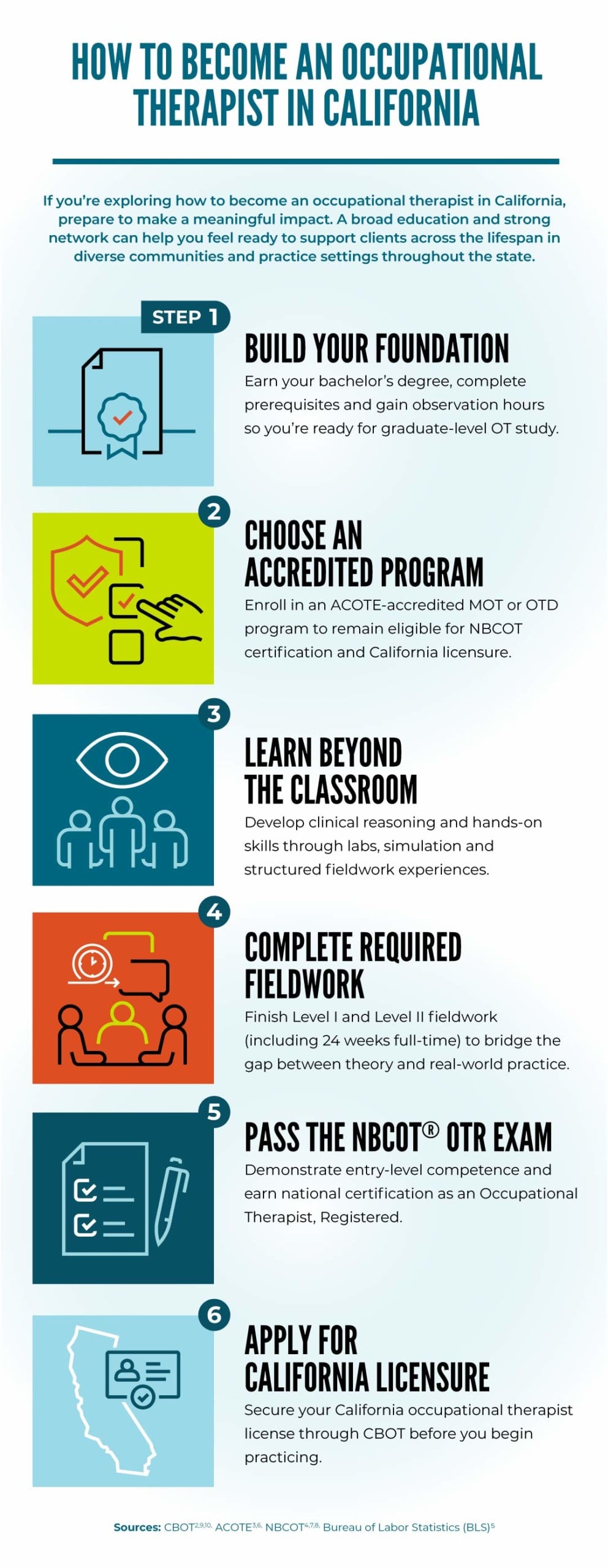
Let’s review the key steps to becoming an OT in California, from occupational therapist programs in California to earning NBCOT certification and completing California occupational therapist license requirements. We’ll also highlight where our occupational therapy programs at USAHS may align with your path.
What Is an Occupational Therapist?
Occupational therapists assess, plan and deliver rehabilitation that helps people build or regain the skills they need for daily life and independence. OTs take a whole-person approach, looking at routines, environments, habits and goals to help clients make practical changes that support safer and more meaningful participation in everyday activities.
Occupational therapy is a fast-growing field. As of May 2024, the national median wage for occupational therapists is $98,340.1 Employment is projected to grow 14% from 2024 to 2034, which the Bureau of Labor Statistics (BLS) notes is much faster than average.1
Work Settings for Occupational Therapists
One of the most exciting parts of occupational therapy is how many directions it can take you. Occupational therapist work settings can include:1
- Hospitals
- Outpatient clinics
- Schools
- Skilled nursing facilities
- Home health agencies
- Mental health facilities
Your Path to OT Practice in California
BLS state wage data reveals that occupational therapist wages in California are above the national average, largely driven by factors such as high demand and a high cost of living.5 Wages may vary widely by region, work setting, experience level and employment schedule.
According to CBOT, OTs in California support people with a wide range of medical conditions and disabilities to restore functional daily living skills.2 When choosing an OT program, it helps to think beyond the classroom. Your training should prepare you for the settings and client populations you may work with across California, so a broad, well-rounded education is important.
You’ll also want to look for programs that offer strong fieldwork opportunities, ideally with placement options throughout the state. For example, at USAHS, our San Marcos, California campus supports students through partnerships with clinical sites across California, helping you gain experience and build connections where you plan to practice.

Complete a Bachelor’s Degree and OT Prerequisites
To be eligible for an entry-level OT program at the master’s or doctoral level, you typically need a bachelor’s degree plus any required prerequisites. Individual OT programs list mandatory prerequisites on their admissions pages.
Requirements vary by school, but competitive OT programs typically expect students to have:
- A minimum grade point average (GPA)
- Documented observation or volunteer hours in OT or related settings
At USAHS, we outline clear prerequisite requirements on our MOT and OTD admissions pages to help you map out your undergraduate coursework with confidence. Prerequisites typically include foundational science and social science courses. We expect applicants to complete key anatomy and physiology coursework, ensuring they are ready for graduate-level OT study.
If you are not sure how your current transcript lines up, our admissions and advising teams can help you review what you’ve completed, identify any gaps and plan a realistic timeline to fulfill remaining requirements.
Choose an ACOTE-Accredited OT Program (MOT or OTD)
The Accreditation Council for Occupational Therapy Education (ACOTE) accredits OT programs and sets the standards and competencies required for entry-level practice.3
To be eligible for NBCOT certification as an OT (OTR), you need to complete an entry-level master’s or doctoral OT program accredited by ACOTE.4 Otherwise, you cannot sit for the NBCOT exam, and this could delay progress towards obtaining your licensure.
At USAHS, we offer ACOTE-accredited occupational therapist programs in California, including Master of Occupational Therapy (MOT) and a Doctor of Occupational Therapy (OTD) degree programs at our San Marcos, California campus, with multiple formats so you can choose the learning experience that fits your schedule and responsibilities.
Our MOT and OTD program pathways include:
- Residential: Coursework and immersive weekday lab experiences held on campus and online each week.
- Hybrid Immersion: Includes online coursework, live virtual weekday sessions and two in-person lab immersions per term held on campus over extended weekends.
- Flex: Built for students who need more weekday flexibility, this format combines online coursework with live virtual evening/weekend sessions and immersive on-campus labs on select weekends so you can keep moving toward your graduate OT degree with a schedule that works for you.
Across all formats, the focus is the same: hands-on skill development, clinical reasoning and preparation for fieldwork and entry-level practice.
Aside from San Marcos, our MOT and OTD programs are also available at the following campuses:
- Augustine, Florida
- Miami, Florida
- Austin, Texas
- Dallas, Texas
At USAHS, our OT programs are built around a blended learning approach that combines online coursework with hands-on labs and fieldwork, all designed to align with ACOTE standards.
To build real clinical confidence, you need time to learn the why behind what you’re doing, innovative practice in lab and simulation environments and opportunities to apply those skills with real clients during fieldwork in real-world practice settings.
Complete Required OT Fieldwork
ACOTE standards specify Level I and Level II fieldwork to integrate academic learning with hands-on practice and to prepare students to be entry-level OTs.6 Think of fieldwork as the bridge between “I understand the concept” and “I can do this safely and confidently with a client.”
The required levels of fieldwork include:
- Level I fieldwork: Typically includes experiences designed to offer early exposure to different settings.6 This is where many students begin to envision their future role as an OT.
- Level II fieldwork: Includes at least 24 weeks of full-time fieldwork (typically two 12-week rotations) in practice areas like physical rehabilitation, pediatrics, mental health or community practice.6
At USAHS, we build fieldwork into the OT experience in a way that supports growth across different settings and client populations. Clinical education is designed to help you translate classroom learning into OT practice, strengthen clinical reasoning and develop confidence as you move toward entry-level competence.
Because fieldwork placements depend on site availability and alignment, it’s important to stay flexible. Placement options can vary from student to student. To support the most diverse fieldwork experiences that align with academic needs, students should be prepared to travel and/or relocate for their fieldwork rotations.
Pass the NBCOT OTR Exam
The Occupational Therapist Registered (OTR) exam is a national certification exam administered through Pearson VUE. Its purpose is to measure entry-level competence in areas like evaluation, intervention, ethics and foundational knowledge.7,8
Passing the OTR exam grants you NBCOT certification as an OTR, which is a common requirement for state licensure in various states, including California.2,8 The NBCOT exam typically becomes less intimidating when you treat preparation like a regular part of your routine instead of a last-minute sprint across the finish line.
Your coursework, fieldwork and exam preparation resources all help you make progress toward the goal of demonstrating entry-level competence across the full scope of OT practice.
Apply for an OT License From the California Board of Occupational Therapy
After passing the NBCOT exam, you need to obtain a California occupational therapist license from CBOT before you can practice in California.2 CBOT may issue a limited permit that allows practice under supervision while your NBCOT results and licensure are being processed. Specific conditions and time limits apply.9,10
For example, CBOT’s limited permit information states you need to request that NBCOT release your exam score to the Board, and you have to meet the permit requirements to practice under supervision while you complete the full licensure process.10
Plan for the background check. CBOT’s application checklist highlights fingerprinting and states that background information cannot be shared among organizations, so expect to complete the CBOT-specific process even if you have been fingerprinted elsewhere.9
Where USAHS Fits in Your California OT Journey
If you want a clear path to becoming an OT in California, start by choosing a program that supports licensure requirements and aligns with how you want to study. At USAHS, we offer occupational therapy degree programs that meet ACOTE accreditation requirements across all our campuses.
For our Master of Occupational Therapy (MOT) and Doctor of Occupational Therapy (OTD) programs, campus options include San Marcos, California; St. Augustine, Florida; Miami, Florida; Austin, Texas and Dallas, Texas. That flexibility can be helpful if you are considering where you want to live during school, where you want to complete fieldwork or where you plan to practice after graduation.
Here are a few USAHS program features that often matter to students in California:
- Flexible learning formats: USAHS offers Residential, Hybrid Immersion and Flex learning pathways that combine online coursework with on-campus labs.
- Hands-on preparation: OT education requires extensive practice, feedback and repetition. We offer learning experiences that combine coursework with labs, community engagement and fieldwork.
- Fieldwork support and professional readiness: At USAHS, we emphasize preparation for the NBCOT certification exam as part of the MOT and OTD learning experience, helping you build clinical knowledge, reasoning and professional readiness. Licensure requirements are set by the state board, not the school, but the structure of your program and the depth of your academic and fieldwork training can play an important role.
- Faculty mentorship: At USAHS, we bring OT expertise into the classroom through expert faculty-practitioners who contribute across a range of practice areas. That breadth can help you learn from clinicians and educators with diverse perspectives and practical We support students through skills training and professional development resources to help you grow confidence, refine clinical reasoning and prepare for the transition into fieldwork and entry-level practice.
Additionally, USAHS offers an OTA to MOT bridge option, for licensed Occupational Therapist Assistants (OTAs) who are wondering how to become an occupational therapist in California.
Let USAHS guide you on your journey to becoming an OT in California.
FAQs
What is occupational therapy?
Occupational therapy is a healthcare profession focused on helping people participate in meaningful daily activities. That can include self-care tasks, like dressing or cooking, work demands, school routines or community involvement.
Occupational therapists evaluate and treat individuals with injuries, illnesses or challenges to help them learn vocational skills, activities of daily living and other tasks that promote independence.1 In practice, that may mean helping someone rebuild functional use of an arm after injury, developing a child’s fine motor skills for school or adapting an environment to reduce fall risk.
In California, occupational therapy practice happens under state licensure, through CBOT, which sets its own requirements for education, exam completion and background checks.2
Is the NBCOT exam required to practice as an OT in California?
Yes. California requires you to be licensed through CBOT before you can practice, and the licensure process relies on NBCOT exam results and reporting.2,9 The NBCOT certification exam is the standard pathway used to demonstrate entry-level competence for licensure eligibility.
CBOT’s application materials reference the need to submit NBCOT verification, a verification of certification or score transfer report, as part of the licensure process.9 CBOT also highlights how limited permits can connect to the NBCOT exam process, as well as score release requirements.10
Salary data may not reflect starting pay for recent graduates.
References:
- “Occupational Outlook Handbook: Occupational Therapists,” U.S. Bureau of Labor Statistics (BLS), August 28, 2025, https://www.bls.gov/ooh/healthcare/occupational-therapists.htm.
- “California Board of Occupational Therapy,” California Board of Occupational Therapy (CBOT), 2026, https://www.bot.ca.gov/.
- “2023 ACOTE Standards,” Accreditation Council for Occupational Therapy Education. (ACOTE), 2026, https://acoteonline.org/accreditation-explained/standards/.
- “Am I eligible to take the NBCOT exam?,” National Board for Certification in Occupational Therapy (NBCOT), https://www.nbcot.org/get-certified/eligibility.
- “May 2023 State Occupational Employment and Wage Estimates: California,” U.S. Bureau of Labor Statistics (BLS), April 3, 2024, https://www.bls.gov/oes/2023/may/oes_ca.htm.
- “C Standards FAQ: Fieldwork – ACOTE Section C Standards,” Accreditation Council for Occupational Therapy Education (ACOTE), https://acoteonline.org/frequently-asked-questions/.
- “Certification Exam Handbook,” National Board for Certification in Occupational Therapy (NBCOt), 2025, https://www.nbcot.org/-/media/PDFs/Cert_Exam_Handbook.pdf.
- “Board Certified Practitioners,” National Board for Certification in Occupational Therapy (NBCOT), 2026, https://www.nbcot.org/.
- “Initial License/Limited Permit Application Requirements,” California Board of Occupational Therapy (CBOT), https://www.bot.ca.gov/applicants/application_checklist.pdf.
- “Limited Permits,” California Board of Occupational Therapy (CBOT), 2026, https://www.bot.ca.gov/applicants/limited_permits.shtml.