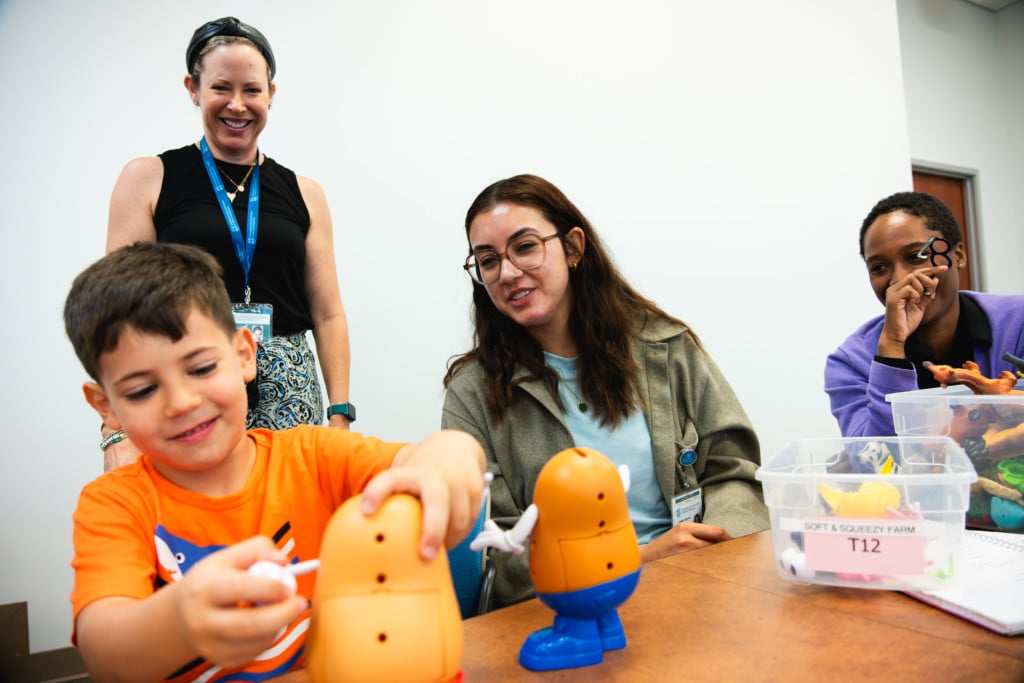


Speech-language pathologists, or speech therapists, specialize in communication. They work with babies, children and adults to treat issues relating to articulation, language, fluency, feeding and swallowing.1
If you’re interested in speech-language pathology (SLP) as a potential career, familiarize yourself with the SLP grad school requirements to get accepted into a Master of Science in Speech-Language Pathology (MS-SLP) program. According to a recent Communication Sciences and Disorders (CSD) Education Survey, the SLP grad school acceptance rate is 42.1% for the 2022-23 school year.2
Read on to learn how to get into SLP grad school.
USAHS SLP Grad School Admissions Requirements
| Degree | Bachelor’s |
| Undergraduate field of study | Communication sciences and disorders (CSD) or speech-language pathology (preferred but not required) |
| GPA | A minimum GPA of 3.0 calculated on SLP master’s program prerequisites (preferred) |
| Prerequisites | American Speech-Language-Hearing Association (ASHA) basic prerequisite course requirements |
| GRE | Not required |
| Resume | A current resume or curriculum vitae |
| Statement of Purpose | A writing sample of two, double-spaced pages in 12-point, Times New Roman or Arial font answering the question, Why do you think you can make a difference in speech-language pathology? |
| Letters of recommendation | Two letters of professional recommendation |
| Observation hours | 25 guided observation hours with an ASHA-certified SLP |
| Interview | Virtual interview, as needed |
- Earn a bachelor’s degree
- Graduate with a minimum GPA of 3.0 (preferred)
- Provide a resume
- Submit letters of recommendation
- Write an essay or personal statement
- Complete 25 observation hours
- Complete prerequisite coursework
- Participate in a virtual interview, as needed
Please note that USAHS doesn’t require a GRE score to gain admission to the MS-SLP program.
How To Get into SLP Grad School in Seven Steps
Follow these seven steps to increase your chance of getting into grad school for speech pathology.
1. Graduate with an Undergraduate Degree
The first MS-SLP admission requirement is to obtain a bachelor’s degree from an accredited institution. While not required, majoring in CSD or speech-language pathology helps ensure you complete all prerequisite coursework.
If your school doesn’t offer a CSD or SLP undergraduate degree, you can still apply as long as you complete the following ASHA prerequisite course requirements:
- Biology
- Chemistry or physics
- Statistics
- Behavioral or social sciences
USAHS offers the following leveling courses if your degree isn’t in CSD or SLP:
- Introduction to Audiology
- Aural Rehabilitation
- Speech Anatomy and Physiology
- Introduction to Communication Sciences and Disorders*
- Phonetics
- Normal Speech and Language Development
At USAHS, we recommend completing prerequisite coursework no more than five years prior to enrollment.
2. Take Your GRE
Depending on the SLP grad school program you are applying to, you may be required to take the Graduate Record Examination (GRE). This standardized test assesses your verbal reasoning, quantitative reasoning and analytical writing skills.3
USAHS is one of the many SLP grad school programs that doesn’t require a GRE score for admission. If standardized tests aren’t your strong suit, you may want to consider the GRE requirement when deciding how to get into SLP grad school.
3. Shadow SLPs
Next, you’ll want to shadow several SLPs in the field to learn more about their day-to-day responsibilities. Since there are multiple career path options, you may want to shadow in a variety of different settings where SLPs work, including:4
- Schools, colleges and universities
- Nonresidential healthcare facilities, hospitals and residential healthcare facilities
- Private practice
- Corporate environments
- Local, state and federal government agencies
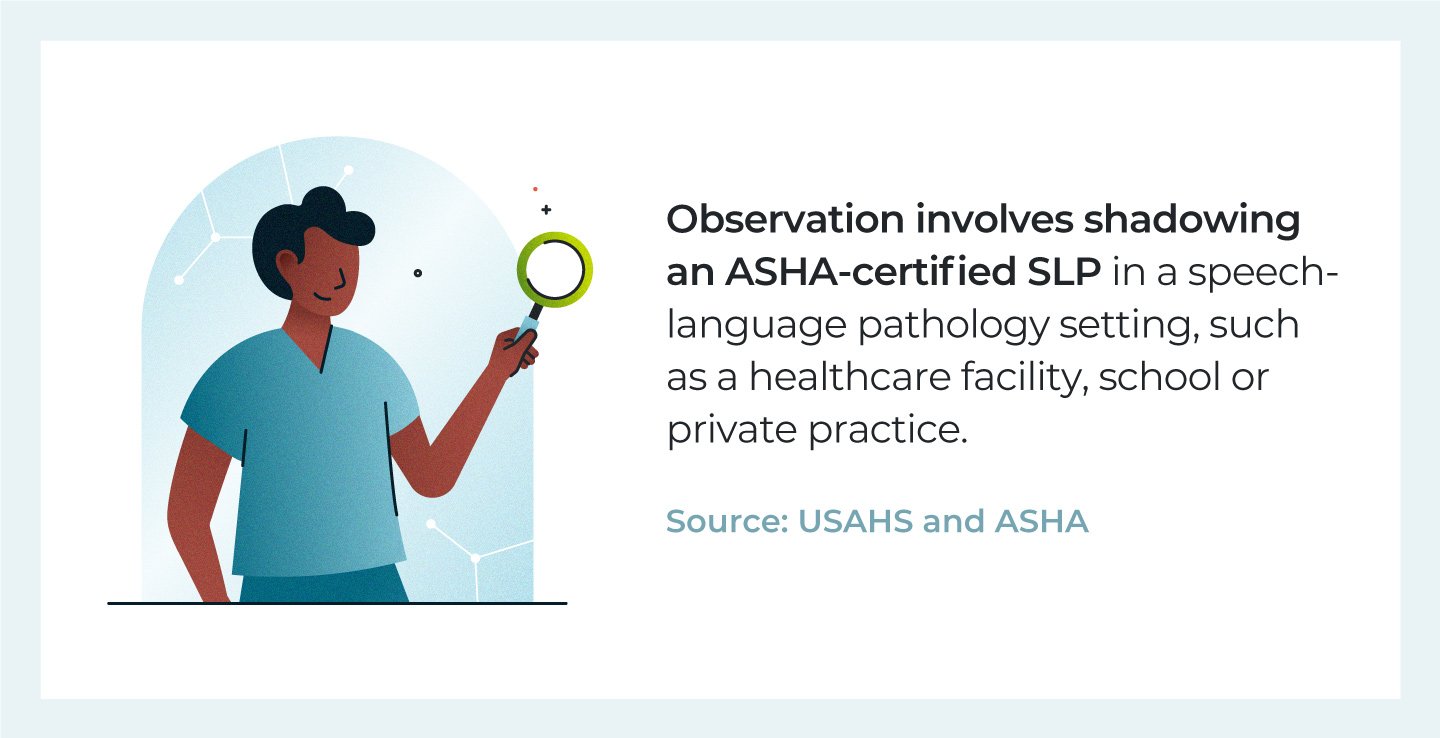
SLP programs require you to complete 25 guided observation hours with an ASHA-certified SLP. Log these hours to ensure you meet your SLP grad school requirements.
4. Gain Field Experience
In terms of how to get into SLP grad school, seek out opportunities to gain experience in the field. While clinical internships typically aren’t available to undergraduate students, you can find non-clinical internships or volunteer opportunities that will strengthen your grad school application.5 These experiences will give insight into an SLP’s daily tasks and allow you to interact and learn from SLPs.
These volunteer opportunities and work experiences don’t count toward the 25-hour observation requirement.
5. Network with SLPs
While not required, networking with SLPs is a great way to learn more about the field and may lead to other opportunities. Attend networking events or connect on LinkedIn to establish relationships.
You may want to connect with alumni who can share advice and experiences on how to get into SLP grad school or provide a reference letter.
6. Research Multiple Programs
Research multiple MS-SLP programs to decide which ones to apply to. Some factors to consider include:
- Curriculum
- Learning model
- Program length
- Mission statement
- Virtual/hybrid coursework options
- Virtual or on-site clinical practica options
- Tuition and financial aid options
- On-campus facilities
Also, speak with current students, alumni and professors to gain insight into each SLP grad school program.
7. Complete SLP Grad School Program Applications
Narrow your options and apply to the program you are most interested in. To improve your chances of acceptance, apply to multiple programs. Each program might have different SLP grad school requirements, so thoroughly read and fill out each application.
Five Tips to Get Accepted into an SLP Grad School
Below are a few tips for how to get into SLP grad school:
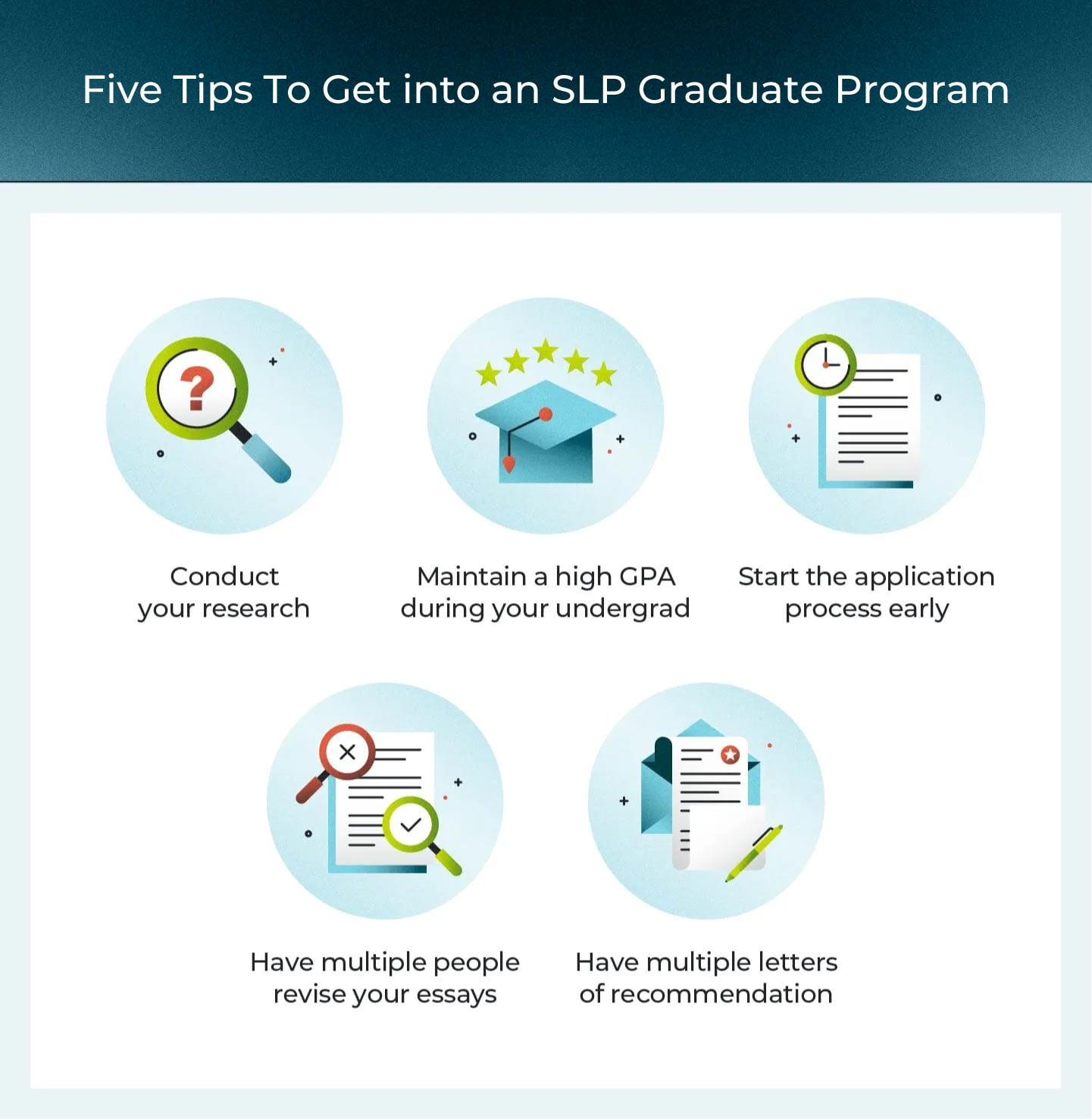
1. Maintain a High GPA During Your Undergrad Program
A grade point average (GPA) is a factor that most SLP grad school programs take into consideration. Retain a minimum GPA of 3.0, either overall or for prerequisite coursework. SLP programs are competitive, and some programs prefer a higher GPA.
2. Have Multiple People Revise Your Essays
Many SLP grad school program requirements include writing a personal essay in response to a specific prompt. Thoroughly answer the question and adhere to font, spacing and length requirements.
After writing your essay, ask family, friends, professors or classmates to review before submitting it.
3. Start the Application Process Early
As each program has various SLP grad school requirements, we recommend getting a head start on the application process to give you plenty of time to apply for each program you’re interested in. Write down each SLP grad school application’s deadline, list each requirement and keep track of your progress. Staying organized and on schedule will help ensure you submit each application on time.
4. Conduct Research
Consider whether each SLP grad school program is the best educational fit for your learning needs and lifestyle. Some questions to ask yourself include:
- Do I want to be in a specific geographic area?
- Do I prefer a small or a large university?
- How many fellow students do I want in my cohort?
- Do I want to specialize in a specific area of SLP?
- Does a traditional, hybrid or online program fit my learning style?
Additionally, you should look into each program’s student outcome data, such as on-time program completion and Praxis exam pass rates. This ensures that you’re applying to an SLP grad school program where graduates have a solid success rate.
5. Submit Multiple Letters of Recommendation
SLP grad school applications require you to submit at least two letters of recommendation. These letters can come from professors, supervisors or employers familiar with you in a professional or academic setting. Take the time to establish professional relationships during undergrad, work experiences and volunteer opportunities so you’re not scrambling when it comes time to ask for a letter of recommendation.
Request these letters in advance to give the individual plenty of time to write your letter.

How to Get into SLP Grad School FAQs
Applying for grad school can be a confusing process. Below, we’ve answered some common questions regarding SLP grad school requirements.
How Hard Is SLP Grad School To Get Into?
Grad schools for SLP programs are typically very competitive. Programs can accommodate a median of about 34 students, according to a recent survey of the 2022-2023 academic year.2 Therefore, you may want to apply to multiple SLP grad school programs to improve your chances of acceptance.
What GPA is Required To Get into SLP Grad School?
Most programs require a minimum 3.0 GPA, either overall or for prerequisite coursework.
Can You Get into an SLP Grad School Program with a Low GPA?
Each program places a different weight on the importance of application factors, so you may be able to get into some SLP grad school programs with a low GPA. Additionally, some programs consider your grade trend, so try to continue to raise your GPA each semester.
Apply to USAHS’ MS-SLP Program
A career as an SLP offers countless benefits. From the impact on patient lives to the high level of job security, there are several reasons to pursue a degree in speech-language pathology.
Now that you know how to get into grad school for speech pathology, we encourage you to apply to our program. With our student-first philosophy, blended learning model and state-of-the-art simulation labs, we provide our SLP grad school students with the tools they need to succeed in their careers.
*Not required if the applicant holds an undergraduate degree in communication sciences and disorders or speech-language pathology.
Sources:
- American Speech-Language-Hearing Association, “Who Are Speech-Language Pathologists, and What Do They Do?” ASHA, 2025, https://www.asha.org/public/who-are-speech-language-pathologists/.
- American Speech-Language-Hearing Association, “CSD Education Survey: Communication Sciences and Disorders Education Trend Data,” ASHA, 2024, https://www.asha.org/siteassets/uploadedfiles/communication-sciences-and-disorders-education-trend-data.pdf.
- ETS, “The GRE® General Test,” ETS, 2025, https://www.ets.org/gre/test-takers/general-test/about.html.
- American Speech-Language-Hearing Association, “Employment Settings for SLPs,” ASHA, 2025, https://www.asha.org/students/employment-settings-for-slps/.
- SpeechPathologyGraduatePrograms.org, “Speech Pathology Internships – Your Complete Guide to Selecting the SLP Internship That’s Right for You,” SpeechPathologyGraduatePrograms.org, May 23, 2024, https://www.speechpathologygraduateprograms.org/2021/09/speech-pathology-internships/.