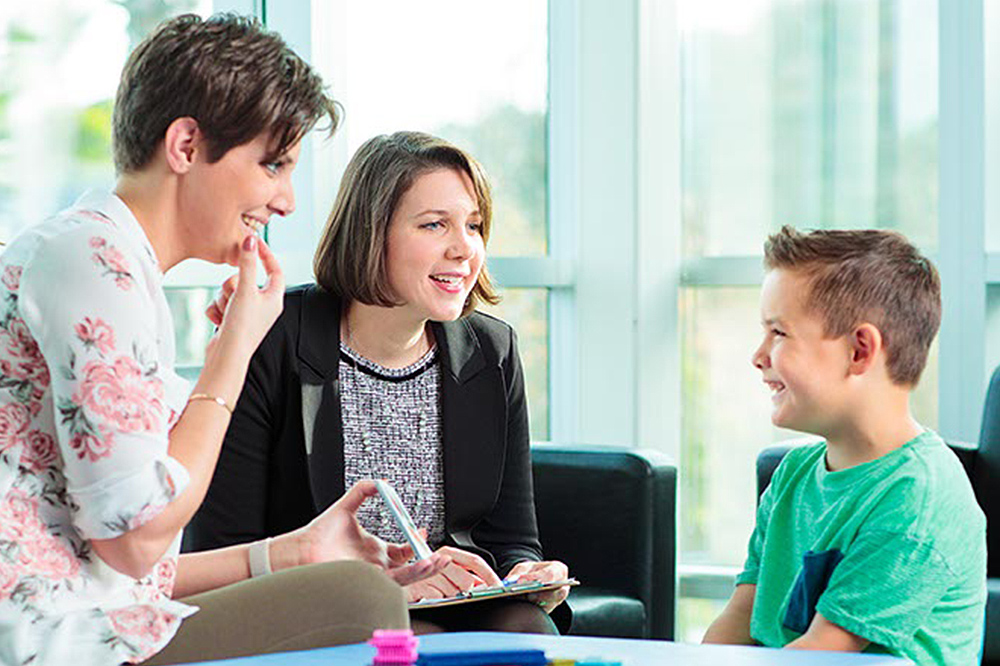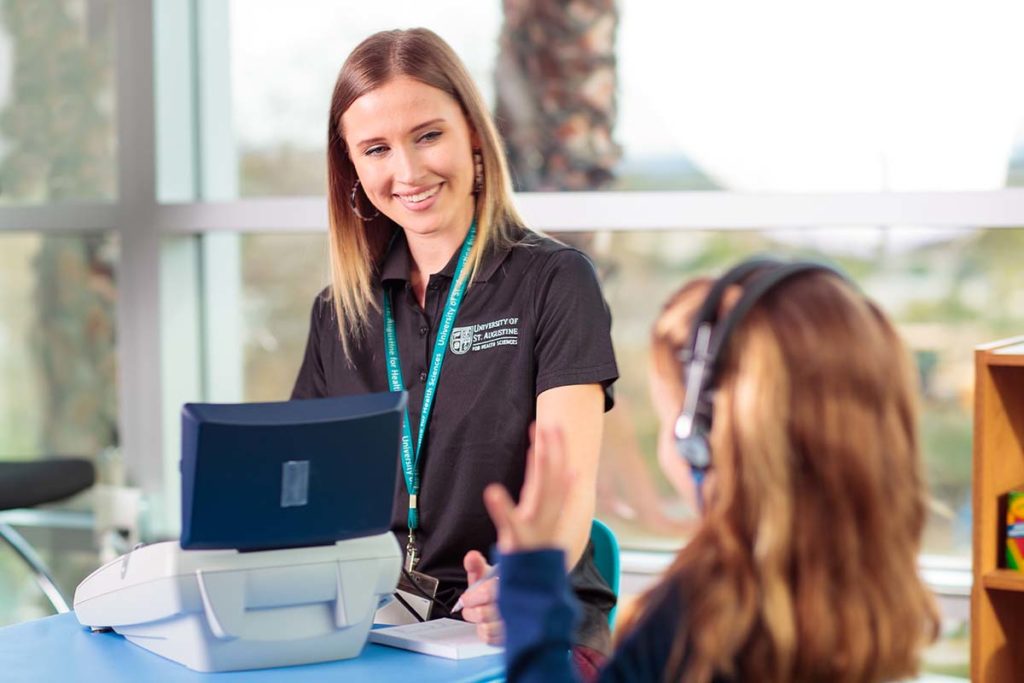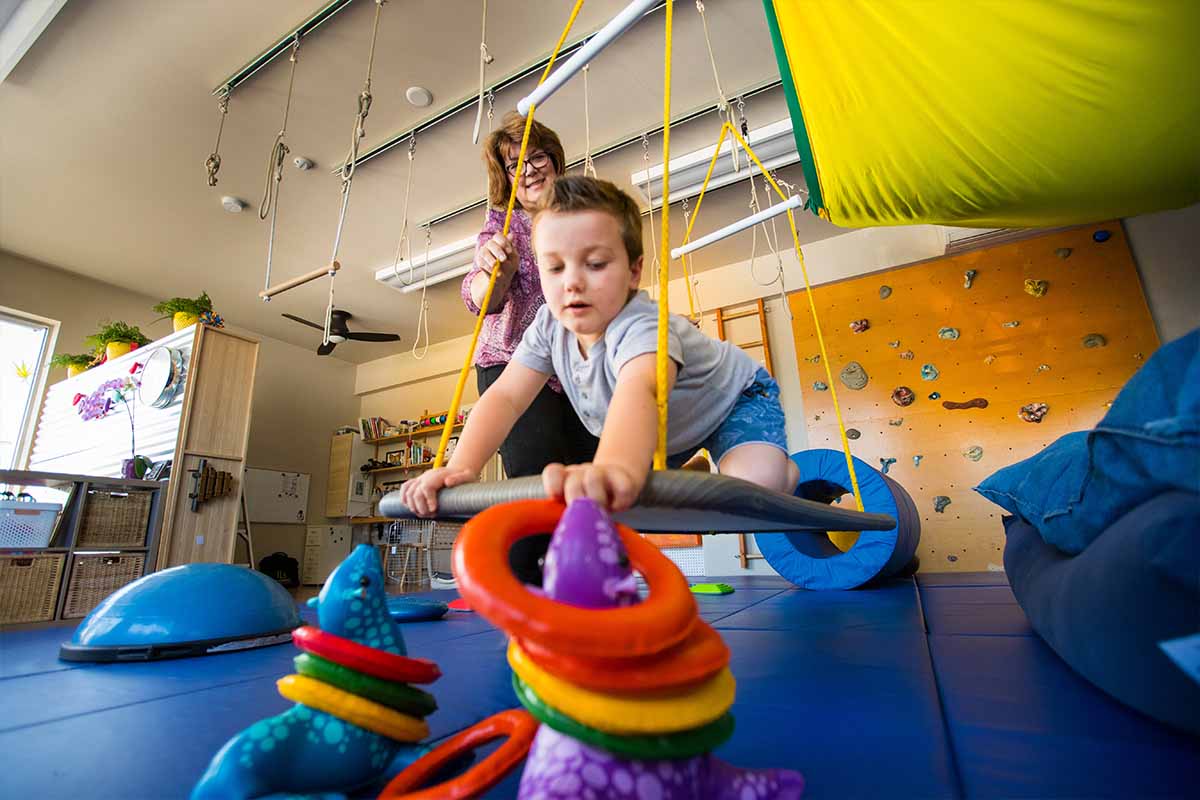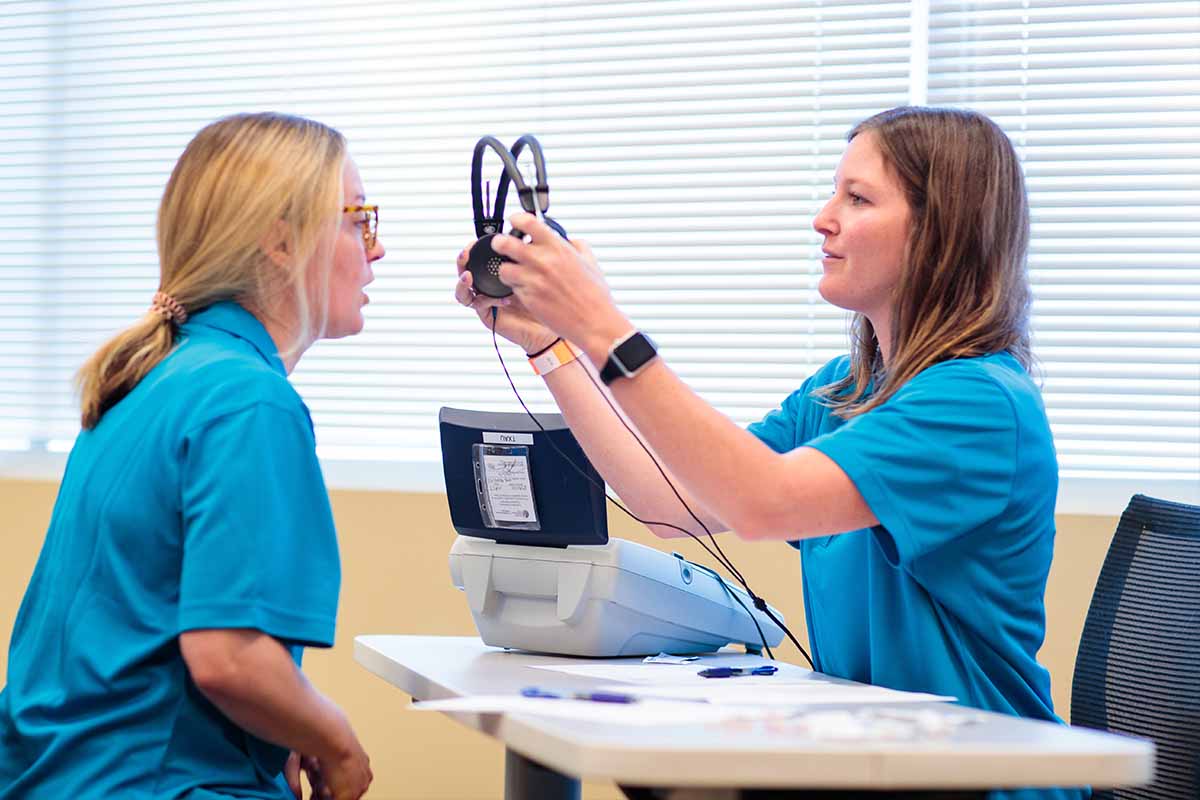

Clinical experiences are where graduate-level speech-language pathology (SLP) education comes to life. They’re where classroom learning becomes real-world clinical practice as you work alongside American Speech–Language–Hearing Association (ASHA)-certified and state-licensed speech-language pathologists (SLPs) and begin providing supervised care to clients.
Along the way, you’ll apply what you’ve learned in coursework and on-campus residencies while building skills across a variety of work environments. Through hands-on skills training during residencies, students practice clinical techniques in a supportive learning environment, receiving individualized feedback from experienced speech-language pathologists. This early, in-person training helps students develop critical clinical competencies, strengthen their confidence, and prepare for the expectations of their first externship placement. As a result, students enter clinical settings having already practiced essential skills and received guidance designed to support their transition into professional practice.
Clinical placements do more than fulfill ASHA’s required 400 supervised clock hours—including at least 375 hours of direct clinical service.1 They help you strengthen your clinical judgment, build confidence and discover the populations and settings that inspire your future career.
That’s why clinical education is an important investment and key part of your journey in the hybrid Master of Science in Speech-Language Pathology (MS-SLP) at the University of St. Augustine for Health Sciences (USAHS).
At USAHS, through a diverse network of clinics, hospitals, schools* and other locations, depending on the state of residence**, you’ll complete supervised clinical practica that increase competence and prepare you for certification and professional practice.2
A thoughtfully designed clinical journey
Clinical education begins long before you step into your first placement, known as an “externship” at USAHS.
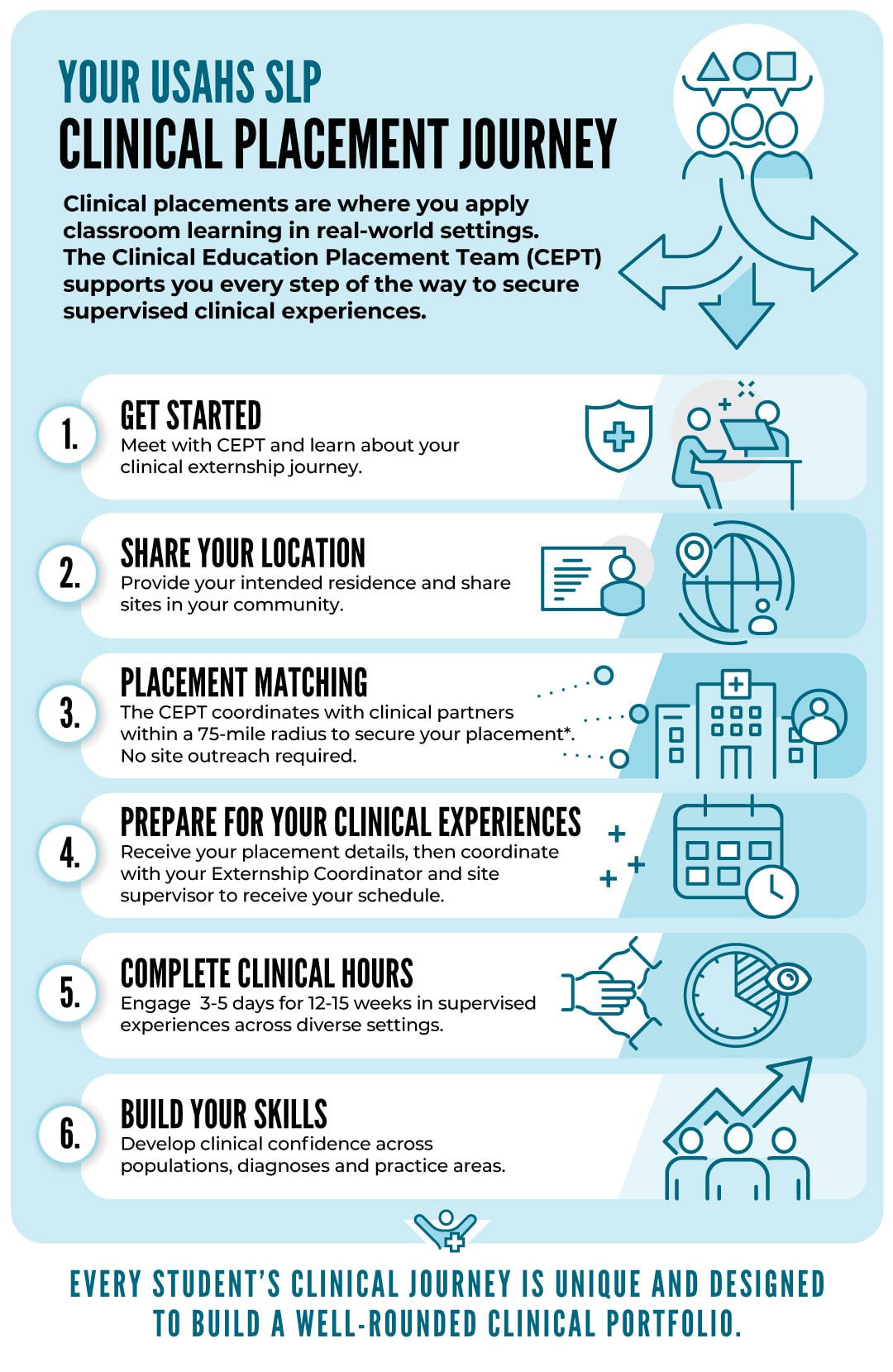
During your first trimester in USAHS’ MS-SLP program, you are introduced to the externship process and meet the University’s dedicated Clinical Education Placement Team (CEPT), a group of full-time professionals focused solely on supporting your clinical externship journey throughout the program.
Early in the program, you’ll provide the address where you plan to live and may also share information about speech-language pathology providers in your community. From there, the CEPT takes the lead, coordinating outreach, securing placements and expanding its clinical network as needed. You won’t be responsible for contacting sites or arranging your own placements.
The CEPT works with an established network of clinical partners to coordinate clinical placements that align with accreditation standards and each student’s clinical development. Whenever possible, the team works to secure placements within 75 miles of your location. If an appropriate placement isn’t available within that distance, you should be prepared for the possibility of travel or temporary relocation to fulfill clinical education requirements.
In areas where clinical placement demand is especially high, you may wonder how your required clinical education is completed. At USAHS, we ensure you meet all requirements through a combination of our established clinical partnerships and additional learning experiences, when needed.
Throughout the process, you’ll be supported by an externship coordinator who monitors progress, works closely with faculty and clinical educators and helps ensure every experience contributes to a well-rounded clinical portfolio. Each clinical partnership is intentionally selected to help students prepare for certification while working with clients of different ages, diagnoses and communication needs.
Because your clinical experiences are selected based on your individual needs, no two clinical portfolios are exactly alike—even if two students complete externships at the same site.
The SLP externship process
The CEPT coordinates placement logistics, establishes and maintains relationships with clinical partners, supports supervisors and works with you to track your clinical progression to ensure you complete the supervised hours needed for graduation and certification.
This personalized approach allows you to focus on advancing as a clinician while knowing you have ongoing support throughout the process.
Clinical experiences are the last three trimesters of your program. The CEPT works with each site to develop a schedule that allows you to engage in evaluation and treatment planning across the lifespan and within all available ASHA Big 9 practice areas.6
You should plan to keep your schedule open three to five days per week, with most clinical experiences occurring during standard clinical operating hours. However, some sites may require evening or weekend hours. Schedules are determined by each clinical site. Flexibility is an important part of the externship and helps you maximize opportunities to expand your clinical knowledge and skills.
Depending on the program schedule, you may complete more than one clinical experience in a single trimester, giving you the opportunity to gain hands-on experience in multiple clinical settings and learn from multiple speech-language pathologists.
Engage in the many possibilities of the profession
SLPs work in a wide range of settings with people across the lifespan.3 That’s why the MS-SLP program is designed to expose you to a variety of clinical environments.
You’ll complete at least one school-based placement, while other clinical practica may include:
- Pro Bono Clinics
- University-led micro-externship
- Private practices
- Home health
- Outpatient and inpatient facilities
- Skilled nursing facilities
- Memory care communities
Flexible clinical education options
Our clinical education program is always evolving. We continuously create new opportunities based on a number of factors, helping ensure you’ll receive the training and support you need. By the time you begin the program, the curriculum will be refined to keep your education relevant, engaging and student-centered.
While traditional in-person placements remain an important part of clinical education, universities also use a variety of learning models.4 At USAHS, depending on state regulations, accreditation requirements and other factors, you may participate in university-led clinics, micro-externships, telepractice and simulation. These approaches are designed to complement direct clinical experiences and help students enhance clinical reasoning while meeting program requirements.
At USAHS, you may also engage in University-led initiatives, such as Pro Bono Clinics in Texas, California or Florida, and micro-externship experiences, created in partnership with local organizations. These initiatives expand access to speech-language pathology services in the communities they serve.
The MS-SLP program uses all modalities of clinical education, such as Simucase, which allows you to practice clinical decision-making through interactive patient scenarios. These experiences are designed to complement supervised clinical education.
Clinical experience in the MS-SLP program isn’t limited to three separate externships; some trimesters may include multiple learning opportunities. Throughout the program, you’ll participate in a range of clinical learning experiences, which may include traditional placements, Pro Bono Clinics, and University-led micro-externships.
You’ll gain firsthand insight into the many career paths available in speech-language pathology. Whether working with children in schools, adults recovering from neurological conditions or clients in community-based settings, this broad clinical exposure helps you discover the environments and populations that best align with your professional goals.5
Building confidence for the future
USAHS’ MS-SLP program was created to expand access to SLP education while helping address the growing need for qualified clinicians in communities across the country.
Clinical education isn’t static. As healthcare needs change and new community partnerships emerge, the program continues to evolve—creating new clinical experiences that reflect where the profession is headed, what our students need and what sets up students for success after graduation. Through a growing network of clinical partners, USAHS helps students complete placements close to home whenever possible. Students gain high-quality supervised education, with clinical partners to help prepare the next generation of SLPs, and communities benefit from expanded access to care.
By graduation, you’ll have collaborated with practicing SLPs, explored multiple practice areas and developed the confidence to begin your career.
Are you ready to take the next step? Connect with an Enrollment Advisor to explore our MS-SLP program and externship opportunities.
*Note: Some states require an additional certification or license in order to work in a school setting. Students should be advised that the program is designed and intended to prepare graduates for SLP licensure in many states. However, graduates may need to complete additional requirements to be eligible for a license or certificate to work in a school setting or to have the ability to complete practicum in a school setting in his/her particular state of residence or school district, depending on the state and/or school district’s unique requirements. Students should contact the state board of education or his or her school district directly to determine if the program meets the requirements for state SLP certification or licensure in a school setting.
**Please visit the “MS-SLP Accreditation” page for more information on states from which we are currently accepting applications for enrollment.
Sources
- “2020 Standards and Implementation Procedures for the Certificate of Clinical Competence in Speech-Language Pathology,” American Speech-Language-Hearing Association (ASHA), 2026, https://www.asha.org/certification/2020-slp-certification-standards/.
- Bouchrika, I. “2026 Understanding Clinical Hours and Practicum Requirements in Online SLP Programs,” Research.com, June 10, 2026, https://research.com/speech-language-pathology/understanding-clinical-hours-and-practicum-requirements-in-online-slp-programs.
- “Speech-Language Pathologist,” Cleveland Clinic, March 27, 2025, https://my.clevelandclinic.org/health/articles/24602-speech-language-pathologist.
- Ma E.P., Lee T., Li W-H., “Enhancing preclinical speech-language pathology students’ self-perceived clinical competence using simulated patients,” CoDAS, January 30, 2026, https://pmc.ncbi.nlm.nih.gov/articles/PMC12978324/.
- “What Students Should Know Before Pursuing a Career in Speech-Language Pathology,” Resident Magazine, June 29, 2026, https://resident.com/health-and-wellness-resources/2026/06/29/what-students-should-know-before-pursuing-a-career-in-speech-language-pathology.
- “Scope of Practice in Speech-Language Pathology,” American Speech-Language-Hearing Association (ASHA), 2026, https://www.asha.org/policy/SP2016-00343.