School of Nursing

Master of Science in Nursing (MSN) Program

A master’s degree in nursing from USAHS opens the door to advanced career opportunities and expanded employment options. Our highly personalized and immersive academic experiences include the very latest educational technologies and simulations. You’ll be guided by a supportive community of nursing faculty committed to your success. Earning your Master of Science in Nursing (MSN) at USAHS will prepare you for an innovative leadership role in today’s global healthcare system.

Learn more about how our MSN program is designed with your needs in mind.

See Requirements & Program Details

Master’s in Nursing Program at a Glance

Requirements: ADN from an accredited nursing program. One full-time year of experience as a registered nurse is required.

Format: Online classes + hands-on

Start Dates: Jan., May, Sept.

Duration: 3.3-3.7 years* (10-11 trimesters), although acceleration options are available

Role Specialties: Family Nurse Practitioner, Adult Gerontology Nurse Practitioner, Psychiatric Mental Health Nurse Practitioner**

Requirements: Bachelor’s degree in nursing (BSN) from an accredited nursing program

Format: Online classes + hands-on

Start Dates: Sept., Jan., May, plus midterm starts

Duration: 2-3 years* (6-9 trimesters), although acceleration options are available

Role Specialties: Family Nurse Practitioner, Adult Gerontology Nurse Practitioner, Psychiatric Mental Health Nurse Practitioner, Nurse Executive, Nurse Educator**

*Please note, the MSN Nurse Educator and MSN Nurse Executive role specialties typically take 2 years and 8 months to complete, based off the most recent 3-year graduate data (2021-2022, 2022-2023 and 2023-2024); however, time to completion may vary by student depending on individual progress, traditional versus accelerated pathway, credits transferred and other factors.
**Sometimes our available role specialties change. Please call for availability.

Limited Time Grant:

All new students admitted into our RN to MSN programs who are ADN-prepared are eligible for a $1,500 RN to MSN first trimester tuition grant in addition to the RN to MSN PMHNP $2,500 grant and the RN to MSN FNP $7,500 grant!***
See terms ***The grant is calculated and applied on a per-credit basis. The total grant amount assumes the completion of the full number of credits in the program. Any transfer credits will reduce the amount of the grant awarded. This offer is not a guarantee that all candidates eligible for the offer will be granted acceptance or admission into USAHS. All prospective students will be subject to the same standard admission and registration process when applying to USAHS. The Grant is applicable to tuition only and does not apply toward books, materials, and other supplies or fees. This offer is only valid for eligible new students who enroll and start classes in the above programs at USAHS in Summer 2026. Please refer to the Financial Aid webpage for additional information.

Facts and Figures

certification pass rate

97%

First-Time FNP Certification Pass Rate Based on 2023 USAHS MSN-FNP, DNP-FNP and PGC (FNP) graduates who took the ANCC or AANP certification exam. The 2023 AANPCB national first-time certification exam pass rate was 73%. First-time licensure pass rates are reported two years post-graduation; rates for 2024 graduates expected in early 2027.

handshake-icon

1-ON-1

Faculty Support and Mentorship Tailored to Your Needs Each student is assigned a faculty advisor when they start the program. On-demand appointments with the faculty advisor and/or course instructors are available.

clinical placement stethoscope icon

100%

Clinical Placements Fall 2021 - Fall 2025. Future clinical education placement experiences will vary based on individual student specialty and academic needs, as well as site availability for assignments from term to term.

lighthouse-icon

40+

Years in Graduate Health Sciences Education

Nursing Program Grants

USAHS supports your journey to a MS in nursing with Special Tuition Grant savings.The grant is calculated and applied on a per-credit basis. The total grant amount assumes the completion of the full number of credits in the program. Any transfer  credits will reduce the amount of the grant awarded. This offer is not a guarantee that all candidates eligible for the offer will be granted acceptance or admission into USAHS. All prospective students will be subject to the same standard admission and registration process when applying to USAHS. The Grant is applicable to tuition only and does not apply toward books, materials, and other supplies or fees. This offer is only valid for eligible new students who enroll and start classes in the above programs at USAHS in Summer 2026. Please refer to the Financial Aid webpage for additional information.

Nurse Practitioner Advance Grant Tuition Savings

Nurse Practitioner Advance Grant Tuition Savings

MSN PMHNP: BSN or RN entry $2,500
MSN FNP: BSN or RN entry: $7,500
DNP FNP: BSN entry $15,000
DNP PMHNP: BSN entry $15,000
RN to MSN: $1,500 Stackable First Trimester Tuition **$1500 will be applied to the RN to MSN first trimester tuition costs. Offer valid through Summer 2026.

Criteria
Available to all eligible students
No application is needed

Nurse Leadership Grant Tuition Savings

Nurse Leadership Grant Tuition Savings

MSN Nurse Executive: BSN entry $5,000
DNP Nurse Executive: BSN entry $10,000
MSN DNP: $10,000

Criteria
Available to all eligible students
No application is needed

Alum Appreciation Grant Tuition Savings

Alum Appreciation Grant Tuition Savings

All Alum Nursing  $5,000

Criteria
Available to all eligible students
No application is needed

MSN Role Specialties

Prior to starting the MSN program, you’ll choose which of our five nursing role specialties you wish to follow. The first three clinical role specialties are available for the RN to MSN and BSN-entry pathways, and the two non-clinical role specialties are available for BSN-entry only.

You can earn your MSN degree in nursing and choose to become an expert in family or mental health. And those entering the programs with a BSN have the additional choices of Nurse Executive or Nurse Educator role specialties. As an MSN student at USAHS, you’ll be well on your way to an exciting career in a clinic or boardroom!

Clinical Specialties

Family Nurse Practitioner

Earn your family nurse practitioner (FNP) credential and increase your responsibilities, versatility and positive impact on patients. As an FNP, you can serve as a provider across a wide range of healthcare settings, from hospitals to private practice. With an MS in nursing, you will work with people of all ages to diagnose and treat conditions, prescribe medication, order tests and promote preventive care. Our FNP role specialty includes one required on-campus clinical intensive and practicum hours that provide the hands-on experience needed to prepare you for the FNP certification exam.

Psychiatric Mental Health Nurse Practitioner

In our Psychiatric Mental Health Nurse Practitioner role specialty, you’ll prepare to provide a full range of specialized services that constitute mental health and psychiatric care and treatment. By studying for a master’s degree in nursing, you will learn to assess and diagnose patients, prescribe medications and provide therapeutic interventions. You may also oversee case management, undertake policy development for programs and engage in comprehensive advocacy education and research. The Master of Science in Nursing curriculum includes one required virtual clinical intensive and practicum hours.

Adult Gerontology Nurse Practitioner (NOT CURRENTLY ENROLLING STUDENTS)

Given the aging baby boomer population and national shortages of nurses and physicians, adult gerontology nurse practitioners (AGNPs) are needed now more than ever. In our AGNP role specialty, you will prepare to assess and diagnose patients and manage their care from young adulthood to old age. By working towards your master’s degree in nursing, you will learn best practices for prescribing medication and other treatments related to complex chronic conditions, as well as strategies for preventing illness and promoting wellness throughout adulthood. You’ll explore strategies for addressing the cultural, psychological and social aspects of aging. Our AGNP curriculum includes one required on-campus clinical intensive and practicum hours.

Non-Clinical Specialties (BSN-Entry Only)

Nurse Executive

Nurse executives design, implement and direct systems for patient care delivery. In our Nurse Executive role specialty, you’ll learn strategies for managing and leading teams, influencing operational and clinical processes, and impacting patient outcomes at your organization. Through our MS in nursing programs, you’ll prepare for a role as a manager, director, supervisor, chief nursing officer and more. This specialty includes optional virtual immersions and required practicum hours. A certification option is available.

Nurse Educator (NOT CURRENTLY ENROLLING STUDENTS)

If you’re passionate about conveying your nursing knowledge and clinical experience to the next generation of nurses, consider a career in nursing education. In our Nurse Educator role specialty, you will learn strategies for curriculum design and delivery. By studying for your master’s degree in nursing, you’ll prepare for a range of teaching and training roles across academic, clinical, and public health settings. Our Nurse Educator role specialty includes optional virtual immersions and required practicum hours. Certifications are available.

Close

MSN Curriculum

If you’re a student in the online RN to MSN program, you’ll complete:

Family Nurse Practitioner (FNP): 59 credit hours and 754 practicum hours

Psychiatric Mental Health Nurse Practitioner (PMHNP): 64 credit hours and 754 practicum hours

Adult Gerontology Nurse Practitioner (AGNP): 64 credit hours and 754 practicum hours

The RN to MSN curriculum for the ADN-prepared nurse bridges into the Master of Science in Nursing curriculum for NP role specialties through four courses, introducing the student to core concepts and graduate education.

If you’re a student in the online BSN-entry Master of Science in Nursing program, you’ll complete:

Family Nurse Practitioner (FNP): 50 credit hours and 754 practicum hours

Psychiatric Mental Health Nurse Practitioner (PMHNP): 55 credit hours and 754 practicum hours

Adult Gerontology Nurse Practitioner (AGNP): 55 credit hours and 754 practicum hours

Those choosing either the Nurse Executive or Nurse Educator role specialty will complete a total of 36 credit hours and 290 practicum hours as follows:

RN to MSN – Family Nurse Practitioner Role Specialty (ADN or ASN entry)

CoursesHours
Curriculum
Trimester 1
In Trimester 1, NUR 6001 is an eight week course that is completed prior to starting NUR 6005. 
NUR 6001 - Clinical Leadership
Clinical leadership requires theoretical knowledge and management skills to lead interprofessional teams. Communication and collaboration within an interprofessional team aimed at delivering high-quality, cost-effective care to diverse populations in both acute and primary care is critical to effective team-based care. Students evaluate successful strategies for delegation, closing the communication loop, team goal setting, efficient oversight, technology support, and data formatting to assess effectiveness of the delivery of care. This course follows recommendations offered by the Agency for Healthcare Quality and Research Team Stepps.
3
NUR 6005 - Patient Safety, Quality, and Just Culture
This course provides an introduction to the knowledge and skills needed to lead patient safety and quality improvement initiatives at the micro and macro levels. The course provides the foundational concepts and methodologies used in process improvement within healthcare. Successful participants develop a system's view of safety and quality challenges and  learn strategies for improving culture, enhancing teamwork, managing change, and measuring success.
3
Trimester 2
NUR 6009 - Ethical, Legal, Health Policy
This course integrates ethical, legal, and health policy issues in contemporary nursing. Students review the major ethical principles, several ethical theories, conceptual frameworks, and ethical decision-making models and analyze the ANA Code of Ethics with Interpretive Statements in relation to individual practice settings and the nursing profession. Students utilize debate methodology to resolve common ethical dilemmas in nursing and discuss legal implications related to providing nursing care—specifically, examples of malpractice, how a bill becomes a law, and the legislative process. Students develop a position paper on a relevant health policy issue including integration of relevant ethical, legal, legislative, and economic implications.
3
NUR 6013 - Scholarly Inquiry
This course is designed to introduce students to the scientific research process, research methodologies, and the contributions of research to the improvement of nursing practice. Students focus on understanding, analyzing, and applying research findings to resolve nursing problems and improve outcomes. The course also provides nursing students with competencies necessary to read, evaluate, and interpret findings of nursing research studies. Emphasis is placed on applying research methodology and ethical consideration in development of a research proposal for evidence-based practice.
3
Trimester 3
IPE 7121 - Organizational Leadership & Policy in Health Care *
This course introduces students to interprofessional healthcare policy and organizational leadership concepts. Students have the opportunity to analyze and advocate for health policy with the inclusion of diverse stakeholders to optimize access to care, improve care coordination, and reduce disparities affecting population health. Various leadership styles are examined as well as self-assessment, goal setting, and strategies for continuous improvement as healthcare leaders.
3
Trimester 4
IPE 7400 - Healthcare Informatics and Technology Management
This course introduces the student to healthcare informatics, focusing on the foundational experiences with health information systems and technology; roles within interprofessional teams (when applicable); and ethical and legal use of technology to improve patient safety, healthcare quality, and population health outcomes. Students examine data management systems to improve outcomes of care and technology for care delivery and to explore new trends to improve patient outcomes using evidence to inform the design of workflows and utilization of health information systems to improve user experience, standards, and safety.
3
NUR 7161 - Theoretical and Scientific Underpinnings for Nursing Practice
This course focuses on the integration of theory, empirical evidence, and the application to nursing practice and decision-making. Nurses use theory combined with the best scientific evidence to provide the highest level of practice and improve quality outcomes. The introduction to the use of theory and the process of theory construction are discussed. Major theories of nursing and theories from other disciplines relative to nursing are analyzed with an emphasis on implications for nursing practice.
3
Trimester 5
IPE 7421 - Interprofessional Approaches to Regional and Global Population Health *
Students evaluate cultural, environmental, societal, and economic factors impacting population health and health outcomes. Students assimilate factors impacting individual and community health. Knowledge is applied to create interprofessional, evidence-based interventions to improve population health and advance health equity.
3
NUR 7050 - Evidence-Based Practice for Nurse Leaders *
This course provides an overview of the evidence-based practice process to prepare the nurse leader as a consumer of scientific evidence for decision making in practice, education, and leadership. A process for formulating a question using PICOT format and conducting literature searches for existing evidence is discussed. The course also includes an overview of the research process with emphasis on the critical appraisal of quantitative evidence for determination of inclusion in a literature synthesis related to the identified practice question. The discussion of biostatistics focuses on determining the appropriateness of the statistical analysis and interpretation of the statistical results in the critically appraised research evidence. Finding and critically appraising research summaries, such as systematic reviews, meta-analyses, and meta-syntheses, and clinical practice guidelines is included. Effectively implementing, evaluating, and disseminating an evidence-based change process is discussed.
3
Trimester 6
NUR 7560 - Advanced Pharmacology
Advanced practice nurses must be knowledgeable about pharmacotherapeutics and principles of safe prescribing. This is an online course that focuses on advanced concepts of pharmacology, including pharmacokinetics, pharmacodynamics, and pharmacogenomics. Emphasis is placed on common drug classes prescribed by advanced practice nurses for acute and chronic conditions in patients across the lifespan. Factors influencing effective therapy and legal considerations are also included.
3
NUR 7610 - Advanced Physiology and Pathophysiology
This course for advanced practice nursing students explores the study of physiology and pathophysiology. Emphasis includes understanding and identifying diseases by examining alterations in common physiological conditions across the lifespan. This course equips advanced practice nurses with the requisite knowledge and skills necessary for accurate disease diagnosis and management through an in-depth exploration of pathophysiologic processes, cellular changes, and systemic manifestations. 
3
Trimester 7
NUR 7570 - Primary Healthcare of the Family I
This course provides in-depth exploration of healthcare issues specific to women and pediatric populations within the primary care setting. Students develop the comprehensive knowledge and skills essential for the formulation of differential diagnoses and management of acute and chronic conditions as well as for health promotion and disease prevention in women and children across the lifespan. The Family Nurse Practitioner (FNP) student applies role specialty competency-based learning through attendance at the required FNP Skills Intensive to progress to practicum. 
Requires completion of on-campus Intensive Experience.
3
NUR 7580 - Advanced Health Assessment and Differential Diagnosis
This course prepares advanced practice nurses to apply methods of advanced assessment in formulating differential diagnoses of acute and chronic conditions across the lifespan. Emphasis is on advanced physical assessment skills, risk assessment, diagnostic reasoning, and documentation.
3
Trimester 8
NUR 7575 - Primary Healthcare of the Family II
This course is designed for the Family Nurse Practitioner (FNP) student, focusing on the assessment, diagnosis, management, and prevention of acute primary care conditions across the lifespan. Emphasizing clinical decision-making and evidence-based practice, students develop the comprehensive knowledge and skills essential for the formulation of differential diagnoses and management of acute primary care conditions. The course highlights care strategies, treatment protocols, and patient education to ensure safe, efficient, and cost-effective care.
3
NUR 7571 - FNP Role Practicum I
This course is the first in a series of three Family Nurse Practitioner (FNP) practicum courses. Students must demonstrate beginning proficiency in integrating theoretical and evidence-based, best practice knowledge of assessment, differential diagnosis, diagnosis, management, and evaluation of patients with acute and chronic health problems for the population of the family across the lifespan while demonstrating fiduciary stewardship in the delivery of quality care. FNP students demonstrate progressive synthesis and application of FNP role competencies, building on and translating concepts and skills derived from prerequisite courses. Students complete clinical hours in diverse primary care settings under the supervision of faculty and qualified preceptors.
4
Trimester 9
NUR 7572 - FNP Role Practicum II
This course builds on the advanced practice nursing concepts, skills, and role development of the family nurse practitioner (FNP) derived in NUR 7571 - FNP Role Practicum I. The student must demonstrate competency in integrating theoretical and evidence-based, best practice knowledge of assessment, differential diagnosis, diagnosis, management, and evaluation of patients with acute and chronic health problems for the population of the family across the lifespan while demonstrating fiduciary stewardship in the delivery of quality care. The FNP student must demonstrate progressive synthesis and application of FNP role competencies. Students complete clinical hours in diverse primary care settings under the supervision of faculty and qualified preceptors.
4
NUR 7585 - Primary Healthcare of the Family III
This course provides an in-depth exploration of chronic primary care conditions across the lifespan, with emphasis on the care of older adults and mental health management. Family Nurse Practitioner (FNP) students develop the comprehensive knowledge and skills essential for the formulation of differential diagnoses, management, and prevention of chronic primary care conditions. Students learn to deliver evidence-based, safe, and cost-effective care in primary care settings, addressing the unique challenges of chronic care management and geriatric care and integrating mental health assessments and interventions.
3
Trimester 10
NUR 7573 - FNP Role Practicum III
This cumulative course is the final in the series of three FNP practicum courses. Students demonstrate mastery of FNP role competencies by engaging in a comprehensive review and evaluation process. The FNP student must exhibit advancing synthesis and application of skills showcasing cumulative proficiency in managing increasingly complex acute and chronic health problems across the lifespan. Students complete clinical hours in diverse primary care settings under the supervision of faculty and qualified preceptors.
5
NUR 7574 - MSN Capstone
This course is the culmination of the advanced practice role specialty of the MSN program. The course is designed to help the student prepare for the role of the advanced practice nurse. Exploration of the advanced practice role occurs as well as demonstration in achievement of program learning outcomes.
1
Degree Credit Hours 59
* Course offers optional immersion. † Course requires practicum hours.

BSN to MSN – Family Nurse Practitioner Role Specialty (BSN entry)

Students entering with a BSN degree complete 50 credit hours as well as a total of 754 practicum hours to earn the MSN degree with the Family Nurse Practitioner role specialty.
CoursesHours
Curriculum
Trimester 1
IPE 7001 - Interprofessional Education and Collaborative Practice *
This course provides students with a foundation for interprofessional education and collaboration. Emphasis is on learning roles and responsibilities of healthcare peers, effective interprofessional communication, teams and teaming, as well as ethical practice and patient (or client)-centered care. All coursework prepares the student to engage on highly functioning healthcare teams, while striving to improve healthcare delivery through increasing patient and practitioner satisfaction, reducing costs, and achieving better outcomes. The course will expose the student to industry-relevant tools and techniques that meet the demands of the contemporary healthcare workplace.  
3
IPE 7121 - Organizational Leadership & Policy in Health Care
This course introduces students to interprofessional healthcare policy and organizational leadership concepts. Students have the opportunity to analyze and advocate for health policy with the inclusion of diverse stakeholders to optimize access to care, improve care coordination, and reduce disparities affecting population health. Various leadership styles are examined as well as self-assessment, goal setting, and strategies for continuous improvement as healthcare leaders.
3
Trimester 2
IPE 7400 - Healthcare Informatics and Technology Management
This course introduces the student to healthcare informatics, focusing on the foundational experiences with health information systems and technology; roles within interprofessional teams (when applicable); and ethical and legal use of technology to improve patient safety, healthcare quality, and population health outcomes. Students examine data management systems to improve outcomes of care and technology for care delivery and to explore new trends to improve patient outcomes using evidence to inform the design of workflows and utilization of health information systems to improve user experience, standards, and safety.
3
NUR 7161 - Theoretical and Scientific Underpinnings for Nursing Practice
This course focuses on the integration of theory, empirical evidence, and the application to nursing practice and decision-making. Nurses use theory combined with the best scientific evidence to provide the highest level of practice and improve quality outcomes. The introduction to the use of theory and the process of theory construction are discussed. Major theories of nursing and theories from other disciplines relative to nursing are analyzed with an emphasis on implications for nursing practice.
3
Trimester 3
IPE 7421 - Interprofessional Approaches to Regional and Global Population Health
Students evaluate cultural, environmental, societal, and economic factors impacting population health and health outcomes. Students assimilate factors impacting individual and community health. Knowledge is applied to create interprofessional, evidence-based interventions to improve population health and advance health equity.
3
NUR 7050 - Evidence-Based Practice for Nurse Leaders *
This course provides an overview of the evidence-based practice process to prepare the nurse leader as a consumer of scientific evidence for decision making in practice, education, and leadership. A process for formulating a question using PICOT format and conducting literature searches for existing evidence is discussed. The course also includes an overview of the research process with emphasis on the critical appraisal of quantitative evidence for determination of inclusion in a literature synthesis related to the identified practice question. The discussion of biostatistics focuses on determining the appropriateness of the statistical analysis and interpretation of the statistical results in the critically appraised research evidence. Finding and critically appraising research summaries, such as systematic reviews, meta-analyses, and meta-syntheses, and clinical practice guidelines is included. Effectively implementing, evaluating, and disseminating an evidence-based change process is discussed.
3
Trimester 4
NUR 7560 - Advanced Pharmacology
Advanced practice nurses must be knowledgeable about pharmacotherapeutics and principles of safe prescribing. This is an online course that focuses on advanced concepts of pharmacology, including pharmacokinetics, pharmacodynamics, and pharmacogenomics. Emphasis is placed on common drug classes prescribed by advanced practice nurses for acute and chronic conditions in patients across the lifespan. Factors influencing effective therapy and legal considerations are also included.
3
NUR 7610 - Advanced Physiology and Pathophysiology
This course for advanced practice nursing students explores the study of physiology and pathophysiology. Emphasis includes understanding and identifying diseases by examining alterations in common physiological conditions across the lifespan. This course equips advanced practice nurses with the requisite knowledge and skills necessary for accurate disease diagnosis and management through an in-depth exploration of pathophysiologic processes, cellular changes, and systemic manifestations. 
3
Trimester 5
NUR 7570 - Primary Healthcare of the Family I
This course provides in-depth exploration of healthcare issues specific to women and pediatric populations within the primary care setting. Students develop the comprehensive knowledge and skills essential for the formulation of differential diagnoses and management of acute and chronic conditions as well as for health promotion and disease prevention in women and children across the lifespan. The Family Nurse Practitioner (FNP) student applies role specialty competency-based learning through attendance at the required FNP Skills Intensive to progress to practicum. 
Requires on-campus intensive experience
3
NUR 7580 - Advanced Health Assessment and Differential Diagnosis
This course prepares advanced practice nurses to apply methods of advanced assessment in formulating differential diagnoses of acute and chronic conditions across the lifespan. Emphasis is on advanced physical assessment skills, risk assessment, diagnostic reasoning, and documentation.
3
Trimester 6
NUR 7571 - FNP Role Practicum I
This course is the first in a series of three Family Nurse Practitioner (FNP) practicum courses. Students must demonstrate beginning proficiency in integrating theoretical and evidence-based, best practice knowledge of assessment, differential diagnosis, diagnosis, management, and evaluation of patients with acute and chronic health problems for the population of the family across the lifespan while demonstrating fiduciary stewardship in the delivery of quality care. FNP students demonstrate progressive synthesis and application of FNP role competencies, building on and translating concepts and skills derived from prerequisite courses. Students complete clinical hours in diverse primary care settings under the supervision of faculty and qualified preceptors.
4
NUR 7575 - Primary Healthcare of the Family II
This course is designed for the Family Nurse Practitioner (FNP) student, focusing on the assessment, diagnosis, management, and prevention of acute primary care conditions across the lifespan. Emphasizing clinical decision-making and evidence-based practice, students develop the comprehensive knowledge and skills essential for the formulation of differential diagnoses and management of acute primary care conditions. The course highlights care strategies, treatment protocols, and patient education to ensure safe, efficient, and cost-effective care.
3
Trimester 7
NUR 7572 - FNP Role Practicum II
This course builds on the advanced practice nursing concepts, skills, and role development of the family nurse practitioner (FNP) derived in NUR 7571 - FNP Role Practicum I. The student must demonstrate competency in integrating theoretical and evidence-based, best practice knowledge of assessment, differential diagnosis, diagnosis, management, and evaluation of patients with acute and chronic health problems for the population of the family across the lifespan while demonstrating fiduciary stewardship in the delivery of quality care. The FNP student must demonstrate progressive synthesis and application of FNP role competencies. Students complete clinical hours in diverse primary care settings under the supervision of faculty and qualified preceptors.
4
NUR 7585 - Primary Healthcare of the Family III
This course provides an in-depth exploration of chronic primary care conditions across the lifespan, with emphasis on the care of older adults and mental health management. Family Nurse Practitioner (FNP) students develop the comprehensive knowledge and skills essential for the formulation of differential diagnoses, management, and prevention of chronic primary care conditions. Students learn to deliver evidence-based, safe, and cost-effective care in primary care settings, addressing the unique challenges of chronic care management and geriatric care and integrating mental health assessments and interventions.
3
Trimester 8
NUR 7573 - FNP Role Practicum III
This cumulative course is the final in the series of three FNP practicum courses. Students demonstrate mastery of FNP role competencies by engaging in a comprehensive review and evaluation process. The FNP student must exhibit advancing synthesis and application of skills showcasing cumulative proficiency in managing increasingly complex acute and chronic health problems across the lifespan. Students complete clinical hours in diverse primary care settings under the supervision of faculty and qualified preceptors.
5
NUR 7574 - MSN Capstone
This course is the culmination of the advanced practice role specialty of the MSN program. The course is designed to help the student prepare for the role of the advanced practice nurse. Exploration of the advanced practice role occurs as well as demonstration in achievement of program learning outcomes.
1
Degree Credit Hours 50
*Course offers optional immersion. †Course requires practicum hours.

RN to MSN – Psychiatric Mental Health Nurse Practitioner Role Specialty (ADN or ASN entry)

CoursesHours
Curriculum
Trimester 1
In Trimester 1, NUR 6001 is an eight week course that students complete prior to starting NUR 6005. 
NUR 6001 - Clinical Leadership
Clinical leadership requires theoretical knowledge and management skills to lead interprofessional teams. Communication and collaboration within an interprofessional team aimed at delivering high-quality, cost-effective care to diverse populations in both acute and primary care is critical to effective team-based care. Students evaluate successful strategies for delegation, closing the communication loop, team goal setting, efficient oversight, technology support, and data formatting to assess effectiveness of the delivery of care. This course follows recommendations offered by the Agency for Healthcare Quality and Research Team Stepps.
3
NUR 6005 - Patient Safety, Quality, and Just Culture
This course provides an introduction to the knowledge and skills needed to lead patient safety and quality improvement initiatives at the micro and macro levels. The course provides the foundational concepts and methodologies used in process improvement within healthcare. Successful participants develop a system's view of safety and quality challenges and  learn strategies for improving culture, enhancing teamwork, managing change, and measuring success.
3
Trimester 2
NUR 6009 - Ethical, Legal, Health Policy
This course integrates ethical, legal, and health policy issues in contemporary nursing. Students review the major ethical principles, several ethical theories, conceptual frameworks, and ethical decision-making models and analyze the ANA Code of Ethics with Interpretive Statements in relation to individual practice settings and the nursing profession. Students utilize debate methodology to resolve common ethical dilemmas in nursing and discuss legal implications related to providing nursing care—specifically, examples of malpractice, how a bill becomes a law, and the legislative process. Students develop a position paper on a relevant health policy issue including integration of relevant ethical, legal, legislative, and economic implications.
3
NUR 6013 - Scholarly Inquiry
This course is designed to introduce students to the scientific research process, research methodologies, and the contributions of research to the improvement of nursing practice. Students focus on understanding, analyzing, and applying research findings to resolve nursing problems and improve outcomes. The course also provides nursing students with competencies necessary to read, evaluate, and interpret findings of nursing research studies. Emphasis is placed on applying research methodology and ethical consideration in development of a research proposal for evidence-based practice.
3
Trimester 3
IPE 7121 - Organizational Leadership & Policy in Health Care *
This course introduces students to interprofessional healthcare policy and organizational leadership concepts. Students have the opportunity to analyze and advocate for health policy with the inclusion of diverse stakeholders to optimize access to care, improve care coordination, and reduce disparities affecting population health. Various leadership styles are examined as well as self-assessment, goal setting, and strategies for continuous improvement as healthcare leaders.
3
Trimester 4
NUR 7050 - Evidence-Based Practice for Nurse Leaders *
This course provides an overview of the evidence-based practice process to prepare the nurse leader as a consumer of scientific evidence for decision making in practice, education, and leadership. A process for formulating a question using PICOT format and conducting literature searches for existing evidence is discussed. The course also includes an overview of the research process with emphasis on the critical appraisal of quantitative evidence for determination of inclusion in a literature synthesis related to the identified practice question. The discussion of biostatistics focuses on determining the appropriateness of the statistical analysis and interpretation of the statistical results in the critically appraised research evidence. Finding and critically appraising research summaries, such as systematic reviews, meta-analyses, and meta-syntheses, and clinical practice guidelines is included. Effectively implementing, evaluating, and disseminating an evidence-based change process is discussed.
3
NUR 7161 - Theoretical and Scientific Underpinnings for Nursing Practice
This course focuses on the integration of theory, empirical evidence, and the application to nursing practice and decision-making. Nurses use theory combined with the best scientific evidence to provide the highest level of practice and improve quality outcomes. The introduction to the use of theory and the process of theory construction are discussed. Major theories of nursing and theories from other disciplines relative to nursing are analyzed with an emphasis on implications for nursing practice.
3
Trimester 5
NUR 7560 - Advanced Pharmacology
Advanced practice nurses must be knowledgeable about pharmacotherapeutics and principles of safe prescribing. This is an online course that focuses on advanced concepts of pharmacology, including pharmacokinetics, pharmacodynamics, and pharmacogenomics. Emphasis is placed on common drug classes prescribed by advanced practice nurses for acute and chronic conditions in patients across the lifespan. Factors influencing effective therapy and legal considerations are also included.
3
NUR 7610 - Advanced Physiology and Pathophysiology
This course for advanced practice nursing students explores the study of physiology and pathophysiology. Emphasis includes understanding and identifying diseases by examining alterations in common physiological conditions across the lifespan. This course equips advanced practice nurses with the requisite knowledge and skills necessary for accurate disease diagnosis and management through an in-depth exploration of pathophysiologic processes, cellular changes, and systemic manifestations. 
3
Trimester 6
NUR 7580 - Advanced Health Assessment and Differential Diagnosis
This course prepares advanced practice nurses to apply methods of advanced assessment in formulating differential diagnoses of acute and chronic conditions across the lifespan. Emphasis is on advanced physical assessment skills, risk assessment, diagnostic reasoning, and documentation.
3
NUR 7310 - Foundations of Neuroscience
This course is the foundation for practicing health professionals who explore and gain knowledge about neurobiology and psychopathophysiology as this relates to the etiology (cause), epidemiology (prevalence), developmental theories, and abnormal behavior. Students learn about evidence based empirical interventions while understanding ethical, cultural, and developmental applications. Students learn about the Diagnostic and Statistical Manual of Mental Disorders criterion and the neurobiological progression across the lifespan. 
3
Trimester 7
NUR 7315 - Advanced Psychopharmacology
This course focuses on evidence-based advanced practice psychopharmacology, building on previous advanced pharmacology coursework. Psychiatric mental health nurse practitioner students learn the scientific principles of pharmacokinetics, pharmacodynamics, pharmacogenetics, and psychotherapeutic medications. Emphasis is placed on psychopharmacologic treatment for acute and chronic psychiatric conditions across the lifespan. Students learn ethical safe prescribing practices and interprofessional collaboration with focus on optimal patient outcomes.
3
NUR 7330 - Psychotherapy for Psychiatric Mental Health Nurse Practitioner Practice
This course focuses on psychotherapeutic theories, psychotherapy modalities, and therapeutic skills for the Psychiatric Mental Health Nurse Practitioner student. Students acquire knowledge about a client-centered, culturally responsive approach; patient goals; therapeutic environment management; psychotherapeutic communication; psychoeducation goals; and crisis management. This course prepares students to apply multiple therapeutic approaches in psychotherapy, including cognitive and dialectical behavioral therapy, motivational interviewing, group supportive therapy, interpersonal therapy, recovery and SMART model framework, trauma therapy, and complementary alternative interventions in addition to applying interprofessional collaboration and developing a framework for clinical practice for individuals and populations across the lifespan. This course includes 50 hours of psychotherapy simulation.
3
Trimester 8
NUR 7350 - PMHNP: Acute and Chronic Management of Child/Adolescent with Psychiatric Mental Health Conditions
This course focuses on the role of the psychiatric mental health advanced practice nurse. Emphasis is on critical thinking, diagnostic reasoning, clinical judgment, theoretical underpinnings while applying scientific evidence-based theories, therapeutic concepts of communication, and screening tools. This course feeds into the associated practicum course for application of assessment skills; Diagnostic and Statistical Manual of Mental Disorders diagnostic reasoning; acute and chronic management, including psychopharmacology and psychotherapy; interprofessional collaboration; ethical standards and cultural diversity inclusion; health promotion; disease prevention; and differential diagnosis in planning care for children, adolescents, and families.
Requires completion of intensive experience.
3
NUR 7541 - PMHNP Role Practicum I Child & Adolescent Populations
This course focuses on the clinical role of the psychiatric mental health advanced practice nurse and builds on previous coursework. Students precept for a minimum of 180 PMHNP direct clinical practice hours through the application of didactic coursework from Acute and Chronic Management of Child/Adolescent with Psychiatric Mental Health Conditions. This clinical practicum allows students to build skills in psychiatric assessment, diagnoses, differential diagnosis, psychopharmacologic and psychotherapy interventions, and interprofessional collaboration. Emphasis is on upholding ethical standards and cultural diversity inclusion, health promotion, disease prevention, and differential diagnosis in planning care for children, adolescents, and families.
4
Trimester 9
NUR 7375 - PMHNP: Acute and Chronic Management of the Adult and Older Adult with Psychiatric Mental Health Conditions
This course focuses on the role of the psychiatric mental health advanced practice nurse. Emphasis is on critical thinking, diagnostic reasoning, clinical judgment, theoretical underpinnings while applying scientific evidence-based theories, therapeutic concepts of communication, and screening tools. This course provides foundational content, which is applied in PMHNP Role Practica II: Adult and Older Adult Populations. Foundational knowledge in advanced assessment skills; Diagnostic and Statistical Manual of Mental Disorders diagnostic reasoning; acute and chronic management, including psychopharmacology and psychotherapy; interprofessional collaboration, ethical standards, and cultural diversity inclusion; and health promotion, disease prevention, differential diagnosis in planning care for adult and older adult populations.
3
NUR 7542 - PMHNP Role Practicum II Adult and Older Adult Populations
This course focuses on the clinical role of the psychiatric mental health advanced practice nurse and builds on previous coursework. Students precept for a minimum of 180 PMHNP direct clinical practice hours through application of didactic coursework from PMHMP: Acute and Chronic Management of the Adult and Older Adult with Psychiatric Mental Health Conditions. This clinical practicum allows students to build skills in psychiatric assessment, diagnoses, differential diagnosis, psychopharmacologic and psychotherapy interventions, and interprofessional collaboration. Emphasis is on upholding ethical standards and cultural diversity inclusion, health promotion, disease prevention, and differential diagnosis in planning care for adults and older adults.
4
Trimester 10
NUR 7327 - APRN Transition to Practice
This course prepares students for the transition to the role of the psychiatric mental health nurse practitioner. This course guides students in preparation for the national board certification examination. Students learn how the psychiatric mental health nurse practitioner integrates a culmination of knowledge into clinical practice. Understanding evidence-based interventions, the scope of practice, and coordinating mental health care is essential in the psychiatric mental health nurse practitioner role.
2
NUR 7543 - PMHNP Role Practicum III Diverse/Special Populations
This course focuses on the role of the psychiatric mental health advanced practice nurse with an emphasis on diverse and special populations. This course builds on previous coursework as students demonstrate critical thinking, diagnostic reasoning, clinical judgment, theoretical underpinnings while applying scientific evidence-based theories, therapeutic concepts of communication, and screening tools. This course is a clinical practice-based practicum lead by expert clinical PMHNP faculty as students expand assessment skills; Diagnostic and Statistical Manual of Mental Disorders diagnostic reasoning; acute and chronic management, including psychopharmacology and psychotherapy; interprofessional collaboration; ethical standards and cultural diversity inclusion; health promotion; disease prevention; and differential diagnosis in planning care for diverse, special populations and specialty populations of the student's choice. Course requires 225 contact hours. 
5
Trimester 11
NUR 7577 - PMHNP MSN Community Engagement Capstone Project
This course has two critical components: Preparation for specialty PMHNP certification and developing a culminating capstone showcasing knowledge of the principles of the PMHNP advanced practice nursing role through the creation of a quality improvement plan focusing on the needs, challenges, and benefits of an interprofessional approach to community-based care for diverse populations. Certification preparation is completed independently within the asynchronous classroom, whereas the MSN Capstone plan is a competency. 
4
Degree Credit Hours 64
* Course offers optional immersion. † Course requires practicum hours.

BSN to MSN – Psychiatric Mental Health Nurse Practitioner Role Specialty (BSN entry)

Students entering with a BSN degree complete 55 credit hours as well as a total of 754 practicum hours to earn the MSN degree with Psychiatric Mental Health Nurse Practitioner role specialty.
CoursesHours
Curriculum
Trimester 1
IPE 7001 - Interprofessional Education and Collaborative Practice *
This course provides students with a foundation for interprofessional education and collaboration. Emphasis is on learning roles and responsibilities of healthcare peers, effective interprofessional communication, teams and teaming, as well as ethical practice and patient (or client)-centered care. All coursework prepares the student to engage on highly functioning healthcare teams, while striving to improve healthcare delivery through increasing patient and practitioner satisfaction, reducing costs, and achieving better outcomes. The course will expose the student to industry-relevant tools and techniques that meet the demands of the contemporary healthcare workplace.  
3
IPE 7121 - Organizational Leadership & Policy in Health Care
This course introduces students to interprofessional healthcare policy and organizational leadership concepts. Students have the opportunity to analyze and advocate for health policy with the inclusion of diverse stakeholders to optimize access to care, improve care coordination, and reduce disparities affecting population health. Various leadership styles are examined as well as self-assessment, goal setting, and strategies for continuous improvement as healthcare leaders.
3
Trimester 2
NUR 7050 - Evidence-Based Practice for Nurse Leaders *
This course provides an overview of the evidence-based practice process to prepare the nurse leader as a consumer of scientific evidence for decision making in practice, education, and leadership. A process for formulating a question using PICOT format and conducting literature searches for existing evidence is discussed. The course also includes an overview of the research process with emphasis on the critical appraisal of quantitative evidence for determination of inclusion in a literature synthesis related to the identified practice question. The discussion of biostatistics focuses on determining the appropriateness of the statistical analysis and interpretation of the statistical results in the critically appraised research evidence. Finding and critically appraising research summaries, such as systematic reviews, meta-analyses, and meta-syntheses, and clinical practice guidelines is included. Effectively implementing, evaluating, and disseminating an evidence-based change process is discussed.
3
NUR 7161 - Theoretical and Scientific Underpinnings for Nursing Practice
This course focuses on the integration of theory, empirical evidence, and the application to nursing practice and decision-making. Nurses use theory combined with the best scientific evidence to provide the highest level of practice and improve quality outcomes. The introduction to the use of theory and the process of theory construction are discussed. Major theories of nursing and theories from other disciplines relative to nursing are analyzed with an emphasis on implications for nursing practice.
3
Trimester 3
NUR 7560 - Advanced Pharmacology
Advanced practice nurses must be knowledgeable about pharmacotherapeutics and principles of safe prescribing. This is an online course that focuses on advanced concepts of pharmacology, including pharmacokinetics, pharmacodynamics, and pharmacogenomics. Emphasis is placed on common drug classes prescribed by advanced practice nurses for acute and chronic conditions in patients across the lifespan. Factors influencing effective therapy and legal considerations are also included.
3
NUR 7610 - Advanced Physiology and Pathophysiology
This course for advanced practice nursing students explores the study of physiology and pathophysiology. Emphasis includes understanding and identifying diseases by examining alterations in common physiological conditions across the lifespan. This course equips advanced practice nurses with the requisite knowledge and skills necessary for accurate disease diagnosis and management through an in-depth exploration of pathophysiologic processes, cellular changes, and systemic manifestations. 
3
Trimester 4
NUR 7310 - Foundations of Neuroscience
This course is the foundation for practicing health professionals who explore and gain knowledge about neurobiology and psychopathophysiology as this relates to the etiology (cause), epidemiology (prevalence), developmental theories, and abnormal behavior. Students learn about evidence based empirical interventions while understanding ethical, cultural, and developmental applications. Students learn about the Diagnostic and Statistical Manual of Mental Disorders criterion and the neurobiological progression across the lifespan. 
3
NUR 7580 - Advanced Health Assessment and Differential Diagnosis
This course prepares advanced practice nurses to apply methods of advanced assessment in formulating differential diagnoses of acute and chronic conditions across the lifespan. Emphasis is on advanced physical assessment skills, risk assessment, diagnostic reasoning, and documentation.
3
Trimester 5
NUR 7315 - Advanced Psychopharmacology
This course focuses on evidence-based advanced practice psychopharmacology, building on previous advanced pharmacology coursework. Psychiatric mental health nurse practitioner students learn the scientific principles of pharmacokinetics, pharmacodynamics, pharmacogenetics, and psychotherapeutic medications. Emphasis is placed on psychopharmacologic treatment for acute and chronic psychiatric conditions across the lifespan. Students learn ethical safe prescribing practices and interprofessional collaboration with focus on optimal patient outcomes.
3
NUR 7330 - Psychotherapy for Psychiatric Mental Health Nurse Practitioner Practice
This course focuses on psychotherapeutic theories, psychotherapy modalities, and therapeutic skills for the Psychiatric Mental Health Nurse Practitioner student. Students acquire knowledge about a client-centered, culturally responsive approach; patient goals; therapeutic environment management; psychotherapeutic communication; psychoeducation goals; and crisis management. This course prepares students to apply multiple therapeutic approaches in psychotherapy, including cognitive and dialectical behavioral therapy, motivational interviewing, group supportive therapy, interpersonal therapy, recovery and SMART model framework, trauma therapy, and complementary alternative interventions in addition to applying interprofessional collaboration and developing a framework for clinical practice for individuals and populations across the lifespan. This course includes 50 hours of psychotherapy simulation.
3
Trimester 6
NUR 7350 - PMHNP: Acute and Chronic Management of Child/Adolescent with Psychiatric Mental Health Conditions
This course focuses on the role of the psychiatric mental health advanced practice nurse. Emphasis is on critical thinking, diagnostic reasoning, clinical judgment, theoretical underpinnings while applying scientific evidence-based theories, therapeutic concepts of communication, and screening tools. This course feeds into the associated practicum course for application of assessment skills; Diagnostic and Statistical Manual of Mental Disorders diagnostic reasoning; acute and chronic management, including psychopharmacology and psychotherapy; interprofessional collaboration; ethical standards and cultural diversity inclusion; health promotion; disease prevention; and differential diagnosis in planning care for children, adolescents, and families.
Required virtual intensive
3
NUR 7541 - PMHNP Role Practicum I Child & Adolescent Populations
This course focuses on the clinical role of the psychiatric mental health advanced practice nurse and builds on previous coursework. Students precept for a minimum of 180 PMHNP direct clinical practice hours through the application of didactic coursework from Acute and Chronic Management of Child/Adolescent with Psychiatric Mental Health Conditions. This clinical practicum allows students to build skills in psychiatric assessment, diagnoses, differential diagnosis, psychopharmacologic and psychotherapy interventions, and interprofessional collaboration. Emphasis is on upholding ethical standards and cultural diversity inclusion, health promotion, disease prevention, and differential diagnosis in planning care for children, adolescents, and families.
4
Trimester 7
NUR 7375 - PMHNP: Acute and Chronic Management of the Adult and Older Adult with Psychiatric Mental Health Conditions
This course focuses on the role of the psychiatric mental health advanced practice nurse. Emphasis is on critical thinking, diagnostic reasoning, clinical judgment, theoretical underpinnings while applying scientific evidence-based theories, therapeutic concepts of communication, and screening tools. This course provides foundational content, which is applied in PMHNP Role Practica II: Adult and Older Adult Populations. Foundational knowledge in advanced assessment skills; Diagnostic and Statistical Manual of Mental Disorders diagnostic reasoning; acute and chronic management, including psychopharmacology and psychotherapy; interprofessional collaboration, ethical standards, and cultural diversity inclusion; and health promotion, disease prevention, differential diagnosis in planning care for adult and older adult populations.
3
NUR 7542 - PMHNP Role Practicum II Adult and Older Adult Populations
This course focuses on the clinical role of the psychiatric mental health advanced practice nurse and builds on previous coursework. Students precept for a minimum of 180 PMHNP direct clinical practice hours through application of didactic coursework from PMHMP: Acute and Chronic Management of the Adult and Older Adult with Psychiatric Mental Health Conditions. This clinical practicum allows students to build skills in psychiatric assessment, diagnoses, differential diagnosis, psychopharmacologic and psychotherapy interventions, and interprofessional collaboration. Emphasis is on upholding ethical standards and cultural diversity inclusion, health promotion, disease prevention, and differential diagnosis in planning care for adults and older adults.
4
Trimester 8
NUR 7327 - APRN Transition to Practice
This course prepares students for the transition to the role of the psychiatric mental health nurse practitioner. This course guides students in preparation for the national board certification examination. Students learn how the psychiatric mental health nurse practitioner integrates a culmination of knowledge into clinical practice. Understanding evidence-based interventions, the scope of practice, and coordinating mental health care is essential in the psychiatric mental health nurse practitioner role.
2
NUR 7543 - PMHNP Role Practicum III Diverse/Special Populations
This course focuses on the role of the psychiatric mental health advanced practice nurse with an emphasis on diverse and special populations. This course builds on previous coursework as students demonstrate critical thinking, diagnostic reasoning, clinical judgment, theoretical underpinnings while applying scientific evidence-based theories, therapeutic concepts of communication, and screening tools. This course is a clinical practice-based practicum lead by expert clinical PMHNP faculty as students expand assessment skills; Diagnostic and Statistical Manual of Mental Disorders diagnostic reasoning; acute and chronic management, including psychopharmacology and psychotherapy; interprofessional collaboration; ethical standards and cultural diversity inclusion; health promotion; disease prevention; and differential diagnosis in planning care for diverse, special populations and specialty populations of the student's choice. Course requires 225 contact hours. 
5
Trimester 9
NUR 7577 - PMHNP MSN Community Engagement Capstone Project
This course has two critical components: Preparation for specialty PMHNP certification and developing a culminating capstone showcasing knowledge of the principles of the PMHNP advanced practice nursing role through the creation of a quality improvement plan focusing on the needs, challenges, and benefits of an interprofessional approach to community-based care for diverse populations. Certification preparation is completed independently within the asynchronous classroom, whereas the MSN Capstone plan is a competency. 
4
Degree Credit Hours 55
* Course offers optional immersion. † Course requires practicum hours.

RN to MSN – Adult Gerontology Nurse Practitioner Role Specialty (ADN or ASN entry)

This program is not currently enrolling new students. 
CoursesHours
Curriculum
Trimester 1
In Trimester 1, NUR 6001 is an eight week course that is completed prior to starting NUR 6005.
NUR 6001 - Clinical Leadership
Clinical leadership requires theoretical knowledge and management skills to lead interprofessional teams. Communication and collaboration within an interprofessional team aimed at delivering high-quality, cost-effective care to diverse populations in both acute and primary care is critical to effective team-based care. Students evaluate successful strategies for delegation, closing the communication loop, team goal setting, efficient oversight, technology support, and data formatting to assess effectiveness of the delivery of care. This course follows recommendations offered by the Agency for Healthcare Quality and Research Team Stepps.
3
NUR 6005 - Patient Safety, Quality, and Just Culture
This course provides an introduction to the knowledge and skills needed to lead patient safety and quality improvement initiatives at the micro and macro levels. The course provides the foundational concepts and methodologies used in process improvement within healthcare. Successful participants develop a system's view of safety and quality challenges and  learn strategies for improving culture, enhancing teamwork, managing change, and measuring success.
3
Trimester 2
NUR 6009 - Ethical, Legal, Health Policy
This course integrates ethical, legal, and health policy issues in contemporary nursing. Students review the major ethical principles, several ethical theories, conceptual frameworks, and ethical decision-making models and analyze the ANA Code of Ethics with Interpretive Statements in relation to individual practice settings and the nursing profession. Students utilize debate methodology to resolve common ethical dilemmas in nursing and discuss legal implications related to providing nursing care—specifically, examples of malpractice, how a bill becomes a law, and the legislative process. Students develop a position paper on a relevant health policy issue including integration of relevant ethical, legal, legislative, and economic implications.
3
NUR 6013 - Scholarly Inquiry
This course is designed to introduce students to the scientific research process, research methodologies, and the contributions of research to the improvement of nursing practice. Students focus on understanding, analyzing, and applying research findings to resolve nursing problems and improve outcomes. The course also provides nursing students with competencies necessary to read, evaluate, and interpret findings of nursing research studies. Emphasis is placed on applying research methodology and ethical consideration in development of a research proposal for evidence-based practice.
3
Trimester 3
IPE 7121 - Organizational Leadership & Policy in Health Care *
This course introduces students to interprofessional healthcare policy and organizational leadership concepts. Students have the opportunity to analyze and advocate for health policy with the inclusion of diverse stakeholders to optimize access to care, improve care coordination, and reduce disparities affecting population health. Various leadership styles are examined as well as self-assessment, goal setting, and strategies for continuous improvement as healthcare leaders.
3
Trimester 4
NUR 7161 - Theoretical and Scientific Underpinnings for Nursing Practice
This course focuses on the integration of theory, empirical evidence, and the application to nursing practice and decision-making. Nurses use theory combined with the best scientific evidence to provide the highest level of practice and improve quality outcomes. The introduction to the use of theory and the process of theory construction are discussed. Major theories of nursing and theories from other disciplines relative to nursing are analyzed with an emphasis on implications for nursing practice.
3
IPE 7400 - Healthcare Informatics and Technology Management
This course introduces the student to healthcare informatics, focusing on the foundational experiences with health information systems and technology; roles within interprofessional teams (when applicable); and ethical and legal use of technology to improve patient safety, healthcare quality, and population health outcomes. Students examine data management systems to improve outcomes of care and technology for care delivery and to explore new trends to improve patient outcomes using evidence to inform the design of workflows and utilization of health information systems to improve user experience, standards, and safety.
3
Trimester 5
NUR 7050 - Evidence-Based Practice for Nurse Leaders *
This course provides an overview of the evidence-based practice process to prepare the nurse leader as a consumer of scientific evidence for decision making in practice, education, and leadership. A process for formulating a question using PICOT format and conducting literature searches for existing evidence is discussed. The course also includes an overview of the research process with emphasis on the critical appraisal of quantitative evidence for determination of inclusion in a literature synthesis related to the identified practice question. The discussion of biostatistics focuses on determining the appropriateness of the statistical analysis and interpretation of the statistical results in the critically appraised research evidence. Finding and critically appraising research summaries, such as systematic reviews, meta-analyses, and meta-syntheses, and clinical practice guidelines is included. Effectively implementing, evaluating, and disseminating an evidence-based change process is discussed.
3
IPE 7421 - Interprofessional Approaches to Regional and Global Population Health *
Students evaluate cultural, environmental, societal, and economic factors impacting population health and health outcomes. Students assimilate factors impacting individual and community health. Knowledge is applied to create interprofessional, evidence-based interventions to improve population health and advance health equity.
3
Trimester 6
NUR 7560 - Advanced Pharmacology
Advanced practice nurses must be knowledgeable about pharmacotherapeutics and principles of safe prescribing. This is an online course that focuses on advanced concepts of pharmacology, including pharmacokinetics, pharmacodynamics, and pharmacogenomics. Emphasis is placed on common drug classes prescribed by advanced practice nurses for acute and chronic conditions in patients across the lifespan. Factors influencing effective therapy and legal considerations are also included.
3
NUR 7610 - Advanced Physiology and Pathophysiology
This course for advanced practice nursing students explores the study of physiology and pathophysiology. Emphasis includes understanding and identifying diseases by examining alterations in common physiological conditions across the lifespan. This course equips advanced practice nurses with the requisite knowledge and skills necessary for accurate disease diagnosis and management through an in-depth exploration of pathophysiologic processes, cellular changes, and systemic manifestations. 
3
Trimester 7
NUR 7210 - Adult Gerontology Primary Healthcare Part I
This is the first of three in this didactic course series that focuses on the Adult Gerontology Nurse Practitioner role with application of advanced theoretical knowledge in assessment and management of health promotion, health maintenance, and disease prevention for the adult/geriatric population across the continuum. The assessment and management of common health concerns is introduced. Emphasis is placed on the primary care of adult/geriatric individuals and their families in a multicultural and holistic care environment.
Requires completion of Intensive Experience.
3
NUR 7580 - Advanced Health Assessment and Differential Diagnosis
This course prepares advanced practice nurses to apply methods of advanced assessment in formulating differential diagnoses of acute and chronic conditions across the lifespan. Emphasis is on advanced physical assessment skills, risk assessment, diagnostic reasoning, and documentation.
3
Trimester 8
NUR 7235 - Adult Gerontology Primary Healthcare Part II
In this second of three courses, the adult gerontology nurse practitioner role continues to evolve and will incorporate critical thinking and decision-making skills to aid in providing effective primary care for adult-geriatric individuals and clinical decision making for diagnosis and management of both acute and chronic conditions that affects adult-geriatric individuals. Emphasis is placed on the delivery of evidence-based, safe, cost-effective care in a primary care setting.
4
NUR 7551 - AGNP Role Practicum I
In this first of three clinical practicums for the Adult Gerontology Nurse Practitioner role specialty, students demonstrate beginning proficiency of assessment and management of common health/illness conditions of the adult/geriatric population including promotion and management of common chronic health problems with appropriate pharmacological interventions and patient education. Emphasis is placed on providing care in a multicultural, holistic environment including health promotion and illness prevention activities. This is a clinical residency under the supervision of a preceptor; course requires 180 contact hours.
4
Trimester 9
NUR 7250 - Adult Gerontology Primary Healthcare Part III
This is the third of three didactic courses for the Adult Gerontology Nurse Practitioner role and emphasizes advanced theoretical knowledge in the assessment and management of acute, chronic, and complex health conditions affecting the adult geriatric population, including the frail elderly population. Palliative and end of life care issues with inclusion of multidimensional interventions are also applied. Legal, ethical, financial, and cultural concepts related to advanced-practice nursing and professional credentialing are integrated. Emphasis is placed on primary health care of adult geriatric individuals and their families in a multicultural environment.
4
NUR 7552 - AGNP Role Practicum II
This is the second of three clinical practicums and focuses on the role of the Adult Gerontology Nurse Practitioner in the advanced beginner stage of caring for patients in a primary care setting. A synthesis of theory and application of evidence-based knowledge are incorporated to provide comprehensive assessment and management of health promotion/disease prevention activities with appropriate pharmacological interventions and patient education. Both acute and chronic health conditions of the adult geriatric population are included. Emphasis is placed on the adult geriatric primary care of individuals and their families within a multicultural environment. Requires 180 contact hours as clinical residency under the supervision of a preceptor. 
4
Trimester 10
NUR 7553 - AGNP Role Practicum III
This is the third and final practicum for the Adult Gerontology Nurse Practitioner role in which role competence should be displayed. A synthesis of theory and application of evidence-based knowledge are incorporated to provide comprehensive assessment and management of health promotion/disease prevention activities with appropriate pharmacological interventions and patient education. This includes a compilation of all concepts learned such as crisis intervention, acute and chronic illness, palliative care, and complex health conditions applied to the full spectrum of ages including adolescent, adult, old, young-old, middle-old, oldest-old and frail elderly populations. Emphasis is placed on the adult geriatric primary care of individuals and their families within a multicultural environment. Course requires 225 contact hours as a clinical residency under the supervision of a preceptor.
5
NUR 7576 - MSN-AGNP Capstone
This course is the culmination of the advanced practice role specialty of the MSN-AGNP program. Demonstration of the role of the advanced practice AGNP role by implementing an MSN capstone project in a community-of- interest environment. Students create an e-portfolio to demonstrate acquisition of program learning core competency outcomes. This involves making an action out of knowledge, analysis, reflection, judgement in the needs of population health, discovering evidence-based resolutions while interacting and creating a project aimed at improving overall holistic physical and mental health.
4
Degree Credit Hours 64
* Course offers optional immersion. † Course requires practicum hours

BSN to MSN – Adult Gerontology Nurse Practitioner Role Specialty (BSN entry)

This program is not currently enrolling new students. Students entering with a BSN degree complete 71 credit hours as well as a total of 1,334 practicum hours to earn the MSN degree with the Adult Gerontology Nurse Practitioner role specialty.
CoursesHours
Curriculum
Trimester 1
IPE 7001 - Interprofessional Education and Collaborative Practice *
This course provides students with a foundation for interprofessional education and collaboration. Emphasis is on learning roles and responsibilities of healthcare peers, effective interprofessional communication, teams and teaming, as well as ethical practice and patient (or client)-centered care. All coursework prepares the student to engage on highly functioning healthcare teams, while striving to improve healthcare delivery through increasing patient and practitioner satisfaction, reducing costs, and achieving better outcomes. The course will expose the student to industry-relevant tools and techniques that meet the demands of the contemporary healthcare workplace.  
3
IPE 7121 - Organizational Leadership & Policy in Health Care
This course introduces students to interprofessional healthcare policy and organizational leadership concepts. Students have the opportunity to analyze and advocate for health policy with the inclusion of diverse stakeholders to optimize access to care, improve care coordination, and reduce disparities affecting population health. Various leadership styles are examined as well as self-assessment, goal setting, and strategies for continuous improvement as healthcare leaders.
3
Trimester 2
IPE 7400 - Healthcare Informatics and Technology Management
This course introduces the student to healthcare informatics, focusing on the foundational experiences with health information systems and technology; roles within interprofessional teams (when applicable); and ethical and legal use of technology to improve patient safety, healthcare quality, and population health outcomes. Students examine data management systems to improve outcomes of care and technology for care delivery and to explore new trends to improve patient outcomes using evidence to inform the design of workflows and utilization of health information systems to improve user experience, standards, and safety.
3
NUR 7161 - Theoretical and Scientific Underpinnings for Nursing Practice
This course focuses on the integration of theory, empirical evidence, and the application to nursing practice and decision-making. Nurses use theory combined with the best scientific evidence to provide the highest level of practice and improve quality outcomes. The introduction to the use of theory and the process of theory construction are discussed. Major theories of nursing and theories from other disciplines relative to nursing are analyzed with an emphasis on implications for nursing practice.
3
Trimester 3
IPE 7421 - Interprofessional Approaches to Regional and Global Population Health
Students evaluate cultural, environmental, societal, and economic factors impacting population health and health outcomes. Students assimilate factors impacting individual and community health. Knowledge is applied to create interprofessional, evidence-based interventions to improve population health and advance health equity.
3
NUR 7050 - Evidence-Based Practice for Nurse Leaders *
This course provides an overview of the evidence-based practice process to prepare the nurse leader as a consumer of scientific evidence for decision making in practice, education, and leadership. A process for formulating a question using PICOT format and conducting literature searches for existing evidence is discussed. The course also includes an overview of the research process with emphasis on the critical appraisal of quantitative evidence for determination of inclusion in a literature synthesis related to the identified practice question. The discussion of biostatistics focuses on determining the appropriateness of the statistical analysis and interpretation of the statistical results in the critically appraised research evidence. Finding and critically appraising research summaries, such as systematic reviews, meta-analyses, and meta-syntheses, and clinical practice guidelines is included. Effectively implementing, evaluating, and disseminating an evidence-based change process is discussed.
3
Trimester 4
NUR 7560 - Advanced Pharmacology
Advanced practice nurses must be knowledgeable about pharmacotherapeutics and principles of safe prescribing. This is an online course that focuses on advanced concepts of pharmacology, including pharmacokinetics, pharmacodynamics, and pharmacogenomics. Emphasis is placed on common drug classes prescribed by advanced practice nurses for acute and chronic conditions in patients across the lifespan. Factors influencing effective therapy and legal considerations are also included.
3
NUR 7610 - Advanced Physiology and Pathophysiology
This course for advanced practice nursing students explores the study of physiology and pathophysiology. Emphasis includes understanding and identifying diseases by examining alterations in common physiological conditions across the lifespan. This course equips advanced practice nurses with the requisite knowledge and skills necessary for accurate disease diagnosis and management through an in-depth exploration of pathophysiologic processes, cellular changes, and systemic manifestations. 
3
Trimester 5
NUR 7210 - Adult Gerontology Primary Healthcare Part I
This is the first of three in this didactic course series that focuses on the Adult Gerontology Nurse Practitioner role with application of advanced theoretical knowledge in assessment and management of health promotion, health maintenance, and disease prevention for the adult/geriatric population across the continuum. The assessment and management of common health concerns is introduced. Emphasis is placed on the primary care of adult/geriatric individuals and their families in a multicultural and holistic care environment.
Requires on-campus skills intensive
3
NUR 7580 - Advanced Health Assessment and Differential Diagnosis
This course prepares advanced practice nurses to apply methods of advanced assessment in formulating differential diagnoses of acute and chronic conditions across the lifespan. Emphasis is on advanced physical assessment skills, risk assessment, diagnostic reasoning, and documentation.
3
Trimester 6
NUR 7235 - Adult Gerontology Primary Healthcare Part II
In this second of three courses, the adult gerontology nurse practitioner role continues to evolve and will incorporate critical thinking and decision-making skills to aid in providing effective primary care for adult-geriatric individuals and clinical decision making for diagnosis and management of both acute and chronic conditions that affects adult-geriatric individuals. Emphasis is placed on the delivery of evidence-based, safe, cost-effective care in a primary care setting.
4
NUR 7551 - AGNP Role Practicum I
In this first of three clinical practicums for the Adult Gerontology Nurse Practitioner role specialty, students demonstrate beginning proficiency of assessment and management of common health/illness conditions of the adult/geriatric population including promotion and management of common chronic health problems with appropriate pharmacological interventions and patient education. Emphasis is placed on providing care in a multicultural, holistic environment including health promotion and illness prevention activities. This is a clinical residency under the supervision of a preceptor; course requires 180 contact hours.
4
Trimester 7
NUR 7250 - Adult Gerontology Primary Healthcare Part III
This is the third of three didactic courses for the Adult Gerontology Nurse Practitioner role and emphasizes advanced theoretical knowledge in the assessment and management of acute, chronic, and complex health conditions affecting the adult geriatric population, including the frail elderly population. Palliative and end of life care issues with inclusion of multidimensional interventions are also applied. Legal, ethical, financial, and cultural concepts related to advanced-practice nursing and professional credentialing are integrated. Emphasis is placed on primary health care of adult geriatric individuals and their families in a multicultural environment.
4
NUR 7552 - AGNP Role Practicum II
This is the second of three clinical practicums and focuses on the role of the Adult Gerontology Nurse Practitioner in the advanced beginner stage of caring for patients in a primary care setting. A synthesis of theory and application of evidence-based knowledge are incorporated to provide comprehensive assessment and management of health promotion/disease prevention activities with appropriate pharmacological interventions and patient education. Both acute and chronic health conditions of the adult geriatric population are included. Emphasis is placed on the adult geriatric primary care of individuals and their families within a multicultural environment. Requires 180 contact hours as clinical residency under the supervision of a preceptor. 
4
Trimester 8
NUR 7553 - AGNP Role Practicum III
This is the third and final practicum for the Adult Gerontology Nurse Practitioner role in which role competence should be displayed. A synthesis of theory and application of evidence-based knowledge are incorporated to provide comprehensive assessment and management of health promotion/disease prevention activities with appropriate pharmacological interventions and patient education. This includes a compilation of all concepts learned such as crisis intervention, acute and chronic illness, palliative care, and complex health conditions applied to the full spectrum of ages including adolescent, adult, old, young-old, middle-old, oldest-old and frail elderly populations. Emphasis is placed on the adult geriatric primary care of individuals and their families within a multicultural environment. Course requires 225 contact hours as a clinical residency under the supervision of a preceptor.
5
NUR 7576 - MSN-AGNP Capstone
This course is the culmination of the advanced practice role specialty of the MSN-AGNP program. Demonstration of the role of the advanced practice AGNP role by implementing an MSN capstone project in a community-of- interest environment. Students create an e-portfolio to demonstrate acquisition of program learning core competency outcomes. This involves making an action out of knowledge, analysis, reflection, judgement in the needs of population health, discovering evidence-based resolutions while interacting and creating a project aimed at improving overall holistic physical and mental health.
4
Degree Credit Hours 55
*Course offers optional immersion. †Course requires practicum hours. 

MSN – Nurse Executive Role Specialty (BSN entry)

Students entering with a BSN degree complete 36 credit hours as well as a total of 290 practicum hours to earn the MSN degree with Nurse Executive role specialty.
CoursesHours
Curriculum
Trimester 1
IPE 7001 - Interprofessional Education and Collaborative Practice *
This course provides students with a foundation for interprofessional education and collaboration. Emphasis is on learning roles and responsibilities of healthcare peers, effective interprofessional communication, teams and teaming, as well as ethical practice and patient (or client)-centered care. All coursework prepares the student to engage on highly functioning healthcare teams, while striving to improve healthcare delivery through increasing patient and practitioner satisfaction, reducing costs, and achieving better outcomes. The course will expose the student to industry-relevant tools and techniques that meet the demands of the contemporary healthcare workplace.  
3
IPE 7121 - Organizational Leadership & Policy in Health Care
This course introduces students to interprofessional healthcare policy and organizational leadership concepts. Students have the opportunity to analyze and advocate for health policy with the inclusion of diverse stakeholders to optimize access to care, improve care coordination, and reduce disparities affecting population health. Various leadership styles are examined as well as self-assessment, goal setting, and strategies for continuous improvement as healthcare leaders.
3
Trimester 2
IPE 7400 - Healthcare Informatics and Technology Management
This course introduces the student to healthcare informatics, focusing on the foundational experiences with health information systems and technology; roles within interprofessional teams (when applicable); and ethical and legal use of technology to improve patient safety, healthcare quality, and population health outcomes. Students examine data management systems to improve outcomes of care and technology for care delivery and to explore new trends to improve patient outcomes using evidence to inform the design of workflows and utilization of health information systems to improve user experience, standards, and safety.
3
NUR 7161 - Theoretical and Scientific Underpinnings for Nursing Practice
This course focuses on the integration of theory, empirical evidence, and the application to nursing practice and decision-making. Nurses use theory combined with the best scientific evidence to provide the highest level of practice and improve quality outcomes. The introduction to the use of theory and the process of theory construction are discussed. Major theories of nursing and theories from other disciplines relative to nursing are analyzed with an emphasis on implications for nursing practice.
3
Trimester 3
IPE 7421 - Interprofessional Approaches to Regional and Global Population Health *
Students evaluate cultural, environmental, societal, and economic factors impacting population health and health outcomes. Students assimilate factors impacting individual and community health. Knowledge is applied to create interprofessional, evidence-based interventions to improve population health and advance health equity.
3
NUR 7050 - Evidence-Based Practice for Nurse Leaders *
This course provides an overview of the evidence-based practice process to prepare the nurse leader as a consumer of scientific evidence for decision making in practice, education, and leadership. A process for formulating a question using PICOT format and conducting literature searches for existing evidence is discussed. The course also includes an overview of the research process with emphasis on the critical appraisal of quantitative evidence for determination of inclusion in a literature synthesis related to the identified practice question. The discussion of biostatistics focuses on determining the appropriateness of the statistical analysis and interpretation of the statistical results in the critically appraised research evidence. Finding and critically appraising research summaries, such as systematic reviews, meta-analyses, and meta-syntheses, and clinical practice guidelines is included. Effectively implementing, evaluating, and disseminating an evidence-based change process is discussed.
3
Trimester 4
HSA 7250 - Human Resources Management and Organizational Development in Healthcare
Using a systematic approach, students address the role of human resources in healthcare organizations. Students gain an understanding of key roles in planning for workforce needs and aligning with the strategic goals of the organization. Students examine organizational behavior and dynamics, as well as leadership principles to help navigate change. Students analyze theory and practice of managing individuals and groups through motivation, communication, teamwork, collaboration, leadership, organizational change, negotiation, and conflict management and resolution. 
3
NUR 7100 - Pathophysiology, Health Assessment, and Pharmacology (Non-NP)
This course expands on foundational nursing education to enhance nursing expertise in pathophysiology, health assessment, and non-prescriptive pharmacology throughout the lifespan. Emphasizing the specialized knowledge and skills essential for the non-NP advanced practice nurse, this curriculum integrates pathophysiological concepts, physical assessment techniques, and pharmacology principles. Students explore application of these principles to become proficient in the provision of safe and quality care for patient populations across the lifespan and cross-culture presenting with routine medical conditions.
3
Trimester 5
IPE 7133 - Foundations in Healthcare Administration with Strategic Planning
Students build on leadership concepts introduced in IPE 7121 to develop a foundational understanding of healthcare administration while analyzing the changing landscape of the healthcare environment. Application of these concepts occurs through formulating, implementing, and evaluating a strategic plan while working with an interprofessional team. Students examine the role of strategic planning in achieving organizational performance measures as well as the notion of planning as a cyclical process within the healthcare organization in the role of a healthcare administrator.  
3
NUR 7400 - MSN Role Practicum I
The purpose of this practicum course is for the student to synthesize knowledge acquired in didactic courses into role specialty practice. This is a precepted experience with the student, the practicum instructor, and the preceptor working together to provide opportunities for demonstration of synthesis of learning and role integration. In this experience students use reflective journals to reflect on prior learning as they transition into their advanced nursing practice role. This course requires completion of 174 practicum hours.
3
Trimester 6
HSA 7236 - Accounting, Finance and Economics for the Healthcare Leader
This course provides basic accounting, finance, and economics for the healthcare leader. Students will be able to educate patient care team members on financial implications of patient care decisions, use financial statements for decision making, use basic accounting, finance, and economics concepts needed for efficient management of the healthcare organization, develop policies and procedures for coding and reimbursement, and negotiate contracts for effectiveness and compliance.
3
NUR 7450 - MSN Role Practicum II
The purpose of this practicum course is for the student to synthesize knowledge acquired in didactic courses into role specialty practice. This is the second precepted experience with the student, the practicum instructor, and the preceptor working together to provide opportunities for demonstration of synthesis of learning and role integration. In this experience reflective journals are used so that students reflect on their prior learning as they transition into their advanced nursing practice role.This course requires completion of 116 practicum hours and the development of a professional e-portfolio.  
3
Degree Credit Hours 36
* Course requires practicum hours. † Course offers optional immersion.

MSN – Nurse Educator Role Specialty (BSN entry)

*The Nurse Educator role specialty is not accepting new students. Students entering with a BSN degree complete 36 credit hours as well as a total of 290 practicum hours to earn the MSN degree with the Nurse Educator role specialty.
CoursesHours
Curriculum
Trimester 1
IPE 7001 - Interprofessional Education and Collaborative Practice *
This course provides students with a foundation for interprofessional education and collaboration. Emphasis is on learning roles and responsibilities of healthcare peers, effective interprofessional communication, teams and teaming, as well as ethical practice and patient (or client)-centered care. All coursework prepares the student to engage on highly functioning healthcare teams, while striving to improve healthcare delivery through increasing patient and practitioner satisfaction, reducing costs, and achieving better outcomes. The course will expose the student to industry-relevant tools and techniques that meet the demands of the contemporary healthcare workplace.  
3
IPE 7121 - Organizational Leadership & Policy in Health Care
This course introduces students to interprofessional healthcare policy and organizational leadership concepts. Students have the opportunity to analyze and advocate for health policy with the inclusion of diverse stakeholders to optimize access to care, improve care coordination, and reduce disparities affecting population health. Various leadership styles are examined as well as self-assessment, goal setting, and strategies for continuous improvement as healthcare leaders.
3
Trimester 2
IPE 7400 - Healthcare Informatics and Technology Management
This course introduces the student to healthcare informatics, focusing on the foundational experiences with health information systems and technology; roles within interprofessional teams (when applicable); and ethical and legal use of technology to improve patient safety, healthcare quality, and population health outcomes. Students examine data management systems to improve outcomes of care and technology for care delivery and to explore new trends to improve patient outcomes using evidence to inform the design of workflows and utilization of health information systems to improve user experience, standards, and safety.
3
NUR 7161 - Theoretical and Scientific Underpinnings for Nursing Practice
This course focuses on the integration of theory, empirical evidence, and the application to nursing practice and decision-making. Nurses use theory combined with the best scientific evidence to provide the highest level of practice and improve quality outcomes. The introduction to the use of theory and the process of theory construction are discussed. Major theories of nursing and theories from other disciplines relative to nursing are analyzed with an emphasis on implications for nursing practice.
3
Trimester 3
NUR 7050 - Evidence-Based Practice for Nurse Leaders *
This course provides an overview of the evidence-based practice process to prepare the nurse leader as a consumer of scientific evidence for decision making in practice, education, and leadership. A process for formulating a question using PICOT format and conducting literature searches for existing evidence is discussed. The course also includes an overview of the research process with emphasis on the critical appraisal of quantitative evidence for determination of inclusion in a literature synthesis related to the identified practice question. The discussion of biostatistics focuses on determining the appropriateness of the statistical analysis and interpretation of the statistical results in the critically appraised research evidence. Finding and critically appraising research summaries, such as systematic reviews, meta-analyses, and meta-syntheses, and clinical practice guidelines is included. Effectively implementing, evaluating, and disseminating an evidence-based change process is discussed.
3
IPE 7421 - Interprofessional Approaches to Regional and Global Population Health *
Students evaluate cultural, environmental, societal, and economic factors impacting population health and health outcomes. Students assimilate factors impacting individual and community health. Knowledge is applied to create interprofessional, evidence-based interventions to improve population health and advance health equity.
3
Trimester 4
EDF 7175 - Foundational Theories in Education
This online course examines the theories of teaching and learning related to research and health science education. Selected learning theories are analyzed from the perspective of teaching and learning. Students are introduced to the various historical learning theories and research-based educational theories from the perspective of a modern-day learner. Strategies and ideas for the use of educational theories in learning are explored with emphasis on application in today's learning environments.
3
NUR 7100 - Pathophysiology, Health Assessment, and Pharmacology (Non-NP)
This course expands on foundational nursing education to enhance nursing expertise in pathophysiology, health assessment, and non-prescriptive pharmacology throughout the lifespan. Emphasizing the specialized knowledge and skills essential for the non-NP advanced practice nurse, this curriculum integrates pathophysiological concepts, physical assessment techniques, and pharmacology principles. Students explore application of these principles to become proficient in the provision of safe and quality care for patient populations across the lifespan and cross-culture presenting with routine medical conditions.
3
Trimester 5
EDF 7161 - Program and Curricular Design for Health Science Education
The focus of this course is a systematic approach to program planning design. This course examines program planning models such as Interactive Model of Program Design. Learners investigate and learn about constructing program outcomes, learning objectives, transfer of learning, program structure, program evaluation, budgeting, and marketing.
3
NUR 7400 - MSN Role Practicum I
The purpose of this practicum course is for the student to synthesize knowledge acquired in didactic courses into role specialty practice. This is a precepted experience with the student, the practicum instructor, and the preceptor working together to provide opportunities for demonstration of synthesis of learning and role integration. In this experience students use reflective journals to reflect on prior learning as they transition into their advanced nursing practice role. This course requires completion of 174 practicum hours.
3
Trimester 6
EDF 7050 - Teaching Methods in Higher Education
This online course engages learners to examine the basic concepts associated with teaching and learning within higher educational environments and methods to be an effective academic educator. This course focuses on educational theoretical underpinnings for teaching in an academic setting and experiential learning of the processes of instructional design, course development, and effective teaching and facilitation of learning in a higher education environment. Emphasis is placed on the application of knowledge to demonstrate mastery of content taking into consideration the needs of adult learners. This course discusses the fundamentals of teaching and is highly recommended for the new instructor, or instructors wishing to review theories and concepts related to teaching, learning, and assessment.
3
NUR 7450 - MSN Role Practicum II
The purpose of this practicum course is for the student to synthesize knowledge acquired in didactic courses into role specialty practice. This is the second precepted experience with the student, the practicum instructor, and the preceptor working together to provide opportunities for demonstration of synthesis of learning and role integration. In this experience reflective journals are used so that students reflect on their prior learning as they transition into their advanced nursing practice role.This course requires completion of 116 practicum hours and the development of a professional e-portfolio.  
3
Degree Credit Hours 36
*Course offers optional immersion. †Course requires practicum hours. 
Close

MSN Accreditation and State Approvals/Post-Graduation Licensure

Master of Science in Nursing (MSN) Nurse Executive Role Specialty

State Approvals

The University of St. Augustine for Health Sciences is currently accepting applications for enrollment in the Master of Science in Nursing (MSN) Nurse Executive role specialty for residents in the following states: Alabama, Alaska, Arizona, Arkansas, California, Colorado, Connecticut, Delaware, District of Columbia, Florida, Georgia, Hawaii, Iowa, Idaho, Illinois, Indiana, Kansas, Kentucky, Louisiana, Maine, Maryland, Massachusetts, Michigan, Minnesota, Missouri, Montana, Nebraska, New Mexico, Nevada, New Hampshire, New Jersey, North Carolina, Ohio, Oklahoma, Oregon, Pennsylvania, South Carolina, South Dakota, Tennessee, Texas, Utah, Vermont, Virginia, Washington, West Virginia, Wisconsin and Wyoming.

USAHS is currently not accepting applications from states where the program does not have state authorization. However, prospective students are encouraged to check back in the near future as the program may be offered in additional states. Current and admitted students are also advised to monitor this page for any updates prior to relocating to another state, as this can have an impact on continued enrollment in the program and the ability to be placed for on-the-ground activities or practicum experiences. 

Post-Graduation Licensure

The MSN Nurse Executive role specialty program is not designed or intended to lead to professional licensure in any state.

The map below identifies the states from which the University is now accepting applications for the MSN Nurse Executive program (indicated in blue).
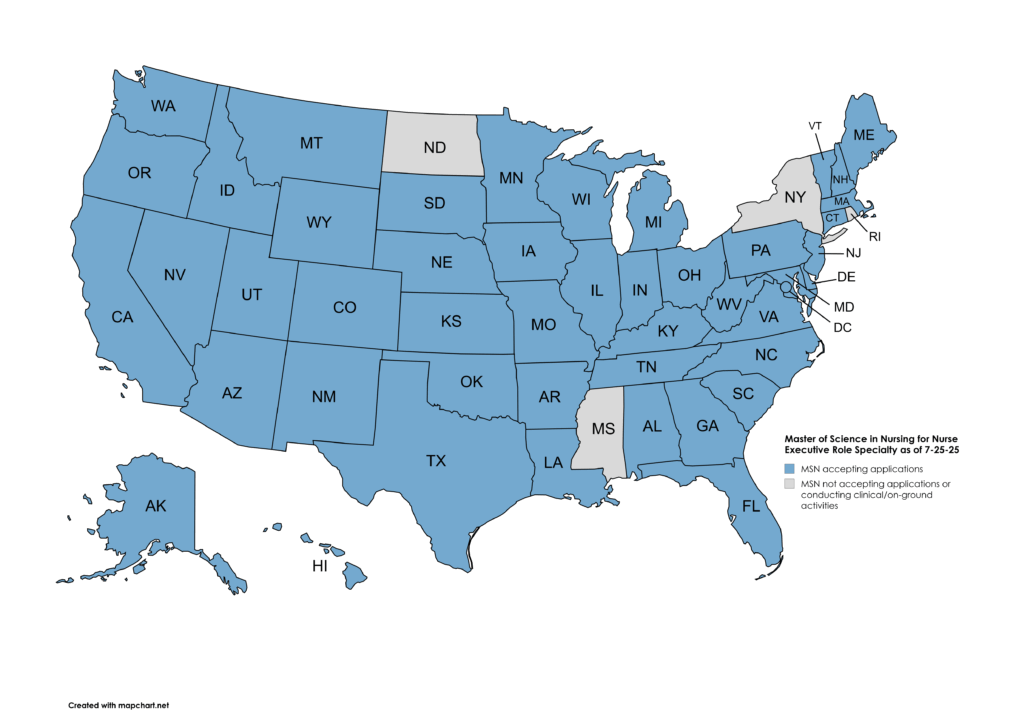
 

It remains students’ responsibility to understand, evaluate, and comply with all requirements relating to practicum experiences, authorization or endorsement for the state in which they reside.

Master of Science in Nursing (MSN) Nurse Educator Role Specialty (not currently enrolling students)

State Approvals

The University of St. Augustine for Health Sciences is currently accepting applications for enrollment in the Master of Science in Nursing (MSN) Nurse Educator role specialty for residents in the following states: Alabama, Alaska, Arizona, Arkansas, California, Colorado, Connecticut, Delaware, District of Columbia, Florida, Georgia, Hawaii, Iowa, Idaho, Illinois, Indiana, Kansas, Kentucky, Louisiana, Maine, Maryland, Massachusetts, Michigan, Minnesota, Missouri, Montana, Nebraska, New Mexico, Nevada, New Hampshire, New Jersey, North Carolina, Ohio, Oklahoma, Oregon, Pennsylvania, South Carolina, South Dakota, Texas, Utah, Vermont, Virginia, Washington, West Virginia, Wisconsin and Wyoming.

USAHS is currently not accepting applications from states where the program does not have state authorization. However, prospective students are encouraged to check back in the near future as the program may be offered in additional states. Current and admitted students are also advised to monitor this page for any updates prior to relocating to another state, as this can have an impact on continued enrollment in the program and the ability to be placed for on-the-ground activities or practicum experiences. 

Post-Graduation Licensure

The MSN Nurse Educator role specialty program is not designed or intended to lead to professional licensure in any state.

The map below identifies the states from which the University is now accepting applications for the MSN Nurse Educator program (indicated in blue).
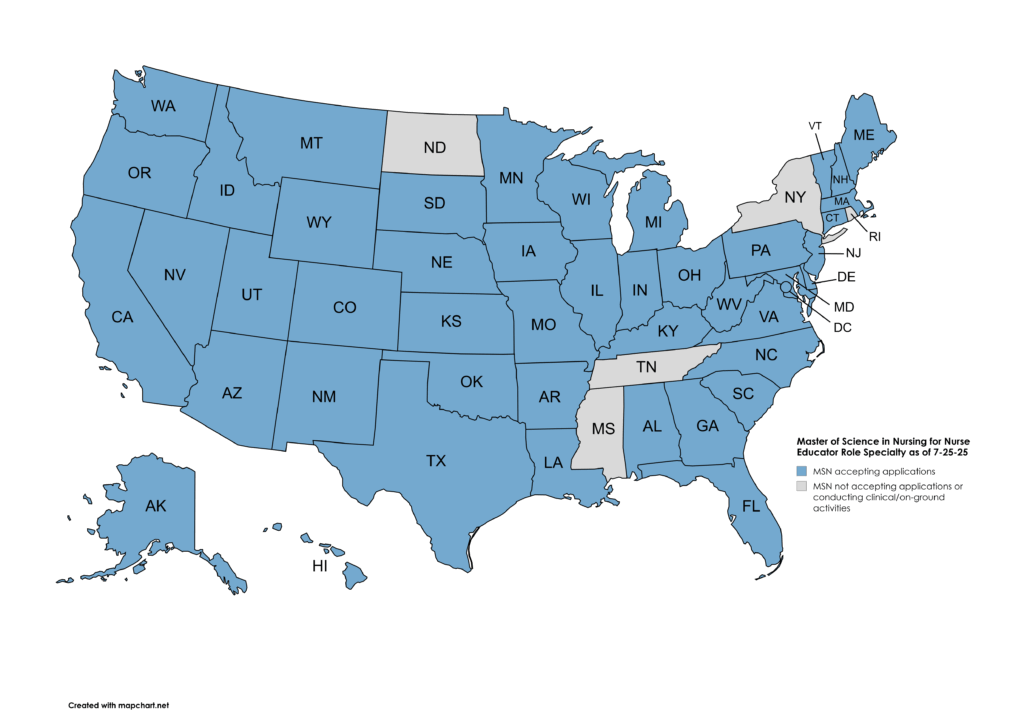
 

It remains students’ responsibility to understand, evaluate and comply with all requirements relating to practicum experiences, authorization or endorsement for the state in which they reside.

Higher Education State Approvals

The University of St. Augustine for Health Sciences holds licensure/authorization to operate a physical campus in three states—California, Florida and Texas. Please refer to the Licensure page for more detailed information. The University has additional state approvals and exemptions to provide distance education. Please visit the State Licensure page for more detailed information.

CCNE Accreditation
CCNE Accreditation

The Master of Science in Nursing program at the University of St. Augustine for Health Sciences is accredited by the Commission on Collegiate Nursing Education, 655 K Street NW, Suite 750, Washington, DC 20001, 202-887-6791.

Non-Licensure Role Specialties

The University of St. Augustine for Health Sciences’ Master of Science in Nursing role specialties in Nurse Educator and Nurse Executive are designed to build on the skills of BSN-prepared licensed nurses by focusing on interprofessional approaches to patient care through role specialties in leadership and education. Because these are post-licensure role specialties, they do not prepare graduates for initial or advanced licensure. It is the prospective student’s responsibility to understand, evaluate and comply with all requirements relating to nursing practice in the state in which they intend to practice and/or reside as requirements vary widely. USAHS makes no representations or guarantees that completion of coursework or programs will permit an individual to obtain state licensure, authorization, endorsement, or other state credential. For more information about the requirements to practice, students should contact the appropriate Board of Nursing or state agency.

Master of Science in Nursing (MSN) Family Nurse Practitioner (FNP) Role Specialty (BSN-Entry)

State Approvals

USAHS is currently accepting applications for enrollment in the Master of Science in Nursing program with Family Nurse Practitioner (MSN-FNP) role specialty for residents in the following states: Alabama, Alaska, Arizona, Arkansas, California, Colorado, Connecticut, Delaware, Florida, Georgia, Hawaii, Illinois, Indiana, Idaho, Iowa, Kansas, Kentucky, Maine, Maryland, Massachusetts, Michigan, Minnesota, Missouri, Montana, Nebraska, New Hampshire, New Jersey, New Mexico, Nevada, North Carolina, Oklahoma, Ohio, Oregon, Pennsylvania, South Carolina, South Dakota, Tennessee, Texas, Utah, Vermont, Virginia, Washington, West Virginia, Wisconsin and Wyoming.

USAHS is currently not accepting applications from states where the program does not meet state licensure requirements and/or where the institution does not have state authorization. However, prospective students are encouraged to check back in the near future as the program may be offered in additional states. 

Post-Graduation Licensure

For states denoted in blue, USAHS has determined the program satisfies the educational requirements for professional licensure in those states. Current and admitted students are also advised to monitor this page for any updates prior to relocating to another state, as this can have an impact on continued enrollment in the program and the ability to be placed for on-the-ground activities or practicum experiences. USAHS has not made a determination regarding whether the MSN-FNP program satisfies the educational requirements for professional licensure in the states denoted in gray.

USAHS has not made a determination that its curriculum meets the educational requirements for licensure or certification in the following locations: American Samoa, the Commonwealth of Puerto Rico, Guam, the Virgin Islands, the Commonwealth of the Northern Mariana Islands, the Republic of the Marshall Islands, the Federated States of Micronesia or the Republic of Palau.
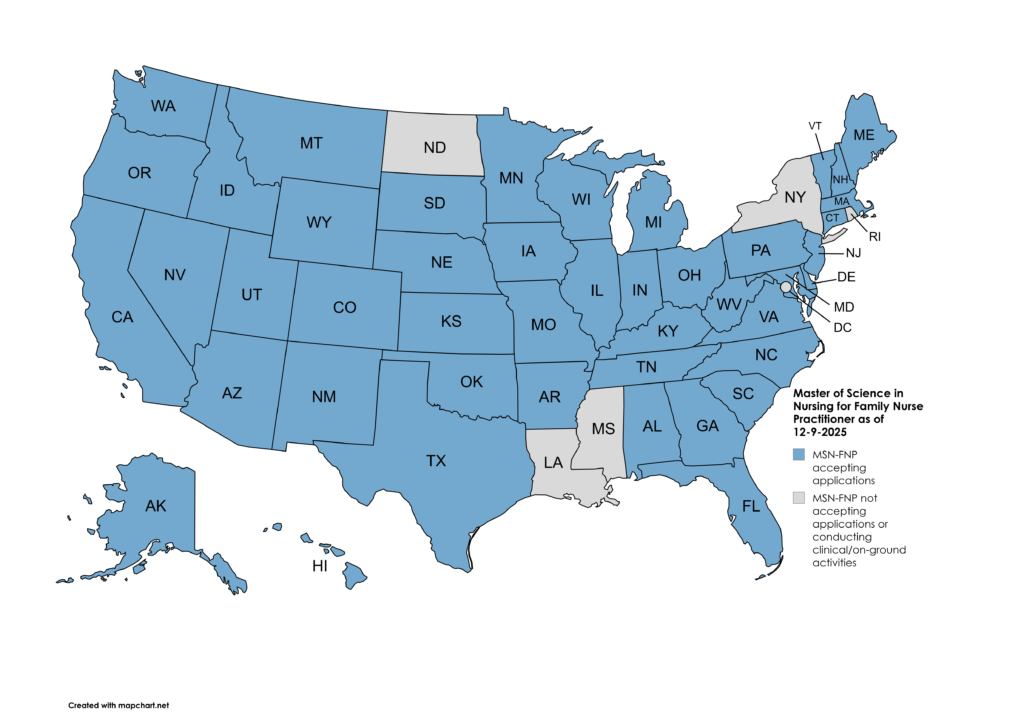
 

It remains the students’ responsibility to understand, evaluate and comply with all requirements relating to practicum experiences, licensing, certification, authorization or endorsement for the state in which they reside. For more information, students should contact the appropriate state licensure board to ensure an understanding of state licensure requirements as regulations vary from state to state.

RN to Master of Science in Nursing (RN to MSN) Family Nurse Practitioner (FNP) Role Specialty

State Approvals

USAHS is currently accepting applications for enrollment in the RN to Master of Science in Nursing program with Family Nurse Practitioner (RN to MSN-FNP) role specialty for residents in the following states: Alaska, Alabama, Arkansas, California, Colorado, Connecticut, Delaware, Florida, Georgia, Hawaii, Idaho, Illinois, Indiana, Iowa, Kansas, Kentucky, Maine, Maryland, Massachusetts, Michigan, Minnesota, Montana, Missouri, Nebraska, Nevada, New Jersey, New Mexico, New Hampshire, North Carolina, Ohio, Oklahoma, Oregon, Pennsylvania, South Carolina, South Dakota, Tennessee, Texas, Utah, Vermont, Virginia, Washington, West Virginia, Wisconsin and Wyoming.

USAHS is currently not accepting applications from states where the program does not meet state licensure requirements and/or where the institution does not have state authorization. However to Master of Science in Nursing (RN to MSN) Psychiatric Mental Health Nurse Practitioner (PMHNP), prospective students are encouraged to check back in the near future as the program may be offered in additional states.

Post-Graduation Licensure

For states denoted in blue, USAHS has determined the program satisfies the educational requirements for professional licensure in those states. Current and admitted students are also advised to monitor this page for any updates prior to relocating to another state, as this can have an impact on continued enrollment in the program and the ability to be placed for on-the-ground activities or practicum experiences. USAHS has not made a determination regarding whether the RN to MSN-FNP program satisfies the educational requirements for professional licensure in the states denoted in gray.

USAHS has not made a determination that its curriculum meets the educational requirements for licensure or certification in the following locations: American Samoa, the Commonwealth of Puerto Rico, Guam, the Virgin Islands, the Commonwealth of the Northern Mariana Islands, the Republic of the Marshall Islands, the Federated States of Micronesia or the Republic of Palau.
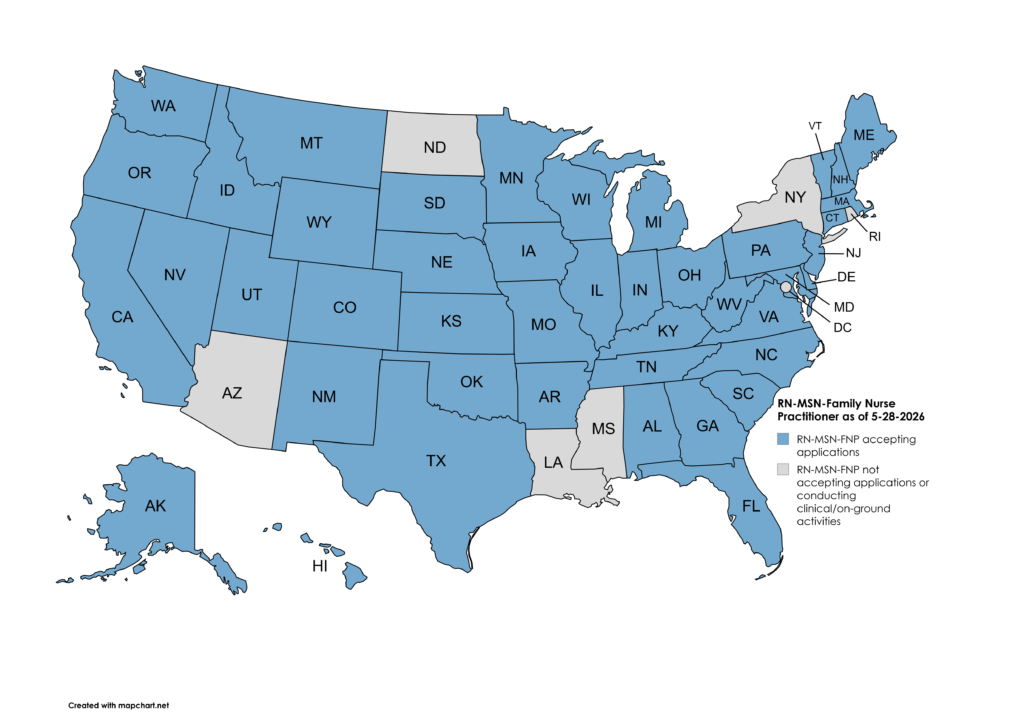
 

It remains students’ responsibility to understand, evaluate and comply with all requirements relating to practicum experiences, licensing, certification, authorization or endorsement for the state in which they reside. For more information, students should contact the appropriate state licensure board to ensure an understanding of state licensure requirements as regulations vary from state to state.

Master of Science in Nursing (MSN) Psychiatric Mental Health Nurse Practitioner (PMHNP) Role Specialty (BSN-Entry)

State Approvals

USAHS is currently accepting applications for enrollment in the Master of Science in Nursing program with Psychiatric Mental Health Nurse Practitioner (MSN-PMHNP) role specialty for residents in the following states: Alabama, Alaska, Arkansas, California, Colorado, Connecticut, Delaware, Florida, Georgia, Hawaii, Idaho, Illinois, Indiana, Iowa, Kansas, Kentucky, Maine, Maryland, Massachusetts, Michigan, Minnesota, Missouri, Montana, Nebraska, Nevada, New Hampshire, New Jersey, New Mexico, North Carolina, Ohio, Oklahoma, Oregon, Pennsylvania, South Carolina, South Dakota, Tennessee, Texas, Utah, Vermont, Virginia, Washington, West Virginia, Wisconsin and Wyoming.

USAHS is currently not accepting applications from states where the program does not meet state licensure requirements and/or where the institution does not have state authorization. However, prospective students are encouraged to check back in the near future, as the program may be offered in additional states. Current and admitted students are also advised to monitor this page for any updates prior to relocating to another state, as this can have an impact on continued enrollment in the program and the ability to be placed for on-the-ground activities or practicum experiences.

Post-Graduation Licensure

The map below identifies the states from which the University is now accepting applications for the MSN-PMHNP program. For states denoted in blue, USAHS has determined the program satisfies the educational requirements for professional licensure in those states. USAHS has not made a determination regarding whether the MSN-PMHNP program satisfies the educational requirements for professional licensure in the states denoted in gray.

USAHS has not made a determination that its curriculum meets the educational requirements for licensure or certification in the following locations: American Samoa, the Commonwealth of Puerto Rico, Guam, the Virgin Islands, the Commonwealth of the Northern Mariana Islands, the Republic of the Marshall Islands, the Federated States of Micronesia, or the Republic of Palau.
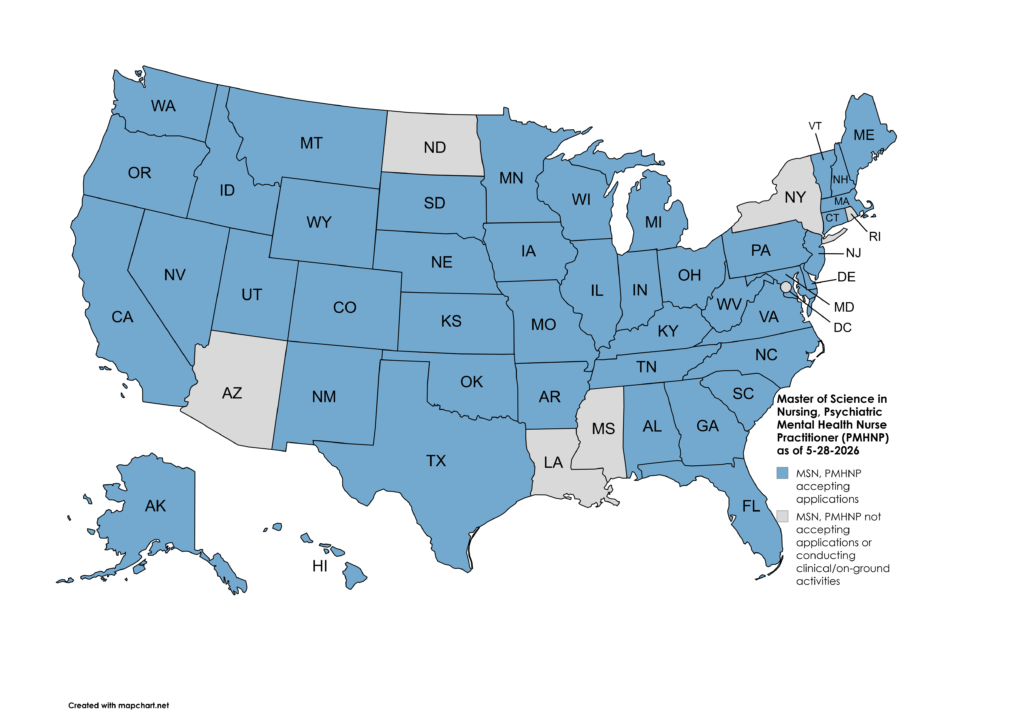
 

It remains students’ responsibility to understand, evaluate, and comply with all requirements relating to practicum experiences, licensing, certification, authorization or endorsement for the state in which they reside. For more information, students should contact the appropriate state licensure board to ensure an understanding of state licensure requirements as regulations vary from state to state.

RN to Master of Science in Nursing (RN to MSN) Psychiatric Mental Health Nurse Practitioner (PMHNP) Role Specialty

State Approvals

USAHS is currently accepting applications for enrollment in the RN to Master of Science in Nursing program with Psychiatric Mental Health Nurse Practitioner (RN to MSN-PMHNP) role specialty for residents in the following states: Alabama, Alaska, Arkansas, California, Colorado, Connecticut, Delaware, Florida, Georgia, Hawaii, Idaho, Illinois, Indiana, Iowa, Kansas, Kentucky, Maine, Maryland, Massachusetts, Michigan, Minnesota, Montana, Missouri, Nebraska, New Jersey, Nevada, New Mexico, New Hampshire, North Carolina, Ohio, Oklahoma, Oregon, Pennsylvania, South Carolina, South Dakota, Tennessee, Texas, Utah, Vermont, Virginia, Washington, West Virginia, Wisconsin and Wyoming.

USAHS is currently not accepting applications from states where the program does not meet state licensure requirements and/or where the institution does not have state authorization. However, prospective students are encouraged to check back in the near future, as the program may be offered in additional states. Current and admitted students are also advised to monitor this page for any updates prior to relocating to another state, as this can have an impact on continued enrollment in the program and the ability to be placed for on-the-ground activities or  practicum experiences.

Post-Graduation Licensure

The map below identifies the states from which the University is now accepting applications for the RN to MSN-PMHNP program. For states denoted in blue, USAHS has determined the program satisfies the educational requirements for professional licensure in those states. USAHS has not made a determination regarding whether the RN to MSN-PMHNP program satisfies the educational requirements for professional licensure in the states denoted in gray.

USAHS has not made a determination that its curriculum meets the educational requirements for licensure or certification in the following locations: American Samoa, the Commonwealth of Puerto Rico, Guam, the Virgin Islands, the Commonwealth of the Northern Mariana Islands, the Republic of the Marshall Islands, the Federated States of Micronesia or the Republic of Palau.
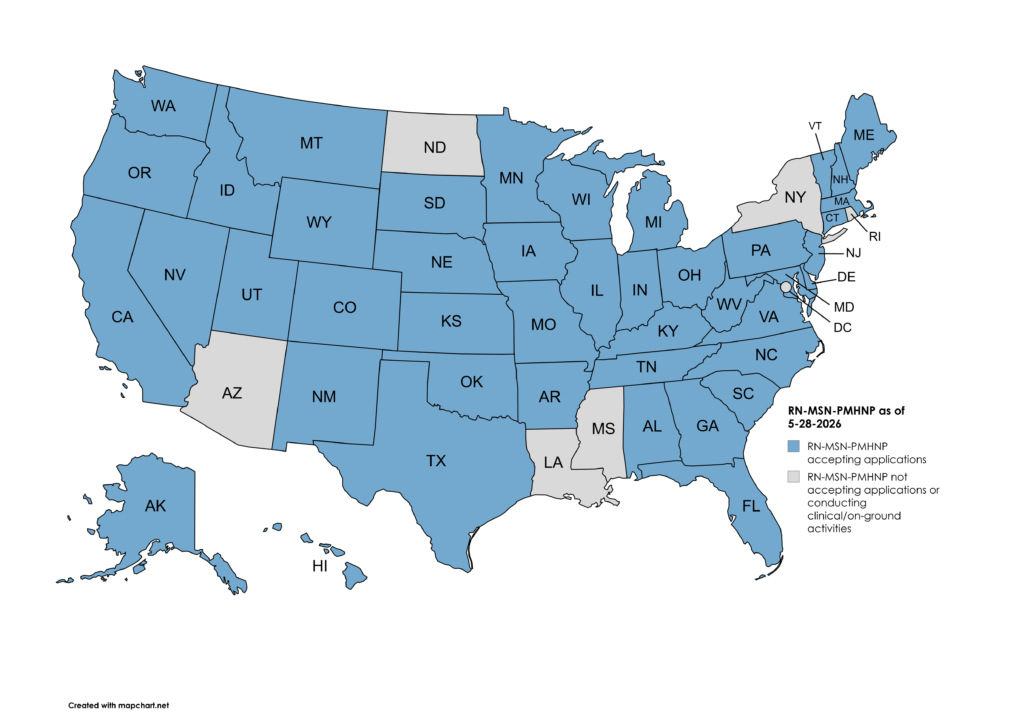
 

It remains students’ responsibility to understand, evaluate, and comply with all requirements relating to practicum experiences, licensing, certification, authorization or endorsement for the state in which they reside. For more information, students should contact the appropriate state licensure board to ensure an understanding of state licensure requirements as regulations vary from state to state.

Master of Science in Nursing (MSN) Adult Gerontology Nurse Practitioner (AGNP) Role Specialty (BSN-Entry) (not currently enrolling students)

State Approvals

USAHS is currently accepting applications for enrollment in the Master of Science in Nursing program with Adult Gerontology Nurse Practitioner (MSN-AGNP) role specialty for residents in the following states: Alabama, Alaska, Arkansas, California, Colorado, Connecticut, Delaware, Florida, Georgia, Hawaii, Idaho, Illinois, Indiana, Iowa, Kansas, Kentucky, Maine, Maryland, Massachusetts, Michigan, Minnesota, Missouri, Montana, Nebraska, Nevada, New Hampshire, New Jersey, New Mexico, North Carolina, Ohio, Oklahoma, Oregon, Pennsylvania, South Carolina, South Dakota, Texas, Utah, Vermont, Virginia, Washington, West Virginia, Wisconsin and Wyoming.

USAHS is currently not accepting applications from states where the program does not meet state licensure requirements and/or where the institution does not have state authorization. However, prospective students are encouraged to check back in the near future, as the program may be offered in additional states. Current and admitted students are also advised to monitor this page for any updates prior to relocating to another state, as this can have an impact on continued enrollment in the program and the ability to be placed for on-the-ground activities or practicum experiences. 

Post-Graduation Licensure

The map below identifies the states from which the University is now accepting applications for the MSN-AGNP program. For states denoted in blue, USAHS has determined the program satisfies the educational requirements for professional licensure in those states. USAHS has not made a determination regarding whether the MSN-AGNP program satisfies the educational requirements for professional licensure in the states denoted in gray.

USAHS has not made a determination that its curriculum meets the educational requirements for licensure or certification in the following locations: American Samoa, the Commonwealth of Puerto Rico, Guam, the Virgin Islands, the Commonwealth of the Northern Mariana Islands, the Republic of the Marshall Islands, the Federated States of Micronesia or the Republic of Palau.
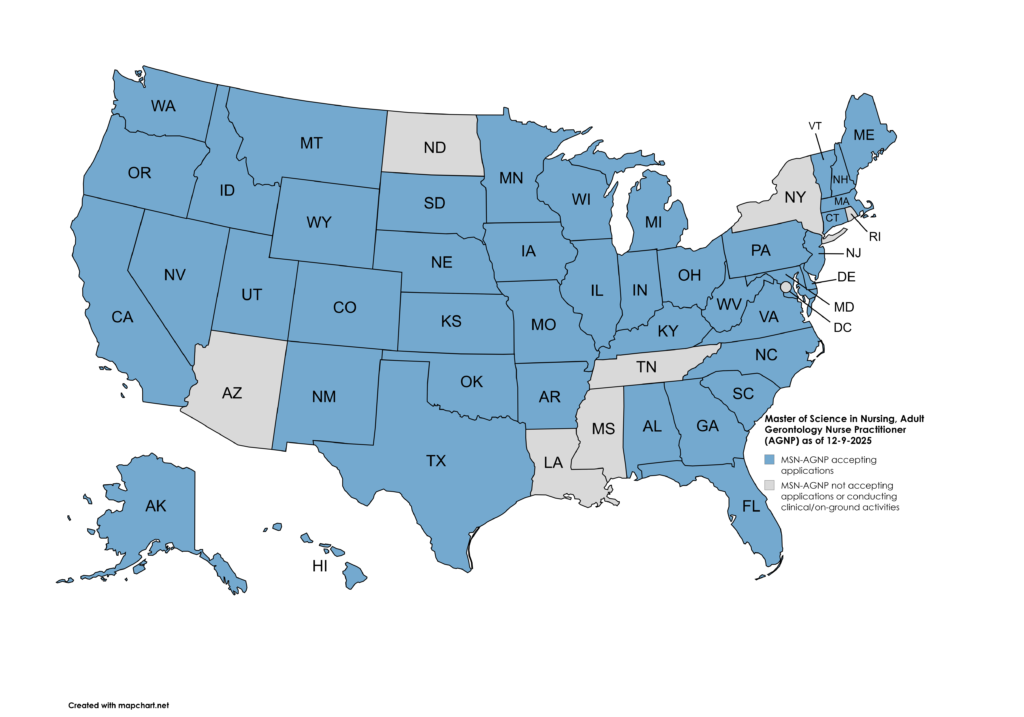
 

It remains students’ responsibility to understand, evaluate, and comply with all requirements relating to practicum experiences, licensing, certification, authorization or endorsement for the state in which they reside. For more information, students should contact the appropriate state licensure board to ensure an understanding of state licensure requirements as regulations vary from state to state.

RN to Master of Science in Nursing (RN to MSN) Adult Gerontology Nurse Practitioner (AGNP) Role Specialty (not currently enrolling students)

State Approvals

USAHS is currently accepting applications for enrollment in the RN to Master of Science in Nursing program with Adult Gerontology Nurse Practitioner (RN to MSN-AGNP) role specialty for residents in the following states: Alaska, Alabama, Arkansas, California, Colorado, Connecticut, Delaware, Florida, Georgia, Hawaii, Idaho, Illinois, Indiana, Iowa, Kansas, Kentucky, Maine, Maryland, Massachusetts, Michigan, Minnesota, Missouri, Montana, Nebraska, Nevada, New Jersey, New Mexico, New Hampshire, North Carolina, Ohio, Oklahoma, Oregon, Pennsylvania, South Carolina, South Dakota, Texas, Utah, Vermont, Virginia, Washington, West Virginia, Wisconsin and Wyoming.

USAHS is currently not accepting applications from states where the program does not meet state licensure requirements and/or where the institution does not have state authorization. However, prospective students are encouraged to check back in the near future, as the program may be offered in additional states. Current and admitted students are also advised to monitor this page for any updates prior to relocating to another state, as this can have an impact on continued enrollment in the program and the ability to be placed for on-the-ground activities or practicum experiences.

Post-Graduation Licensure

The map below identifies the states from which the University is now accepting applications for the RN to MSN-AGNP program. For states denoted in blue, USAHS has determined the program satisfies the educational requirements for professional licensure in those states. USAHS has not made a determination regarding whether the RN to MSN-AGNP program satisfies the educational requirements for professional licensure in the states denoted in gray.

USAHS has not made a determination that its curriculum meets the educational requirements for licensure or certification in the following locations: American Samoa, the Commonwealth of Puerto Rico, Guam, the Virgin Islands, the Commonwealth of the Northern Mariana Islands, the Republic of the Marshall Islands, the Federated States of Micronesia or the Republic of Palau.
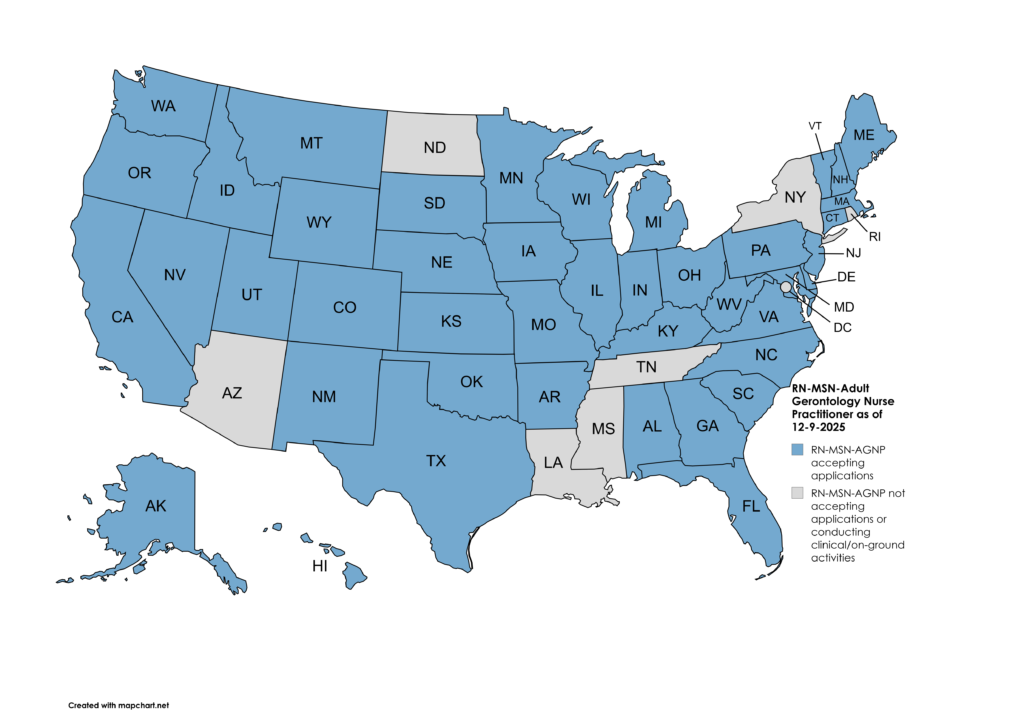
RN-MSN-AGNP map

It remains students’ responsibility to understand, evaluate and comply with all requirements relating to practicum experiences, licensing, certification, authorization or endorsement for the state in which they reside. For more information, students should contact the appropriate state licensure board to ensure an understanding of state licensure requirements as regulations vary from state to state.

CCNE Accreditation

CCNE Accreditation

The Master of Science in Nursing (MSN) program at the University of St. Augustine for Health Sciences is accredited by the Commission on Collegiate Nursing Education, 655 K Street NW, Suite 750, Washington, DC 20001, 202-887-6791.

Note on Certification Exams

Nurse Practitioner graduates must hold a master’s, postgraduate or doctoral degree from a nurse practitioner program accredited by the CCNE or ACEN to be eligible to take the necessary role specialty national examination to be certified as a nurse practitioner, which most states require in order to be licensed to practice as an NP. Graduates should take the exam that aligns with their role specialty: FNP-BC or FNP; PMHNP-BC or PMH-BC; or AGPCNP-BC or A-GNP. The Master of Science in Nursing (MSN) program at the University of St. Augustine for Health Sciences is accredited by the Commission on Collegiate Nursing Education, 655 K Street NW, Suite 750, Washington, DC 20001, 202-887-6791.

Note on Licensure, Authorization, Endorsement or Other State Credential Necessary to Practice as a Nurse Practitioner

Most states require that graduates pass a nurse practitioner national certification exam in order to apply for licensure or other credential to practice as a nurse practitioner in a state. Graduates must hold a master’s, postgraduate or doctoral degree from a nurse practitioner program accredited by the CCNE or ACEN in order to be eligible for an NP national certification exam; national certification as an NP is required for licensure to practice as an NP in most states. Graduates should take the exam that aligns with their role specialty (FNP-BC or FNP; PMHNP-BC or PMH-BC; or AGPCNP-BC or A-GNP). The Master of Science in Nursing (MSN) program at the University of St. Augustine for Health Sciences is accredited by the Commission on Collegiate Nursing Education, 655 K Street NW, Suite 750, Washington, DC 20001, 202-887-6791. While the MSN-FNP (RN- and BSN-entry), MSN-PMHNP (RN- and BSN-entry) and MSN-AGNP (RN- and BSN-entry) programs are designed to lead to licensure, authorization, endorsement or other state credential necessary to practice as a nurse practitioner, it is prospective students’ responsibility to understand, evaluate, and comply with all requirements relating to nursing practice in the state in which they intend to practice and/or reside, as requirements vary widely. Prospective students are advised that relocation to another state may impact their ability to complete field experiences and/or to obtain professional licensure, certification or other credential in another state. Prospective students are advised to carefully review, evaluate and understand the requirements of the applicable licensure board in the state in which they intend to relocate. USAHS makes no representations or guarantee that completion of coursework or programs will permit an individual to obtain state licensure, authorization, endorsement or other state credential, including prescriptive authority, where requirements may vary between different states. Additionally, current and admitted students are also advised to monitor this page for any updates prior to relocating to another state, as this can have an impact on continued enrollment in the program and the ability to be placed for practicum experiences. For more information about the requirements to practice, students should contact the appropriate Board of Nursing or state agency.

Notice to State of Washington Students: The University of St. Augustine for Health Sciences is approved by the Washington State Board of Nursing to conduct practice experiences for residents of Washington state for the MSN/Nurse Educator, MSN/Nurse Executive, MSN/FNP,  MSN/AGNP, MSN/PMHNP, RN-MSN/FNP, RN-MSN/AGNP, RN-MSN/PMHNP, MSN-entry DNP, DNP/Nurse Executive, DNP/FNP, Post-Graduate Nursing Certificate (PMHNP), and Post-Graduate Nursing Certificate (FNP) program tracks. Learn more.

View our state licensure page.

Close

MSN Program Data

MSN Learning Outcomes

Upon completion of the Master of Science in Nursing (MSN) program, graduates will be able to:

    • Employ the skills necessary to engage in lifelong learning through intellectual inquiry to maintain continuing competence and professional growth.
    • Communicate and collaborate with other healthcare providers in the promotion of wellness and the management of acute and chronic disorders for optimization of patient outcomes.
    • Apply leadership skills to improve outcomes for individuals, diverse populations and organizations.
    • Apply systems thinking and synthesize scientific data with concepts and models from nursing and other sciences to promote health, prevent illness and maintain quality of life for individuals and populations.
      Practice critical thinking and evidence-based decision-making to ensure the delivery of nursing care that is of optimal quality and safety.
    • Effectively and ethically use technology in the direct or indirect delivery and coordination of nursing care and collection of data for improvement of quality and safety.
    • Deliver or direct nursing practice using advanced knowledge, professional skills and decision-making based on theory and best scientific evidence.
    • Exhibit professionalism and adherence to ethical standards of nursing practice; advocate for patients and promote policy development to ensure quality healthcare that is safe, equitable and cost-effective.
Close

Master of Science in Nursing Program Role Specialties At a Glance

Select your Entry-Point

Why USAHS

Clinical Placement Concierge
Get personalized support from a dedicated clinical placement team to secure a practica placement that aligns with your career goals, specialty interests, and schedule.
Dedicated Support
Your success is our priority. You’ll receive one-on-one faculty mentorship Each student is assigned a faculty advisor when they start the program. On-demand appointments with faculty advisor and/or course instructors are available. and personalized academic advising designed to keep you supported, engaged, and thriving throughout your journey. Watch Video
Meet our Faculty
Built for Working Nurses
Whether you are looking to fast-track your degree or take a lighter courseload, we offer individualized study plans. Learn mostly online and attend one hands-on intensive (where required) Watch Video
Cutting-Edge Learning Technology
Master advanced skills through online coursework and realistic virtual simulations that prepare you with the clinical skills to confidently take the next step in your career. Explore Innovative Learning
Solely Dedicated to Health Sciences
With over 40 years dedicated to health sciences, USAHS helps nursing graduate students advance in clinical expertise, research, and leadership while collaborating with peers across disciplines in patient-centered care. Discover Our Story
Choose Your Role Specialty
Whether you are interested in clinical care or leadership, we offer role specialties through our MSN program. From FNP, PMHNP, Nurse Executive and more, you can tailor your degree to match your career goals. (Role availability varies by program entry). Find Your Specialty

MSN Student Perspectives

“The MSN program gave me the push I needed in various aspects of my life. It improved my confidence and helped me truly believe in myself. To network and be around other nurses who are looking to improve the nursing profession is inspiring, and I’m truly honored to be a part of it.”

Tina B.

MSN student

Tina B.

Getting Started

Ready to begin your journey toward fulfilling your MSN degree? It’s easy to get started right away!

Gather MoreInformation

Gather More
Information

Our webinars and virtual campus tours provide a wealth of information to help ensure you make the right choice.

Schedule a One-on-One Consultation

Schedule a One-on-One Consultation

Our enrollment advisors are always ready to provide personalized guidance on your path to a master’s degree in nursing based on your needs.

Start YourApplication

Start Your
Application

There’s no time like the present to start on your MSN degree!!

Relevant Articles

Latest Nursing News

Let's Connect

We’re here to support you on your educational journey.

Please complete our contact form. An enrollment advisor will reach out to provide information and answer your questions.