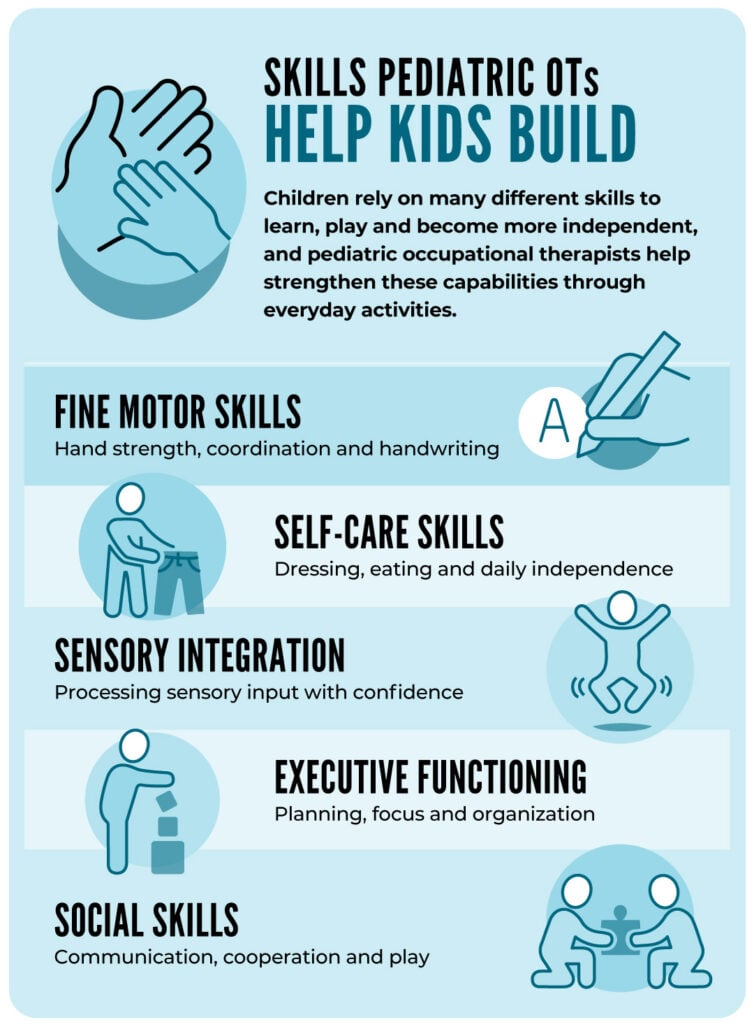

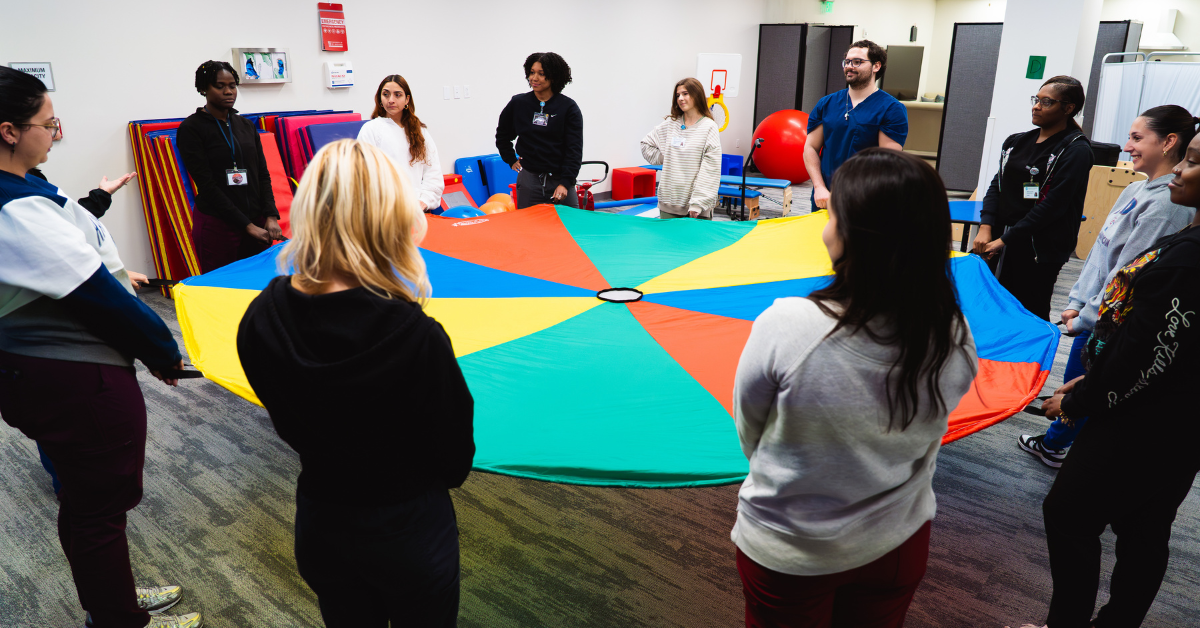
School-based occupational therapy plays a vital role in helping students fully engage in their educational experience. Occupational therapy in schools may include collaborative, student-centered goals that integrate interprofessional skills and knowledge to support student access and participation.1
As the demand for these services continues to grow, according to the Bureau of Labor Statistics (BLS), employment for occupational therapists (OTs) is projected to increase by 14% from 2024 to 2034, with approximately 10,200 openings each year across diverse settings, including schools.2
To meet this need, the Master of Occupational Therapy (MOT) and Doctor of Occupational Therapy (OTD) programs at the University of St. Augustine for Health Sciences (USAHS) are designed to equip graduates with the skills and knowledge necessary for effective school-based practice.
So, what do occupational therapists do in schools? School-based occupational therapy focuses on helping children and older youth participate in the occupations of school, such as learning, play, self-care and social activities within educational environments.
According to BLS, there’s a steady demand for school-based practitioners, with about 13% of OTs working in educational services.2 Let’s review what to expect in a school-based OT role, including salary data, job outlook, demand drivers and the OT education and licensure pathways that help students prepare to practice in schools.
School-Based OT Salary Overview
National salary data often show earnings for OTs across all practice settings instead of separating the individuals who only work in occupational therapy in schools. Schools are a common employment setting for OTs, but detailed pay breakdowns can vary by region and employer type.
Payscale reports that the median annual salary for school-based OTs is approximately $64,816* as of 2026.3** Actual earnings vary based on factors like geographic location, years of experience, employment structure and local school funding. Some OTs work directly for school districts, while others work through healthcare contractors or regional education service providers, which can also affect pay.
OTs work across a wide range of industries, including the offices of health practitioners, hospitals, schools, nursing care facilities and home health.2 Pay patterns may differ between medical and educational settings.
Job Outlook: Overall Demand for Occupational Therapists
The BLS projects 14% employment growth for all OTs from 2024 to 2034, which is significantly faster than the average growth rate for all occupations.2 Approximately 10,200 job openings are projected each year due to a combination of employment growth and workforce replacement needs.2 These openings happen across many settings, including hospitals, outpatient clinics, community-based programs and school systems, including occupational therapy elementary school.

Education and Licensure Pathway for School-Based OTs
To become an OT, you typically need to earn a master’s or doctoral degree in OT from a program accredited by the Accreditation Council for Occupational Therapy Education (ACOTE). After graduation, candidates need to pass the National Board for Certification in Occupational Therapy (NBCOT) certification exam and meet state licensure requirements before they can begin practicing.4
Some states require additional school services credentials or teaching-related endorsements for OTs working in public K-12 school systems. For example, certain state education departments issue specialized school-based therapy endorsements that need to be earned in addition to OT licensure.5 Since requirements vary by state, it’s important to review your local licensing and education department guidelines for clarity.
OT Pathways at USAHS
USAHS offers entry-level MOT and OTD programs built to prepare students for practice across a range of settings, including pediatric and school-based environments.
You can choose from Residential, Hybrid Immersion or Flex formats, opting for the learning style that best fits your schedule while still completing the same curriculum and meeting accreditation requirements.
Our OT program pathways include:
- Residential: The Residential pathway includes coursework and immersive weekday lab experiences held on campus and online each week.
- Hybrid Immersion: The Hybrid Immersion pathway consists of online coursework, live weekday sessions held virtually and two immersive in-person lab experiences per term held on campus over extended weekends.
- Flex: The Flex pathway is designed for students who want to take more time to earn their degree. It includes online coursework, live evening and weekend sessions held virtually, plus immersive on-campus labs during select weekends.
Across our OT curriculum, students combine didactic coursework with Level I and Level II fieldwork in a variety of clinical environments. Coursework with a pediatric focus helps students build the knowledge base that can translate to school-based OT roles.
Hands-on training continues during two full-time Level II fieldwork rotations. Depending on site availability, students may complete placements in school-based settings, pediatric clinics or community programs, gaining real-world experience that supports career readiness.
We also offer an OTA to MOT Bridge program for licensed OT assistants looking to move into a more advanced OT role, creating an additional pathway into school-based practice for working professionals.
Preparing for a School-Based OT Career During Your OT Program
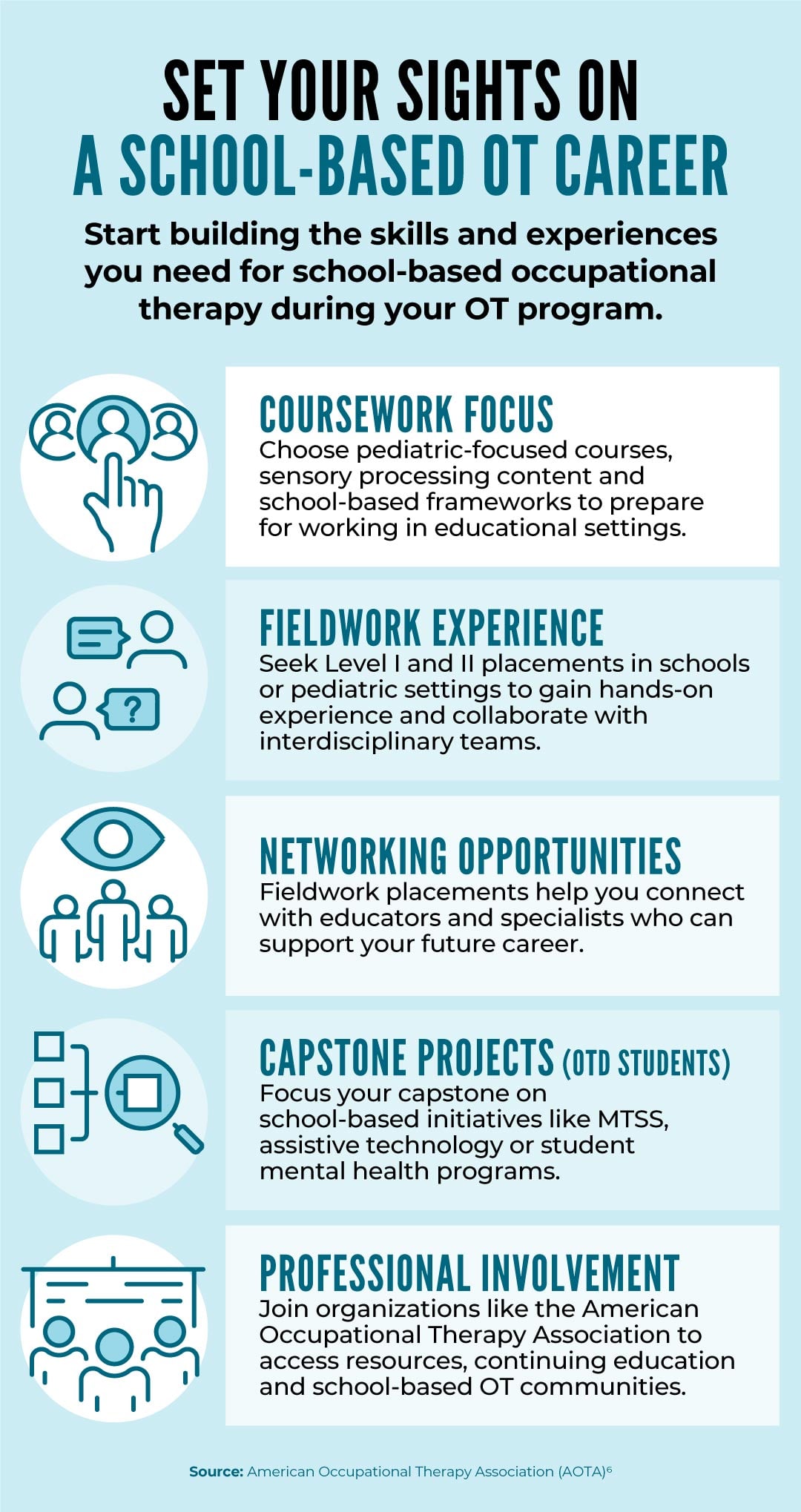
Students interested in school-based OT may choose experiences that build pediatric and other relevant practice skills.
Pediatric-focused coursework, sensory processing materials, mental health interventions and classes addressing school-based practice frameworks help lay a strong academic foundation for work in educational environments.
Fieldwork selection also plays an important role. Requesting Level I and Level II placements in school districts, early intervention programs or pediatric community organizations allows students to develop experience working with interdisciplinary teams that include teachers, psychologists, speech-language pathologists (SLPs) and special education staff.
These placements also help students expand their professional networks, which can support future employment goals.
OTD students can further customize their training through the doctoral capstone experience. Capstone projects may focus on school-based initiatives, such as Multi-Tiered Systems of Support (MTSS), assistive technology implementation for classroom participation or development of mental health programming for students. These focused experiences allow students to explore program development, leadership or research topics related to school OT practice.
Professional involvement also helps with career development. The American Occupational Therapy Association (AOTA) and state OT associations provide access to continuing education, school-based practice resources and professional communities focused on education, literacy and autism-related interventions.6
Is School-Based OT a Good Career Option?
School-based OT exists within a profession projected to grow 14% between 2024 and 2034, suggesting ongoing demand for OT services in healthcare and educational settings.2
Occupational therapists have a long-standing role in K-12 school systems, supporting students’ access, participation and success in learning environments. With continued emphasis on inclusive education, school-based practice can be a steady career option for OTs who want to work with children and adolescents.
For those who enjoy partnering with educators and families, problem-solving in real-world school routines and helping students build independence in daily activities, school-based OT offers a meaningful path grounded in collaboration, functional outcomes and long-term impact.
Entry-level OT programs, like our MOT and OTD, provide the academic preparation, fieldwork experience and pediatric-focused training students need to begin working towards their ideal career.
*This data represents national figures, is not based on school-specific data and represents national median annual wages, not starting pay for recent grads. Conditions in your area may vary. USAHS does not guarantee salary levels.
**The information provided on this website is based on self-reported data and is intended for general informational purposes only. Payscale is a limited data source that relies on voluntary submissions from individuals and employers. Please be aware that the accuracy, completeness and reliability of the data may vary due to its voluntary nature and limited scope. While efforts are made to maintain the data’s accuracy, we cannot guarantee its absolute correctness or currency.
FAQs
Is there a strong demand for school-based occupational therapists?
Yes. OT employment is projected to grow 14% nationwide between 2024 and 2034, with thousands of openings each year across practice settings, including schools.2 Schools remain a consistent employer for OTs, proving the demand for school-based practitioners.2
How does a school-based OT salary compare with hospital or outpatient OT?
In some cases, school-based salaries may differ from salaries for those who work in medical settings. Pay often varies depending on region, employer, funding structures, contract arrangements and years of experience. Some hospital or outpatient positions may offer higher salaries, while school-based positions may offer advantages like academic calendars, predictable schedules and certain benefits structures.2,3
What qualifications do I need to work as a school-based OT?
To work as a school-based OT, you typically need a master’s or doctoral degree in OT from an ACOTE-accredited program, successful completion of the NBCOT certification exam and state OT licensure.4 Additional state-specific education department credentials may also be required for OTs working in public school systems, depending on local regulations.5
Do I need a teaching credential in addition to my OT license?
Sometimes. Requirements vary by state. Some states require OTs working in school systems to obtain a school services endorsement or related credential issued by the state education department. Others allow OTs to practice in schools with OT licensure alone.5 Prospective practitioners should review requirements in the state where they plan to practice to determine whether additional credentials are necessary.
References:
- “School systems,” American Occupational Therapy Association (AOTA), 2026, https://www.aota.org/practice/practice-settings/schools-early-intervention-community-education/schools.
- “Occupational Therapists: Occupational Outlook Handbook,” U.S. Bureau of Labor Statistics (BLS), August 28, 2025, https://www.bls.gov/ooh/healthcare/occupational-therapists.htm.
- “Average School-Based Occupational Therapist Hourly Pay,” Payscale, January 6, 2026, https://www.payscale.com/research/US/Job=School-Based_Occupational_Therapist/Salary.
- “Everything You Need to Know About Getting Certified,” National Board for Certification in Occupational Therapy (NBCOT), 2026, https://www.nbcot.org/exam.
- “School Occupational Therapist Standard Certificate,” New Jersey Department of Education, 2026, https://www.nj.gov/education/certification/edsrvs/endorsementsedsrvs/2910S.shtml.
- “Sessions for every role, American Occupational Therapy Association (AOTA), 2026, https://www.aota.org/.